

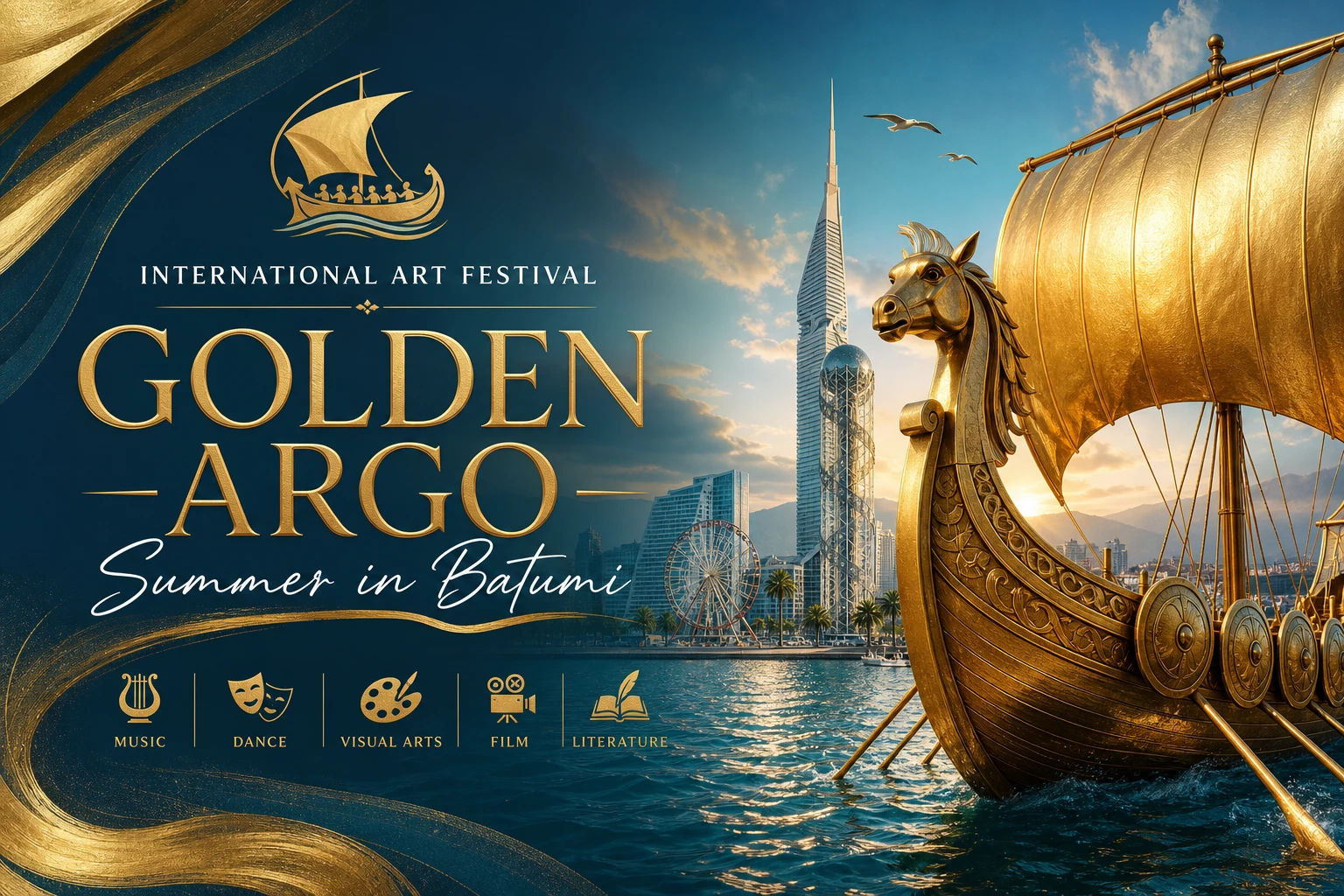
Event Has Passed - See You Next Time!
Event Details
Date
to
Location
Batumi, Georgia
Batumi, Georgia
Price
from €190
About This Event
International Art Festival "Golden Argo — Summer in Batumi" 2026: Nine Years of Song, Dance, and Georgian Hospitality
The name itself carries mythology. The Golden Fleece — the gleaming prize that Jason and the Argonauts sought in ancient Colchis, the kingdom that became modern-day western Georgia — is woven into Georgian national identity so deeply that it appears on the country's coat of arms, in its city names, and in the very reason that ancient Greek sailors risked everything to reach this coast. When the International Art Festival "Golden Argo — Summer in Batumi" takes its name from the ship that carried those sailors, it is making a deliberate cultural statement: this Black Sea port has been welcoming travellers from across the known world for over two thousand years, and it will do so again on June 25 to 30, 2026, for the festival's ninth edition.
The 2026 Golden Argo brings 500+ participants from across the world to Batumi for six days of competition, performance, excursions, and the kind of warm Georgian hospitality that leaves international visitors booking their return before the closing ceremony is over. With just four group spots remaining as of February 2026, demand has once again outpaced availability — a consistent pattern for an event that has built a loyal international following across its eight previous editions.
Dates: June 25 – 30, 2026. Venue: Batumi, Georgia (Batumi Summer Theatre and city venues). Participant package: €190 per person (full board, accommodation, excursions). For participants only; open to all art forms from folklore to fine arts.
What the Golden Argo Festival Is and Why It Exists
The International Art Festival "Golden Argo — Summer in Batumi" is an international festival and competition event hosted in Batumi every summer, open to performing and visual arts groups and soloists from around the world. It is organised by the Culture and Tourism Development and Supporting Unity — a Georgian cultural organisation with deep roots in the country's growing festival hosting tradition.
The festival's concept is double-layered in a way that makes it unusual among international arts competitions. It is simultaneously a competitive festival — with structured categories, independent judging, and medals — and a cultural tourism experience, where the competition is embedded in a programme of Georgian hospitality, excursions, performances, and direct encounters with Adjarian culture that most international groups would never organise independently.
The result is that participants do not simply arrive, compete, and leave. They spend six days in Batumi and its surroundings, performing on one of the Caucasus region's finest outdoor stages, visiting landmarks that few international travellers know about, eating extraordinary food, and sharing meals and downtime with performers from a dozen other countries who are doing exactly the same thing. The competition is real and the awards matter — but the experience around the competition is what brings groups back year after year.
The Golden Argo runs as the first event in Batumi's summer festival trilogy: it is immediately followed by the Golden Waterfall Festival (July 2–7, 2026) and the Golden Fleece Festival (July 8–13, 2026) — all three events using the same Batumi Summer Theatre infrastructure, the same organisational networks, and the same combination of competition, performance, and excursion programme. Together, they give international arts groups three separate windows in late June and early July to bring their ensembles to Batumi's summer stage.
The Competition: Who Can Participate and What Is Judged
The Golden Argo welcomes an exceptionally broad range of performing and visual arts categories — one of the reasons it attracts 500+ participants from such diverse institutional backgrounds.
Accepted participant categories include:
Dance:
- Folk and ethnic dance groups
- Contemporary and modern dance (soloists and groups)
- Classical and neoclassical ballet
- Ballroom, Latin, standard dance
- Jazz and theatrical dance
- Show dance, majorette, flag dance, and twirling
Music and vocal:
- Folklore groups (instrumental and vocal)
- Chamber choirs, children's choirs, mixed choirs
- Vocal ensembles (all genres)
- Pop, classical, folk, and jazz soloists
- Orchestras and instrumental ensembles (chamber orchestra, folk orchestra, brass band, wind and percussion)
Theatre and variety:
- Theatrical and dramatic groups
- Variety, circus, and acrobatics
- Puppetry
Fine and applied arts:
- Painting and drawing
- Photography
- Applied arts and crafts
This breadth means that a single festival can host a Bulgarian folk dance troupe, a children's choir from Estonia, a hip-hop solo performer from Ukraine, a Japanese koto ensemble, and a Georgian applied arts exhibition all within the same competitive framework, judged by independent professionals in each category.
The jury consists of independent professionals and academics in each art form, with awards issued as follows: Grand Prix (overall outstanding achievement), Gold, Silver, and Bronze prizes per category, and Diplomas of Participation for all registered groups. The awards ceremony takes place at the Closing Gala Concert on June 30.
Six Days on the Black Sea: The Festival Programme
The Golden Argo's six-day programme is carefully structured to balance competition with experience — ensuring that every participating group gets both their competitive moments on stage and the broader cultural immersion that makes the festival distinctively Georgian.
Day 1 — June 25: Arrival and Orientation
Groups arrive in Batumi, check into their 3-star hotels, and receive their orientation materials. The evening is free — most participants take their first walk along the Batumi Boulevard, encounter the Black Sea for the first time, and discover the remarkable variety of cuisine in Batumi's restaurant district. The combination of sea air, palm trees, and the glittering lights of the boulevard is the kind of first impression that immediately confirms the decision to come.
Day 2 — June 26: Opening Ceremony and First Concerts
The festival opens formally at the Batumi Summer Theatre with the Opening Ceremony — speeches, welcome performances by Georgian ensembles, and the announcement of the competition categories and schedule. First competition rounds begin in the afternoon, with the evening programme featuring the festival's opening gala performance.
Day 3 — June 27: Makhuntseti Waterfall and Adjarian Highlands
The mid-festival excursion takes groups to the Makhuntseti Waterfall — a stunning 26-metre cascade in the subtropical forest of Upper Adjara, approximately 30 kilometres from Batumi. The Makhuntseti area also contains a medieval arched stone bridge (the Queen Tamar Bridge) dating from the 12th century — one of the finest examples of medieval Georgian stone architecture in Adjara. The combination of waterfall, forest, and ancient stonework in a landscape that most participants have never seen before is consistently one of the festival's most memorable single days.
Day 4 — June 28: Competition Rounds and Evening Concert
Competition rounds continue at the Batumi Summer Theatre and secondary city venues, with afternoon performances and an evening concert at one of Batumi's cultural spaces. Participants have free time in the morning to explore the city's historic core — the Old Batumi area near the Piazza with its ornate 19th-century European-style buildings, the bustling bazaar market, and the city's distinctive mix of Belle Époque and modernist architecture.
Day 5 — June 29: Ureki Magnetic Beach
The second excursion day takes participants to Ureki — the magnetite black-sand beach approximately 15 kilometres north of central Batumi. Ureki's black sand is naturally magnetic (containing iron-rich mineral particles from the local geology) and is promoted in Georgia for its therapeutic properties. The calm, shallow bay, warm Black Sea water (approximately 22–24°C in late June), and the extraordinary visual contrast of jet-black sand against turquoise water make Ureki one of the most distinctive beach experiences in the entire Caucasus region.
Day 6 — June 30: Closing Ceremony and Grand Gala
The festival closes with the Closing Ceremony and Grand Gala Concert at the Batumi Summer Theatre — the competitive awards ceremony, prize presentations, diplomatic speeches, and a final collective performance where all participating groups share the stage. This is the emotional peak of the festival: the combination of competition results, shared memories across six days, and the particular warmth of Georgian farewell hospitality produces the kind of event finale that performers carry with them for years.
The Batumi Summer Theatre: Georgia's Premier Outdoor Stage
Almost every performance, ceremony, and concert at the Golden Argo takes place at or around the Batumi Summer Theatre — the outdoor covered performance venue that serves as the hub of Batumi's entire summer cultural programme.
The Batumi Summer Theatre has a long history as the city's principal outdoor performance space. Its location in central Batumi, within walking distance of the boulevard and the seafront, makes it accessible to both participants and the Batumi public — local audiences regularly attend festival performances alongside the competing groups. The theatre's open-air architecture, with a covered stage and tiered seating, is suited to the warm June evenings of Batumi's subtropical climate.
For international groups, performing at the Batumi Summer Theatre carries a specific prestige: it is the same stage used by the Golden Waterfall and Golden Fleece festivals that follow, by the Black Sea Jazz Festival in July, and by the other cultural events that constitute Batumi's summer season. Walking onto it for the first time during sound check, with the warm evening air and the distant sound of the boulevard behind the theatre, is an experience that groups with performance experience at international festivals consistently describe as immediately distinctive.
The Golden Argo in the Context of Georgian Culture
The Golden Argo takes its name from the ship of the Argonauts — the crew of heroes who sailed from ancient Greece to Colchis (the region of western Georgia) in pursuit of the Golden Fleece. The myth of the Argonauts is one of the oldest sustained narratives in European literature, predating Homer's Iliad, and its geographic setting in Colchis gives modern Georgia a claim to some of antiquity's most mythologised cultural territory.
For Georgians, the myth is not simply a borrowed classical story — it is a source of deep national pride. The Golden Fleece appears on the Georgian coat of arms. The city of Poti, 50 kilometres north of Batumi, sits near the ancient site of Phasis — the Colchian capital that ancient sources identified as the Argonauts' destination. Batumi's position on the Colchian coast means that the city has a direct mythological connection to the Golden Argo story that the festival's name acknowledges explicitly.
Georgia's performing arts culture runs deep alongside this mythological identity. The country's polyphonic singing tradition — a UNESCO Intangible Cultural Heritage — is one of the world's most complex and beautiful vocal forms, with three-part dissonant harmonies that developed independently of Western European choral traditions. Georgian folk dance — featuring the extraordinary athleticism of Kartuli (the male warrior dance) and the gliding grace of Kartuli female forms — is internationally recognized as among the world's most technically accomplished and visually striking national dance traditions.
Hosting an international arts competition in this environment means that participating groups inevitably encounter the depth of Georgian cultural achievement — in the performances they see from Georgian groups, in the excursion programme, and in the everyday cultural life of a city where polyphonic singing and folk dance are genuinely popular, not simply performed for tourists.
Participant Package: What €190 Covers
The participant fee of €190 per person for the six-day, five-night Golden Argo 2026 package is one of the most straightforward and value-dense structures in the international festival circuit. Here is what it includes:
- Accommodation: 5 nights in a 3-star hotel in Batumi, with sharing arrangements (double/triple rooms for groups)
- Full board: Three meals per day throughout the stay (breakfast, lunch, dinner)
- Festival registration fee: Entry into the competition categories chosen, including judging, scoring, and award consideration
- Official festival diploma: All registered participants receive a certificate of participation
- Excursion programme: Group transport and guided visits to Makhuntseti Waterfall, Ureki beach, and Batumi city orientation (as included in the standard itinerary)
- Festival events access: All Opening and Closing ceremonies, Gala Concerts, and competition viewing for the group
Not included: International travel to Batumi; visa costs where applicable; personal spending; optional additional excursions (such as Prometheus Cave in Kutaisi, typically priced at approximately €15 per person).
The fee structure applies uniformly — group leaders and conductors are included in the per-person calculation at the same rate. Groups sending larger delegations (soloists entering multiple categories, combined ensembles) pay per registered individual.
Practical Travel Information for Golden Argo Participants
Batumi's improving international connectivity means the journey is manageable from most of Europe, the Middle East, and Central Asia:
By air: Batumi International Airport (BUS) serves direct routes from Tbilisi, Istanbul, Warsaw, Tel Aviv, Vienna, and various Central Asian capitals depending on the season. The airport is 4 kilometres from central Batumi — a 10–15-minute taxi for approximately €5–8.
From Tbilisi by train: The scenic rail journey takes approximately 4–5.5 hours. The fast Pendolino service runs in approximately 4 hours with tickets from GEL 25 (approximately €8–10 at current rates). Tbilisi International Airport (TBS) is one of the most connected airports in the region, with direct flights from across Europe, the Middle East, and Central Asia — making it the primary international hub for most delegations arriving at the Golden Argo.
Visa: Georgia maintains one of the most generous visa-free entry regimes in the world — citizens of most EU countries, the United States, United Kingdom, Canada, Australia, Japan, South Korea, Israel, Turkey, and dozens of other nations can enter Georgia without a visa for up to 365 days.
Hotel accommodation is included in the festival package at 3-star hotels in Batumi. Participants should confirm their specific hotel allocation through their contact with the festival organisers. For accompanying family members or non-competing staff not covered by the participant package, Batumi has a full range of accommodation from €25 (simple guesthouses) to €130+ (seafront hotels in peak summer).
Weather in late June: Average highs of 27–29°C; warm evenings around 22–24°C; subtropical humidity; occasional afternoon rainfall. Light clothing, sunscreen, and a compact rain jacket are all practical items.
Batumi Beyond the Festival Stage
The Golden Argo's excursion programme covers the region's highlights, but participants with free time will find Batumi itself richly rewarding:
Batumi Boulevard stretches six kilometres along the Black Sea coast and is the city's social spine: cafés, playgrounds, the Ali and Nino rotating sculpture, the Batumi Ferris Wheel, the palm-lined promenade, and the Black Sea pebble beach.
Old Batumi (Piazza area): The ornate 19th-century European-style buildings — Italian and French-influenced facades built during Batumi's turn-of-the-century oil boom when it was a free port of the Russian Empire — cluster around the Piazza public square, a short walk from the boulevard.
Batumi Botanical Garden: Eight kilometres north of the city, 108 hectares of subtropical plants from around the world, with Black Sea views and a café at the cliff edge. Entry approximately €3.
Georgian cuisine in Batumi: Adjarian khachapuri (boat-shaped, with egg and butter), khinkali (spiced meat dumplings), fresh Black Sea fish, walnut-sauce preparations, local Adjarian wines and chacha (grape spirits) — Batumi's restaurants offer one of the richest regional food experiences in the Caucasus.
A Festival That Earns Its Name
The International Art Festival "Golden Argo — Summer in Batumi" has spent nine editions earning the right to its mythological name. It gathers performers from across the world to the coast where the Argonauts once landed, puts them on one of the Caucasus region's finest stages, surrounds them with Georgian hospitality and spectacular landscapes, and sends them home with diplomas, memories, and an understanding of Georgia that no tourism brochure can provide.
With only four group spots remaining as of February 2026, June 25–30 in Batumi is filling up fast. If your ensemble is ready for an international stage on the Black Sea, the ninth Golden Argo is waiting for you.
Verified Information at a Glance
| Detail | Information |
|---|---|
| Event | International Art Festival "Golden Argo — Summer in Batumi" 2026 — 9th Edition (IX) |
| Category | International Folklore, Dance, Music, Vocal and Fine Arts Festival and Competition |
| Dates | Thursday June 25 to Tuesday June 30, 2026 (6 days, 5 nights) |
| Location | Batumi, Adjara, Georgia |
| Primary performance venue | Batumi Summer Theatre, Batumi (confirmed by programme pattern) |
| Organiser | Culture and Tourism Development and Supporting Unity (Georgia) |
| Scale | 500+ participants; near capacity as of February 2026 |
| Participant fee | €190 per person (6 days / 5 nights full board) — includes accommodation (3-star hotel), three meals daily, festival registration, diploma, excursion programme |
| Accepted categories (confirmed) | — |
| Dance | folk, contemporary, classical ballet, ballroom, jazz, show dance, majorette, flag dance, twirling |
| Music | folklore groups, choirs (chamber/children/mixed), vocal ensembles, orchestras, instrumental ensembles |
| Vocal soloists | pop, classical, folk, jazz |
| Theatre and variety | dramatic, circus, acrobatics, puppetry |
| Fine and applied arts | painting, photography, applied arts |
| Awards | Grand Prix, Gold/Silver/Bronze prizes per category, Diplomas of Participation |
| Confirmed programme elements | — |
| June 25 | Arrivals |
| June 26 | Opening Ceremony + concerts at Batumi Summer Theatre |
| June 27 | Excursion to Makhuntseti Waterfall and surroundings |
| June 28 | Competition rounds + evening concert |
| June 29 | Ureki magnetic black-sand beach excursion |
| June 30 | Closing Ceremony + Grand Gala Concert + awards |
| Follows in series with | Golden Waterfall Festival (July 2–7, 2026) and Golden Fleece Festival (July 8–13, 2026) |
| Registration | Via folklorefestivals.com or direct contact with organiser |
| Festival listing | folklorefestivals.com/festival/international-art-festival-golden-argo-summer-in-batumi-2026 |
| Batumi airport (BUS) | 4 km from center; connections from Tbilisi, Istanbul, and European routes |
| Visa | Visa-free entry for most nationalities up to 365 days |
| June weather | 27–29°C average high; subtropical; occasional afternoon showers |
Event Has Passed - See You Next Time!
Event Details
Date
to
Location
Batumi, Georgia
Batumi, Georgia
Price
from €190