

Event Has Passed - See You Next Time!
Event Details
Date
to
Location
City-wide — Avenida Central, Praça da República, Historic Centre, Braga
Braga, Portugal
Price
Free Entry
About This Event
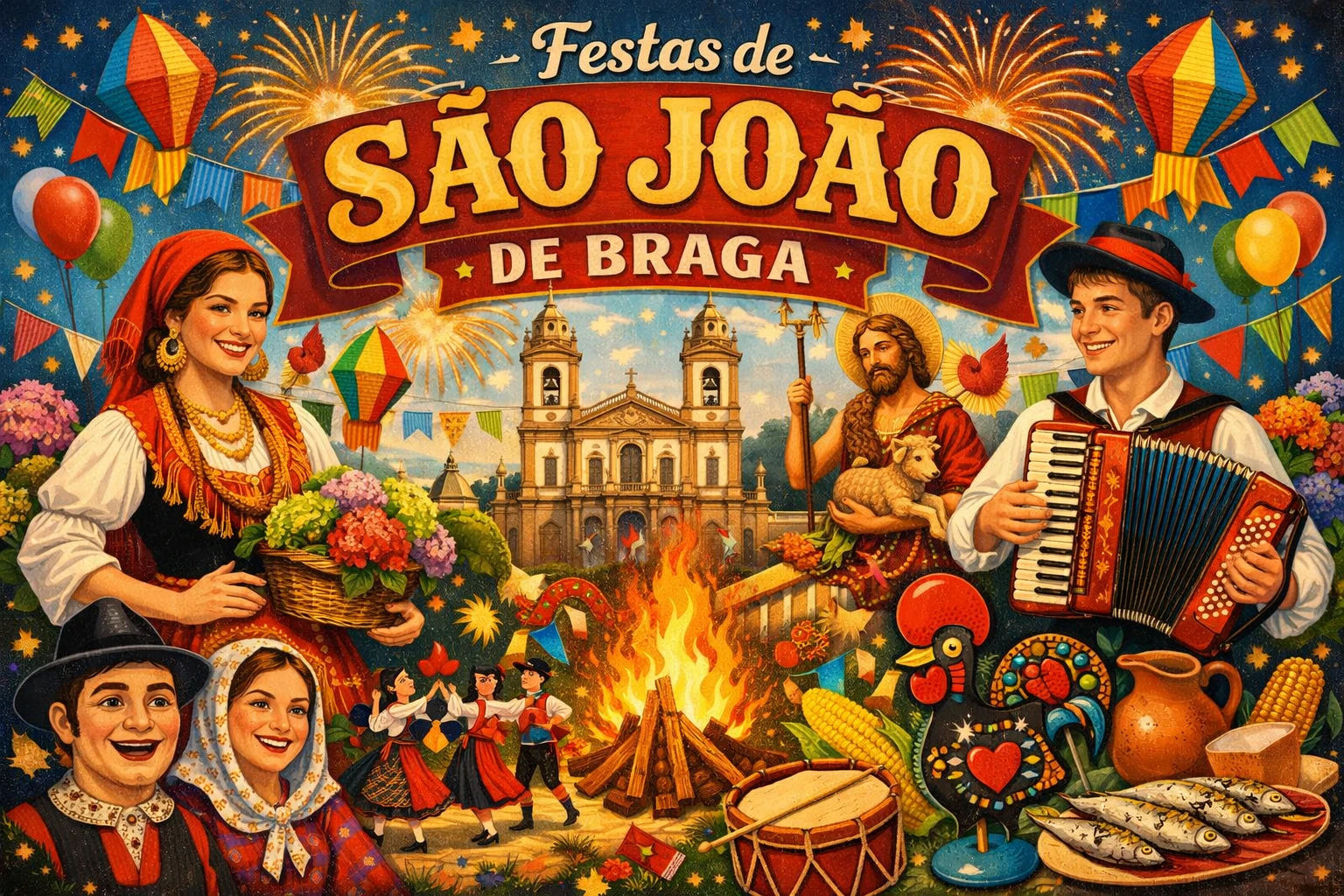
Festas de São João de Braga 2026: Portugal's Greatest Popular Festival Returns June 17–24
There are festivals that entertain. There are festivals that attract. And then there is São João de Braga — a celebration so deep in the identity of this city that calling it a festival feels insufficient. It is the year. Everything else in Braga's calendar leads to it or recovers from it. From Wednesday June 17 to Wednesday June 24, 2026, the entire city transforms into the thing that Braga's official festival website claims without exaggeration: the largest popular festival in Portugal.
The Associação de Festas de São João de Braga (AFSJB) confirmed the 2026 dates on March 5 — eight days of processions, concerts, folk dance, cavaquinho music, cascatas (ornamental water displays), giant figures, bell concerts, fireworks, roasted sardines, manjericos (basil pots), and the joyful chaos of martelinhos (plastic toy hammers) being tapped on strangers' heads in streets that haven't slept since the week before.
The peak is the night of June 23 into June 24 — St John's Eve and St John's Day — when Braga becomes, briefly, the most alive city in the Iberian peninsula.
A Festival Born in Medieval Braga: Over Seven Centuries of Midsummer Tradition
The Festas de São João de Braga are one of the oldest surviving popular festivals in Portugal. The earliest documentary evidence dates from the 14th century, though historians believe the celebrations are older than the Christian feast day they now carry — rooted in the Midsummer solstice traditions that predate Christianity across Atlantic Europe and that the Church eventually absorbed by assigning June 24 to the birth of St John the Baptist.
Braga has celebrated this feast day continuously since at least the 1300s, in a city that was already one of Portugal's most significant ecclesiastical centers long before the country itself existed. Braga is the seat of the Archdiocese of Braga — the oldest in Portugal, whose first bishop was appointed in the early 5th century — and the Sé Primaz de Braga (Braga Cathedral), begun in 1070, is the oldest continuously functioning cathedral in the country. The feast of St John, patron of summer and of fertility, was always going to root itself deeply in a city of this religious and civic weight.
The Chapel of São João da Ponte — built in the 16th century on the orders of Archbishop Dom Diogo de Sousa, who also redesigned much of Braga's urban fabric in the Renaissance period — became the physical focal point of the festival's devotional programme. The Parque da Ponte that surrounds it is still one of the central gathering points of the June celebrations.
Today, the festival is described as bringing together 200+ hours of programming and engaging 365 entities — churches, civic associations, folklore groups, music ensembles, schools, businesses, and the city's university community — in a civic celebration that has no real parallel in Portugal and few parallels anywhere in Europe.
The 2026 Edition: Eight Days of Everything
The 2026 Festas de São João de Braga run from June 17 through June 24, with the programme building in intensity toward the June 23–24 peak. Here is what the eight days look like across Braga's most important streets, squares, and sacred spaces.
Opening Days: June 17–19
The festival opens on June 17 with one of its most distinctive and emotionally resonant moments: the Concerto de Sinos (Bell Concert), when the bell towers of the Sé Primaz, Santa Cruz, São Vicente, and Bom Jesus churches ring simultaneously as the first signal that São João has begun.
The Novenas to São João Baptista begin at the Igreja de São João do Souto and continue daily for the nine days leading to the feast — a devotional programme running alongside the secular festival events that reminds visitors that São João in Braga is not simply a street party but a genuine religious celebration with centuries of liturgical tradition behind it.
The Cortejo Infantil "São João da Pequenada" (the children's procession) brings the city's youngest citizens into the opening days — schools, childhood groups, and youth organisations parading in traditional and festive dress through the Praça da República, one of the city's main civic squares.
The opening days also launch the Cascatas Sanjoaninas competition — a uniquely Braga tradition where households, businesses, and community groups construct ornamental water features (cascatas) around the city, blending religious imagery with folk art, flowers, and water in tableaux that remain on display through the festival week. The inauguration typically takes place at Braga Parque shopping center, which serves as a central display point.
Midweek Programme: June 20–22
The middle days of the festival expand the programming across multiple simultaneous stages and venues.
The Festival Braga Capital do Cavaquinho — a major event in itself — occupies the Campo da Vinha for two full days, celebrating the cavaquinho, Portugal's small four-stringed instrument (the ancestor of the Hawaiian ukulele) that has deep roots in Minho folk music. The festival brings players and groups from across Portugal and the Portuguese-speaking world to compete and perform in a discipline that most international visitors will not have encountered before but will immediately recognise as central to the acoustic texture of northern Portuguese folk culture.
The Cortejo Etnográfico (Ethnographic Parade) departs from the Arco da Porta Nova — the 18th-century baroque gateway that marks the entrance to Braga's historic center and is one of the most photographed architectural elements in the city — in the late afternoon of June 22. Groups dressed in traditional Minho costumes representing different parishes, villages, and occupations parade through the historic streets in a display of living folk heritage that manages, despite its length and complexity, to feel entirely unselfconscious.
The Festival Folclórico "Romarias do Minho" follows on the Avenida Central — the broad tree-lined boulevard at the heart of Braga's modern civic life — bringing folk dance groups from across the Minho region to perform their regional traditions for an audience that grows progressively more enthusiastic as the evening advances.
The Gala Sanjoanina at the Theatro Circo — the city's historic theatre on Avenida da Liberdade — is the festival's most formal musical event: an evening concert in a prestigious venue that provides a counterpoint to the outdoor folk celebrations and demonstrates that Braga's São João programme encompasses the entire range of cultural register, from street carnival to concert hall.
The Rodopiada de Gigantones e Cabeçudos (parade of giant puppet figures and oversized-head characters) takes place at the Praça da República — the chaotic, beloved tradition of Braga's giant folkloric figures being carried and danced through the square to the accompaniment of drums and enthusiastic children. The gigantones have been part of Minho festival culture for centuries and remain one of the most distinctively northern Portuguese visual elements of the whole event.
The Cantares ao Desafio — improvised sung competition at the Parque da Ponte — is one of the festival's most intimate and culturally specific events: pairs of singers competing in improvised verse to a set melodic structure, a tradition that descends from the troubadour culture of medieval Iberia and that is still practised by specialists across northern Portugal.
The academic community contributes with the Noite Académica "A U.M. vem ao São João" (Academic Night — University of Minho comes to São João), bringing the energy of one of Portugal's most dynamic university campuses into the festival streets — a tradition that reflects Braga's identity as the city with the youngest average population in Portugal.
The Night of June 23–24: When Braga Belongs to Everyone
The noite de São João — the night of June 23 into June 24 — is the festival's irreducible heart. Everything before it has been preparation. Everything after it is memory.
The afternoon of June 23 begins building deliberately. The Cortejo Sanjoanino departs from Largo São João do Souto in the morning of June 24 — the procession of the Carros das Ervas (decorated herb carts), the Rei David (King David float), and the Pastores (Shepherds) — a processional tradition whose components trace back to the Baroque era and possibly earlier.
The afternoon of June 24 brings the Transladação do Andor de São João — the procession of the decorated litter of St John from the Igreja de São João do Souto toward the cathedral — followed at 18:00 by the Solenísssima Procissão de São João Baptista departing from the Sé Primaz de Braga. The main procession moves through the historic center in full liturgical and civic regalia, with the Archbishop presiding and thousands of Braga residents and visitors lining the streets.
At 19:30, the Despedida a São João (Farewell to St John) at both the Sé Primaz and the Igreja de São João do Souto brings the religious programme to its close.
But the night is far from over. While the religious programme closes, the streets fill with sardine grills — the smell of charcoal and sardines drifting through every alley in the old city — with stalls selling manjericos (the scented basil pots that are São João's floral symbol), alho-porro (leeks traditionally used to tap people gently on the head as a blessing), and paper balloons floating up into the warm June sky.
Popular concerts on the Avenida Central bring the crowds to their peak — in 2025, Diogo Piçarra performed at 01:30 (the night truly starts late in Braga during São João). Major artists play to tens of thousands of people on the main avenue, with the crowd ebbing and flowing between the concert stages and the illuminated streets of the historic center.
The night culminates with the Fogo de São João — the main fireworks display launched from Monte do Picoto at 23:30 over the terreiro da ponte (the area around the chapel of São João da Ponte). Fireworks over Braga at the height of the solstice night, with the city's lights below and the Minho landscape stretching into the dark beyond: this is the image that everyone who has experienced São João de Braga carries home with them.
The Symbols of São João: What to Know Before You Go
The Festas de São João de Braga come with a specific material culture that visitors quickly absorb:
Manjericos — small basil plants in decorated clay pots, traditionally given between lovers or friends as tokens of affection. The scent of basil becomes the smell of São João.
Martelinhos — small plastic hammers (or, in older tradition, soft garlic or leek stalks) that people tap on each other's heads as a form of playful blessing. Strangers tap strangers. It is entirely normal. It is São João.
Alho-porro (leeks) — the traditional version of the martelho; bunches of leeks sold by vendors throughout the streets.
Sardines — grilled on charcoal on every corner; eaten with bread and cheap vinho verde. The quintessential June food.
Paper balloons — lanterns launched into the sky on the night of June 23; dozens rising simultaneously over the illuminated city create one of the visual highlights of the evening.
Cascatas — the ornamental water displays built around the city for the competition, incorporating religious figures, folk imagery, and local symbols in each creator's interpretation.
Practical Information for Visitors
The Festas de São João de Braga 2026 are almost entirely free admission. The processions, parades, folk dance festivals, street concerts, and the main fireworks are all public events accessible to everyone. Some ticketed events exist (Gala Sanjoanina at Theatro Circo, specific ticketed concerts), but the core São João experience costs nothing beyond food, drink, and transport.
Getting to Braga:
- From Porto by train: 50 minutes direct (CP Alfa Pendular), from Porto Campanhã or Porto São Bento. Porto Airport (OPO) is approximately 30 minutes from Braga by road — international gateway for most visitors.
- From Lisbon by train: Approximately 3 hours (Alfa Pendular)
- By road from Porto: A3 motorway, approximately 55 km north
Within Braga during São João: The entire historic center becomes pedestrianised and crowd-managed during peak festival evenings. The Praça da República, Avenida Central, Largo São João do Souto, Arco da Porta Nova, and the Parque da Ponte are the key festival zones — all walkable from the city's central hotels.
Accommodation: Book early. The São João week is Braga's single most booked accommodation period — hotels fill months in advance, particularly for the June 23–24 night. Mid-range hotels in the city center range from €60–120/night in standard periods; expect June 23 rates of €100–180+. Apartments via booking platforms are available from €50–100/night. Porto is a viable base if Braga accommodation is full, with the last train back from Braga to Porto running around midnight on most festival nights (check CP schedules).
June weather in Braga: Average highs of 22–25°C in mid-June; warm days and pleasant evenings around 15–18°C. June in the Minho can bring occasional rain — pack a light rain jacket but expect mostly dry evenings for the outdoor events.
Beyond São João: Braga's Historic City Worth Exploring
Visitors who arrive a day or two before the festival — or who stay beyond it — will find Braga richly rewarding.
The Sé de Braga (Braga Cathedral) is Portugal's oldest, with a Romanesque core begun in 1070 and successive architectural layers added through the medieval and baroque periods. The cathedral treasury holds some of the finest medieval religious art in Portugal.
The Bom Jesus do Monte sanctuary — 5 kilometres east on a forested hilltop, accessible by hydraulic funicular — is one of Portugal's most visited pilgrimage sites: a baroque staircase of over 600 steps flanked by chapels representing the Stations of the Cross, climbing to a neoclassical church with panoramic views across the Braga basin.
The Museu do Traje Dr. Gonçalo Sampaio (costume museum) — referenced in the São João programme as the venue for the Trajes exhibition — is one of the festival's cultural partner institutions, providing historical context for the folk costumes visible throughout the parade programme.
The Palácio dos Biscainhos (18th-century baroque palace with formal gardens) and the Museu dos Biscainhos offer a window into aristocratic Braga of the 18th century.
The Largest Popular Festival in Portugal: Eight Days That Define a City
Braga and São João are inseparable. The city does not merely host this festival — it becomes it, for eight days every June, in the way that only a celebration with seven centuries of continuous practice behind it can. The streets smell of sardines and basil. The bell towers ring at dawn. The giant figures dance in the square. The fireworks explode over the medieval bridge at midnight.
June 17–24, 2026. Braga. Free. The largest popular festival in Portugal. It has been waiting 700 years for your visit.
Verified Information at a Glance
| Detail | Information |
|---|---|
| Event | Festas de São João de Braga 2026 — "A Maior Festa Popular de Portugal" |
| Category | Traditional Religious and Popular City Festival / Intangible Cultural Heritage |
| Dates | Wednesday June 17 to Wednesday June 24, 2026 (8 days) |
| Peak night | June 23 (evening) into June 24 (early morning and day) — St John's Eve and St John's Day |
| Organiser | Associação de Festas de São João de Braga (AFSJB) |
| Official website | saojoaobraga.pt |
| City | Braga, northern Portugal |
| Admission | Free (most events); some ticketed concerts (Gala Sanjoanina at Theatro Circo; specific popular concerts) |
| Scale | 200+ hours of programming; 365 entities involved |
| Key locations | — |
| Confirmed 2026 programme elements | — |
| Solenísssima Procissão de São João Baptista — June 24, 18 | 00, from Sé Primaz |
| Despedida a São João — June 24, 19 | 30 |
| Fogo de São João (main fireworks from Monte do Picoto) — June 24, 23 | 30 |
| Festival traditions | Manjericos (basil pots), martelinhos (toy hammers), alho-porro (leeks), sardinhas assadas (grilled sardines), paper balloons, cascatas, Vinho Verde |
| Historical origin | Documented from the 14th century; oldest popular festival in Portugal |
| facebook.com/saojoaobraga | |
| Nearest airport | Porto Francisco Sá Carneiro (OPO) — ~55 km; Porto to Braga by train ~50 minutes |
| June weather Braga | 22–25°C average high; pleasant evenings; occasional light rain possible |
Event Has Passed - See You Next Time!
Event Details
Date
to
Location
City-wide — Avenida Central, Praça da República, Historic Centre, Braga
Braga, Portugal
Price
Free Entry