

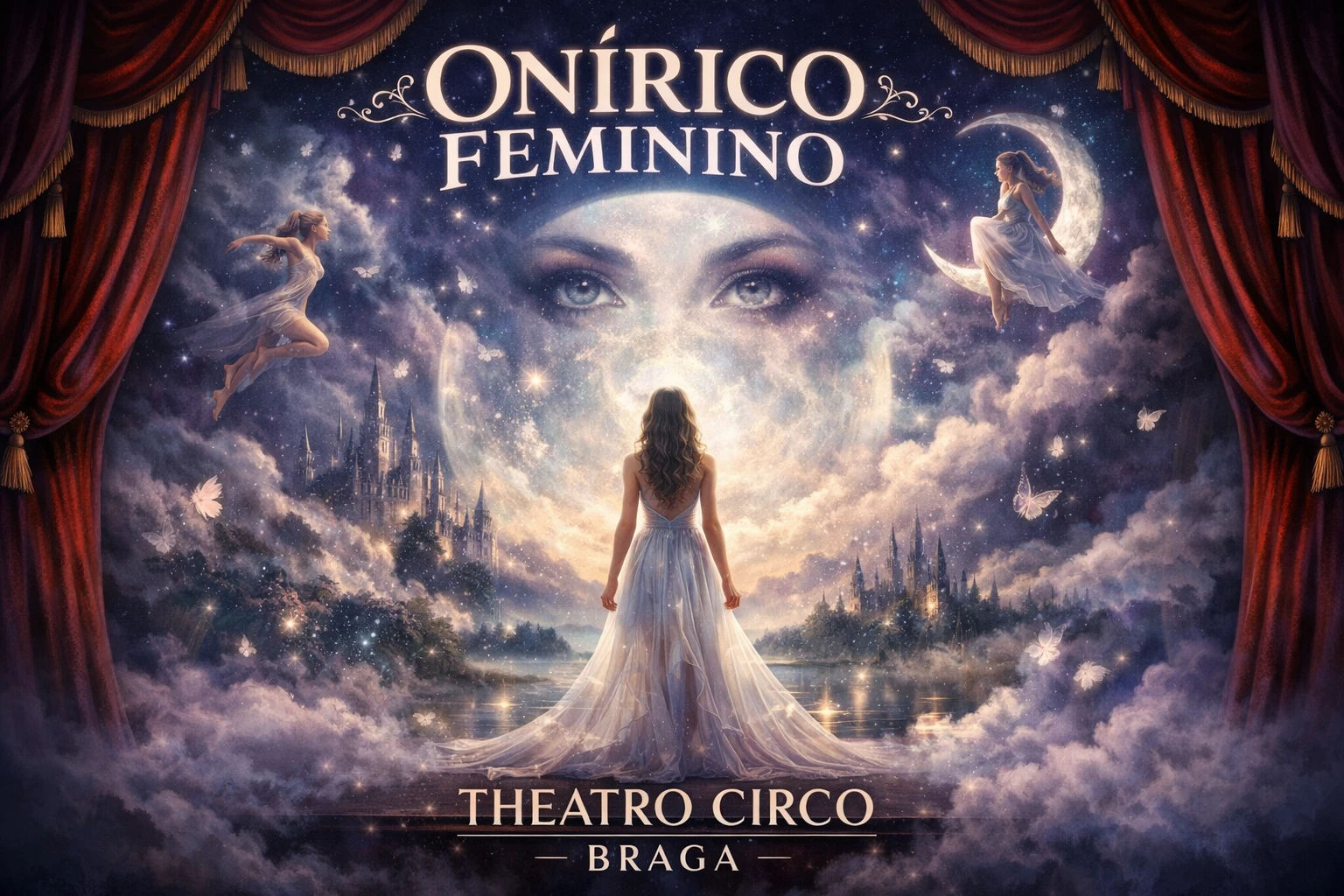
Event Has Passed - See You Next Time!
Event Details
Date
Time
9:30 PM - 11:00 PM
Location
Theatro Circo, Avenida da Liberdade 697, 4710-251 Braga
Braga, Portugal
Price
from €12
About This Event
Onírico Feminino at Theatro Circo Braga 2026: When World-Class Opera Meets More Than a Century of Song
Not every concert asks you to reconsider how you hear music. Most performances, however technically accomplished, exist within a frame you already recognise: a singer, a pianist, a stage. What Elisabete Matos, Maciej Pikulski, and Pedro Ribeiro have created with "Onírico Feminino: O teu olhar sobre mim" is something deliberately more ambitious than that. It is a programme that sets out to reflect on the imaginary of song through works spanning more than a century of musical creation, from Romanticism through the 20th century, using the voice, the piano, and the art of staging to reimagine how women have been seen, heard, and constructed in the Western musical tradition.
The performance takes place on Saturday 18 April 2026 at 21:30 at the Theatro Circo in Braga, one of the finest and most historically significant theatres in Portugal. Tickets are priced at €12 for standard seats, with a reduced price of €8 available. This is part of the Theatro Circo's extraordinary April 2026 programme, coinciding with the theatre's 111th anniversary week.
The Concept: What "Onírico Feminino" Actually Means
A Reflection on How Song Imagines Women
The title needs a moment of attention. "Onírico" in Portuguese means oneiric, relating to dreams or the dream world. "Feminino" means the feminine. The full title, "O teu olhar sobre mim," translates as "Your gaze upon me." Put together, the work is proposing to explore how the female figure has been dreamed into existence through song: how composers, librettists, and musical traditions have constructed the feminine as an image, a projection, an object of longing, beauty, tragedy, and idealization.
This is rich territory. From the Lieder of Schubert and Schumann through the late Romantic composers and into the 20th century, the Western art song tradition has produced hundreds of works in which the female voice is simultaneously the singer and the object being sung about, simultaneously present and imagined, real and constructed. Elisabete Matos, as one of Portugal's greatest dramatic sopranos, brings to this project not just a voice of extraordinary power and beauty but a career-long experience of embodying women created by male composers, from Puccini's Tosca and Mimi to Wagner's Senta and Isolde.
The collaboration with Maciej Pikulski at the piano and Pedro Ribeiro as stage director transforms what might have been a recital into something interrogative and theatrical. The programme proposes to reflect on the imaginary of song through works that cross more than a century of musical creation, between Romanticism and the 20th century. That is both a musical and a conceptual ambition.
Elisabete Matos: A Soprano Born in the Shadow of Braga
From the Conservatório de Braga to La Scala and the Metropolitan Opera
The return of Elisabete Matos to perform in the city of Braga carries a particular resonance. She was born in Caldas das Taipas, in the municipality of Guimarães, and her first musical studies, in both violin and singing, took place at the Conservatório de Música Calouste Gulbenkian de Braga. The city is, in the most literal sense, where her voice began.
From that regional conservatory, Matos won a scholarship from the Calouste Gulbenkian Foundation and moved to Madrid to complete her training at the School of Singing, studying under Ángeles Chamorro, Marimí del Pozo, Félix Lavilla, and Miguel Zanetti. Her early career launched at the Hamburg Opera with the roles of Donna Elvira in Mozart's Don Giovanni and Alice Ford in Verdi's Falstaff. Then, in 1997, came the debut that changed everything.
At the reopening of the Teatro Real de Madrid, she sang the leading role of Marigaila in the world premiere of Divinas Palabras by Antón García Abril, with Plácido Domingo in the tenor part. Domingo was so impressed that he immediately invited her to sing alongside him in multiple productions, including Massenet's Le Cid (as Chimène) and Sly by Wolf-Ferrari (as Dolly, with José Carreras as the protagonist).
From there, the career unfolded across the great houses of the world. The Gran Teatre del Liceu in Barcelona. La Fenice in Venice. La Scala in Milan. The Teatro Regio in Turin. The Teatro di San Carlo in Naples. The Berlin State Opera. The Wiener Staatsoper. And, in a career moment that places her among the very highest tier of operatic sopranos, the New York Metropolitan Opera, where she sang Minnie in Puccini's La Fanciulla del West during the 2010–2011 season, returning in 2012 as Abigaille in Nabucco and in 2013 as Tosca.
Awards, Recordings, and Recognition
In 2000, Matos won a Grammy Award for her recording of the title role in La Dolores by Tomás Bretón, for Decca, alongside Plácido Domingo. She has been decorated twice by the President of the Portuguese Republic: first as Officer and later as Grand Officer of the Order of Infante D. Henrique, Portugal's highest distinction for public figures. She received the Gold Medal for Artistic Merit of the City of Guimarães, and was declared Favourite Daughter of Vila de Caldas das Taipas, the parish of her birth.
She is described consistently across major opera publications as a lirico-spinto soprano of exceptional power and beauty, owning a large voice capable of dramatic intensity with a timbre of sheer beauty. Her repertory encompasses more than fifty roles, with particular depth in Puccini and Wagner, though her concert work ranges from Bach to contemporary music.
In 2019, she was appointed Artistic Director of the Teatro Nacional de São Carlos in Lisbon, becoming the first woman to hold that position in the theatre's history. Her tenure there demonstrated that the depth of her artistic vision matched the power of her voice.
Bringing this artist back to the stage of a theatre in the region where she first learned to sing is, in itself, a kind of completion. The 18 April performance at Theatro Circo is that reunion made concrete.
Maciej Pikulski: The Polish Pianist Who Brings the Lieder Tradition to Portugal
A Specialist in the Art of Collaboration
Maciej Pikulski is a Polish pianist who has built his career in the tradition of the great accompanist-collaborators of the Lied repertoire. This is a specialised and demanding art form. The accompanist in art song is not a background musician keeping time while the singer performs. The pianist in Lied, in the mélodie, in the canção, is an equal partner in the interpretive act, often carrying the emotional subtext of a song while the voice carries its surface, or vice versa. The greatest pianist-accompanists, from Gerald Moore to Charles Spencer, are recognised as artists of the highest order.
Pikulski has performed across Europe and South America, collaborating with a wide range of singers in programmes that reflect the full breadth of the Romantic and 20th-century art song tradition. His presence in this programme reflects a curatorial choice as much as a practical one: the kind of sensitivity and historical knowledge that the "Onírico Feminino" programme requires can only be supplied by a pianist who understands the Lied tradition from the inside.
His collaboration with Elisabete Matos on this programme is the result of a shared artistic vision for what a song recital can be when it takes its conceptual premise seriously and allows the piano's role to be as interrogative as the voice's.
Pedro Ribeiro: The Stage Director Who Transforms a Recital into an Experience
Bringing Visual and Theatrical Intelligence to Art Song
The inclusion of Pedro Ribeiro as stage director is what distinguishes "Onírico Feminino" most clearly from a conventional song recital. Ribeiro is a Portuguese director whose work in theatre and performance has demonstrated a consistent interest in the intersection of text, body, music, and space. His contribution to this project is to create a staging that allows the programme's conceptual premise (the gaze upon the feminine, the dream of the feminine) to be physically present in the space rather than merely implied by the music.
The staging of a song recital is an art form in itself, and one that is still relatively rare in the Portuguese performance context. Most art song concerts present the performers in conventional positions, the singer at the piano, the accompanist at the keyboard, with minimal theatrical elaboration. By introducing a stage director, this programme commits to the idea that how the performance looks, how the bodies in the space relate to each other and to the audience, is as much a part of the meaning as what is sung.
For an audience at the Theatro Circo, this creates an experience that sits between concert and theatre without being fully either. It is the kind of work that the Theatro Circo's programming has consistently sought to present: performances that challenge genre assumptions while remaining emotionally and artistically accessible.
The Programme: Songs Across More Than a Century
The specific repertoire for "Onírico Feminino" includes works spanning from the Romantic era into the 20th century. The programme proposes to reflect on the imaginary of song through works that cross more than a century of musical creation, between Romanticism and the 20th century. This suggests a selection from the great art song traditions of Germany, France, and Portugal, potentially including Lieder by Schumann, Brahms, or Wolf, mélodies by Fauré, Duparc, or Poulenc, and Portuguese canções or other works that engage with the feminine voice and gaze from within their own cultural contexts.
The Romantic era is particularly rich territory for this programme's themes. The Lied tradition, from Schubert through Schumann and Brahms and Wolf, produced hundreds of songs in which the female figure appears as an object of longing, a force of nature, an embodiment of beauty and loss. Hearing those songs performed by a soprano of Elisabete Matos' stature, in a staging that explicitly interrogates the gaze they represent, is an experience of considerable intellectual and aesthetic power.
The 20th-century repertoire adds another dimension: the composers who inherited the Romantic tradition and either continued it, subverted it, or deliberately challenged its assumptions about gender, beauty, and the feminine ideal. Works by Ravel, Poulenc, Britten, or contemporary composers bring the programme's question (what does it mean to be the object of the song's gaze?) into a period where those questions were being asked with increasing urgency.
The 111th Anniversary Week at Theatro Circo: Three Special Nights
The Braga performance of "Onírico Feminino" on 18 April 2026 is the first of three exceptional events presented by Theatro Circo in celebration of its 111th anniversary. The Theatro Circo celebrates 111 years in April and, in the anniversary week, three shows will be presented: Elisabete Matos on 18 April, the post-rock Chicago pioneers Tortoise on 19 April presenting "Touch," and A Garota Não on 21 April presenting "A Vulgar Mulher Extraordinária."
The fact that two of the three anniversary shows, "Onírico Feminino" and "A Vulgar Mulher Extraordinária," both centre on women and the feminine experience, from very different musical and conceptual angles, suggests a deliberate curatorial intelligence in the Theatro Circo's programming choices for this milestone week.
Theatro Circo: A Stage That Demands Great Work of Those Who Stand on It
The Theatro Circo, opened in 1915 and located at Avenida da Liberdade 697 in the heart of Braga, is one of the most beautiful and acoustically refined theatre spaces in northern Portugal. Its Sala Principal seats approximately 1,500 people, and the red and gold decorative scheme, the steep seating rake, and the carefully maintained plaster interior create an atmosphere of genuine theatrical occasion. The acoustic is perfectly suited to the art song format: the house has a warmth and clarity that allows every nuance of a voice and piano combination to reach the upper balconies without amplification.
The theatre has been the principal cultural institution of Braga for over a century, carrying the city's performing arts identity through the Estado Novo dictatorship, through the Carnation Revolution, through democratisation, and into the contemporary cultural dynamism of a city that served as Portugal's Capital of Culture in 2025. Attending a performance there is not merely attending a concert. It is participating in an institution that has shaped the cultural life of an entire city for more than a hundred years.
Braga in April: The City Around the Performance
A City in Full Spring Bloom
Braga in mid-April is one of northern Portugal's most rewarding experiences. The city sits in the green heart of the Minho region, surrounded by vine-covered hills producing Vinho Verde, and its historic centre carries a remarkable concentration of architectural and historical heritage across multiple periods. The streets around the Theatro Circo, on and off the Avenida da Liberdade, are lined with cafes and restaurants that are fully alive in April evenings.
The Sé de Braga, one of Portugal's oldest cathedrals, begun in the 12th century, is ten minutes on foot from the Theatro Circo and deserves a full morning visit. Its Gothic tombs of Dom Henrique and Dona Teresa, parents of Portugal's first king Afonso Henriques, are extraordinary funerary monuments. The Praça da República (the Arcada) is the social heart of the city and the natural pre-concert gathering point, with cafe terraces under stone arches that fill from early evening onward.
The Bom Jesus do Monte sanctuary, eight kilometres east of the city, is reachable by a 19th-century funicular and offers views across the Minho valley that are particularly beautiful in the April light. The D. Diogo de Sousa Museum of Archaeology provides deep context for the city's Roman foundation as Bracara Augusta.
The Week of Concerts and Liberty Day
The 18 April performance at Theatro Circo sits in the middle of an extraordinary week for culture in Braga. Just three days later, A Garota Não performs "A Vulgar Mulher Extraordinária" at the same theatre on 21 April. And four days after that, on Saturday 25 April, Portugal observes Liberty Day, Dia da Liberdade, marking the 52nd anniversary of the Carnation Revolution of 1974. The combination of three exceptional concert evenings and a national public holiday within one week makes the period from 18 to 25 April 2026 one of the most culturally rich moments in Braga's spring calendar.
Practical Information for Attending the Concert
Date: Saturday 18 April 2026
Start time: 21:30
Age rating: Suitable from age 6
Venue: Theatro Circo, Sala Principal (or confirm specific hall closer to the date via the venue)
Address: Avenida da Liberdade 697, Braga, Portugal
Ticket prices:
- Standard: €12
- Reduced: €8 (student, youth, senior, or other applicable categories; confirm eligibility at time of purchase)
Ticket booking: theatrocirco.com; bol.pt; Theatro Circo box office
Contact: +351 253 203 800; [email protected]
Getting to Braga from Porto: Train from Porto Campanhã or Porto São Bento, approximately 50 minutes on Alfa Pendular services. Trains run frequently, including evening services allowing comfortable return after the concert. Porto Francisco Sá Carneiro Airport is the closest international hub, with metro connection to Porto Campanhã and trains onward to Braga.
Getting to Braga from Lisbon: Direct Alfa Pendular, approximately three hours. Several departures daily.
Getting to Theatro Circo: The venue is centrally located, approximately 15 to 20 minutes' walk from Braga railway station and five to ten minutes from the Praça da República. Arriving by train or on foot from a central hotel is strongly recommended.
Accommodation: Mid-April is an active spring period in Braga. The proximity of Liberty Day on 25 April and the exceptional theatre programme across the week makes booking ahead advisable. The area around the Praça da República and the historic centre offers the best combination of location and atmosphere.
Weather: Mid-April in Braga brings reliable spring warmth, with average daytime temperatures of 16 to 20 degrees Celsius and cooler evenings. A light jacket for the walk to and from the theatre is sensible.
Official venue website: theatrocirco.com
An Evening That Earns Your Full Attention
"Onírico Feminino: O teu olhar sobre mim" is the kind of programme that the best concert halls and the most serious artists create when they trust their audience to bring something to the experience. It is not a concert that asks you to sit back. It is a programme that asks you to listen, to look, and to think about what you are hearing, who is singing it, and what the century-old tradition of the Western art song has imagined when it imagined women.
Elisabete Matos, one of Portugal's greatest voices and a soprano who has stood on the stage of the Metropolitan Opera and La Scala, returns to the region where her musical life began. Maciej Pikulski brings the depth of a specialist accompanist whose understanding of the Lied tradition is architectural. Pedro Ribeiro gives the staging a visual and theatrical intelligence that transforms the recital format into something genuinely new.
At the Theatro Circo in Braga, on a Saturday evening in April 2026, in the 111th anniversary week of the theatre itself, all of that comes together in a room that deserves exactly this quality of work.
Tickets at €12 and €8. Reserve at theatrocirco.com. Come early enough to settle in and let the room do what it has been doing for 111 years: preparing audiences for something worth hearing.
Verified Information at a Glance
| Detail | Information |
|---|---|
| Event Name | Elisabete Matos, Maciej Pikulski e Pedro Ribeiro: Onírico Feminino – O teu olhar sobre mim |
| Event Category | Classical Music / Art Song Recital / Staged Concert Performance |
| Date | Saturday 18 April 2026 |
| Start Time | 21:30 |
| Age Rating | Suitable from age 6 |
| Venue | Theatro Circo, Braga |
| Address | Avenida da Liberdade 697, Braga, Portugal |
| Ticket Prices | Standard €12; Reduced €8 |
| Ticket Booking | theatrocirco.com; bol.pt; Theatro Circo box office |
| Contact | +351 253 203 800; [email protected] |
| Artists | Elisabete Matos: Portuguese dramatic soprano; born in Caldas das Taipas, Guimarães; trained at Conservatório de Música Calouste Gulbenkian de Braga; Grammy Award winner (2000, La Dolores, Decca); performed at the Metropolitan Opera, La Scala, Berlin State Opera, Wiener Staatsoper, Gran Teatre del Liceu, La Fenice, and major houses worldwide; Grand Officer of the Order of Infante D. Henrique; first female Artistic Director of Teatro Nacional de São Carlos, Lisbon |
| Maciej Pikulski | Polish pianist and specialist accompanist in the Lied and art song tradition |
| Pedro Ribeiro | Portuguese stage director |
| Programme Concept | A programme that proposes to reflect on the imaginary of song through works spanning more than a century of musical creation, between Romanticism and the 20th century; exploring the feminine as constructed through the Western art song tradition |
| Context | Part of the Theatro Circo 111th anniversary week (April 2026); the first of three exceptional performances in the anniversary week (Elisabete Matos 18 April; Tortoise 19 April; A Garota Não 21 April) |
| Getting to Braga | Train from Porto approx. 50 minutes; from Lisbon approx. 3 hours (Alfa Pendular) |
| Average Temperature on 18 April in Braga | 16–20°C; light jacket recommended for evening |
| Nearby Events | A Garota Não at Theatro Circo (21 April 2026); Liberty Day / Dia da Liberdade (25 April 2026); Miguel Araújo at Theatro Circo (29 April 2026); Braga Romana XXII Edition (20–24 May 2026) |
| Official Venue Website | theatrocirco.com |
Event Has Passed - See You Next Time!
Event Details
Date
Time
9:30 PM - 11:00 PM
Location
Theatro Circo, Avenida da Liberdade 697, 4710-251 Braga
Braga, Portugal
Price
from €12