
Event Has Passed - See You Next Time!
Event Details
Date
Location
Parks and public spaces citywide, Brno (e.g., Kraví hora hill)
Brno, Czech Republic
Price
Free Entry
About This Event
Čarodějnice – Walpurgis Night in Brno: The Czech Tradition of Burning the Witches
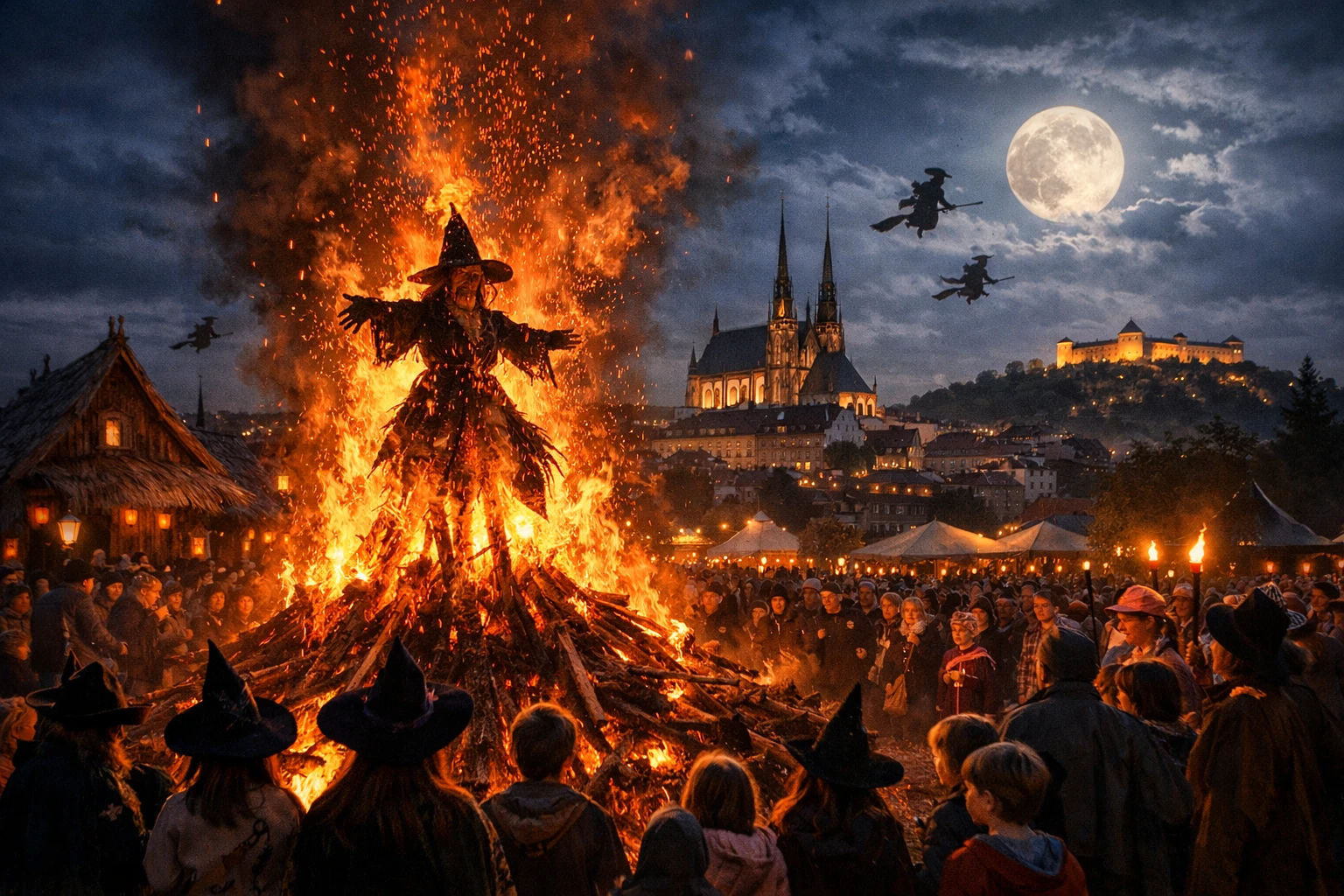
Every year on the evening of Thursday, April 30, 2026, something wonderfully strange and deeply rooted happens across Brno and the whole of the Czech Republic. Bonfires are lit in parks, castle grounds, neighbourhood squares, and back gardens. Effigies of witches are tossed into the flames. Children arrive dressed in pointed hats and cloaks. The smell of grilled špekáčky sausages fills the cool spring air, and families and friends gather around the fire to mark the end of winter in the most ancient way imaginable.
This is Čarodějnice — also known as Pálení čarodějnic (Burning of the Witches), or Walpurgis Night — and it is one of the most atmospheric, genuinely joyful, and historically fascinating traditions on the Czech calendar. For visitors in Brno on April 30, it is an unmissable window into the city's folk culture, its neighbourhoods, and the kind of community celebration that no ticketed event can replicate.
What Is Čarodějnice? The Ancient Origins of Walpurgis Night
The tradition of Walpurgis Night stretches back far beyond Christianity, rooted in pre-Christian Slavic and Germanic beliefs about the transition between seasons. The last night of April was considered one of the most magically charged nights of the year — a liminal moment when the boundary between the human world and the spirit world grew thin.
According to folk belief, witches were at the peak of their power on this night. They gathered on hilltops, rode through the air on broomsticks, and caused harm to livestock, crops, and households that weren't protected. The response to this threat was fire. Communities lit large bonfires on hills and in open fields to drive the witches away, to purify the land, and to signal that spring had arrived and winter's dark forces were finished.
In the Christian calendar, April 30th falls on the eve of the feast day of Saints Philip and Jacob, which is why the tradition is also sometimes called Filipojakubská noc (the Night of Philip and Jacob) in Czech. But the pre-Christian roots run deeper than any church feast day, and it's those ancient impulses — fire, community, the turning of the season — that give Čarodějnice its enduring energy.
How the Tradition Evolved
Over the centuries, the tradition transformed from a genuine protective ritual into something more festive and communal. The fear of real witches faded; the bonfire remained. By the 19th and 20th centuries, Pálení čarodějnic had become the celebration it largely is today: a community gathering around a large fire, often with a witch effigy burned at the peak of the evening, accompanied by food, drink, music, and — especially — children in witch costumes.
In communist-era Czechoslovakia, the tradition was deliberately suppressed as a "bourgeois superstition," but it proved impossible to extinguish entirely and came back with full force after 1989. Today, it is one of the most widely celebrated folk traditions in the Czech Republic, arguably more alive in community terms than many official public holidays.
How Brno Celebrates Čarodějnice: A City-Wide Event
What makes Brno particularly special for Čarodějnice is the sheer number and variety of events spread across the city's many distinct neighbourhoods and districts. There is no single centralised event — instead, virtually every městská část (city district) organises its own celebration, giving the evening a genuinely grassroots, community-led character. You can wander from one neighbourhood to the next and find a different bonfire, a different programme, a different crowd.
Špilberk Castle: The Most Dramatic Setting in Brno
For sheer atmosphere, nothing in Brno competes with Špilberk Castle on Walpurgis Night. The Brno City Museum organises a special Čarodějnice event at Špilberk each year, with the bonfire lit on the castle's cannon bastion (dělový bastion) and the western curtain wall. The programme runs from approximately 3:00 PM and includes guided competitions for children, theatrical performances, witch-themed activities, and the central ceremony of burning the witch effigy as the evening darkens.
The medieval silhouette of Špilberk against the night sky, lit by bonfire light, with the city of Brno spread out below, is genuinely one of the most visually spectacular ways to spend April 30 anywhere in Central Europe. Check the muzeumbrna.cz website for the confirmed 2026 programme details and any ticketing requirements.
Brno-Královo Pole: A Classic Neighbourhood Celebration
The district of Brno-Královo Pole hosts one of the most traditional and well-organised neighbourhood Čarodějnice celebrations in the city. In recent years it has taken place in the park on Slovanské náměstí, running from 4:00 PM to 10:00 PM. This is a genuinely family-friendly event with a programme designed to entertain children alongside the adults: witch costume contests, children's games, traditional music, grilled sausages, and the centrepiece bonfire.
This kind of neighbourhood event, run by the local district council (Městská část), is perhaps the most authentic way to experience Čarodějnice in Brno — surrounded by local families doing exactly what their parents and grandparents did on this evening.
Brno-Líšeň: Bonfires in the Ravine
The Líšeň district takes things outdoors in the most literal sense, hosting its Pálení čarodějnic in the Líšeňská rokle (Líšeň Ravine), a beautiful natural green corridor within the city. The combination of the woodland setting, the ravine, and the bonfire gives this particular celebration a wilder, more elemental atmosphere than the park-based events elsewhere in the city.
Brno-Černovice: Evening into the Night
The Černovice district hosts its celebration at the Areál zdraví on Kneslova 1A, typically running from 5:30 PM to 1:00 AM — making it one of the later-running events in the city for those who want to extend the evening well into the night. A DJ provides music, and the programme runs long enough to fully cross from the last evening of April into the first hours of May 1st, the Day of Love — connecting the two traditions in the most seamless way possible.
Brno Zoo
For families with younger children, Brno Zoo typically offers its own Čarodějnice-themed programme on the afternoon and evening of April 30, with performances, activities, and themed entertainment running through the day. The zoo's natural setting, combined with witch-themed activities designed specifically for young visitors, makes it one of the most child-friendly options in the city.
The Heart of the Celebration: Fire, Food, and Community
Whatever event you attend in Brno on April 30, certain elements will be universal. Understanding them in advance makes the evening feel richer rather than unfamiliar.
- The Bonfire and the Witch Effigy
- The centrepiece of every Pálení čarodějnic event is the bonfire — large, well-built, and lit ceremonially rather than casually. In many celebrations, an effigy of a witch made from old clothes and stuffed with straw is thrown into the fire at the high point of the evening. This is the symbolic act of driving away the winter and its darkness. In smaller, more traditional communities outside the city, the effigy is sometimes elaborate and given a name. In Brno's urban events, it tends to be more straightforward — a broom-riding straw figure that gets a round of cheers when it catches.
- Špekáčky: The Essential Walpurgis Night Food
- If you attend a single Czech bonfire event in your life and eat only one thing, make it špekáčky. These are thick, fatty sausages made with smoked pork and beef, traditionally skewered on long sticks and grilled directly over the open flames. The combination of the fire smoke, the fat dripping onto the coals, and the slightly charred casing makes them taste unlike any sausage you'll eat indoors. Most events sell them on site, and the smell of špekáčky over an open fire on a spring evening is the single most evocative sensory trigger for Czech childhood memories.
- Costumes and Witch Hats
- Don't be surprised to arrive at any Brno Čarodějnice event and find a significant portion of the crowd — children and adults alike — dressed as witches. Pointed black hats, capes, broomsticks, and face paint are all standard dress code, and showing up in costume is welcomed and encouraged rather than unusual. If you're travelling with children, bringing or buying a simple witch hat on the day is a very easy way to participate fully.
The Connection to May 1st: Two Traditions, One Night Apart
Čarodějnice on April 30 and the Day of Love (Den lásky) on May 1st are deeply connected in the Czech folk imagination. They are two halves of the same seasonal transition. The fire of April 30 drives away the darkness and cold; the blossoming cherry trees and the kiss of May 1st celebrate what replaces them.
This means that staying in Brno for both days gives you the fullest possible experience of this spring moment in Czech culture. The evening of April 30 is communal, elemental, and rooted in the oldest human instinct of gathering around fire at a seasonal turning point. The morning of May 1st is romantic, gentle, and literary — Karel Hynek Mácha's Brno, where the first of May is "the time of love." Together, they make a 24-hour window that captures something genuinely essential about life in this part of Central Europe.
Practical Tips for Visiting Brno on Walpurgis Night
- When to arrive: Most events start between 3:00 PM and 6:00 PM, with bonfires lit after dark, usually between 8:00 PM and 9:30 PM. Arriving early means you catch the full programme and get a good spot near the fire.
- What to wear: Dress warmly. April evenings in Brno can drop to 5–10°C (40–50°F), and standing around an outdoor event for several hours requires layers. The bonfire provides heat close up, but the wider event area can be cold.
- Transport: Brno's tram network is your best friend. Tram lines serve Špilberk, Královo Pole (Slovanské náměstí), and the city centre with ease. Avoid driving if attending multiple events, as neighbourhood street parking becomes congested on bonfire night.
- Admission: The vast majority of Čarodějnice events in Brno are free to attend. Some events, like the Špilberk Castle programme, may charge a small entry fee for museum admission. Check individual event pages for details.
- Food and drink: Available at all major events; expect grilled sausages, beer, mulled wine, and soft drinks for children. Cash is useful at smaller outdoor stalls.
- Getting to Brno: Train from Prague (2.5 hours), Vienna (1.5 hours), or Budapest (3 hours); Brno Airport (BRQ) handles regional European flights.
Come for the Fire, Stay for the Spring
Čarodějnice is the kind of tradition that reminds you of something important: that before there were organised festivals and ticketed events, there were just communities, an open field, a pile of wood, and the deep human instinct to mark the turning of a season together. Brno does this as well as anywhere in Central Europe, across a dozen different neighbourhoods, all on the same April evening.
On Thursday, April 30, 2026, find a bonfire in Brno, get yourself a špekáčka, put on a witch hat if you feel like it, and let one of Europe's oldest springtime traditions do exactly what it's always done: make winter feel finished, and spring feel genuinely, warmly, firelit real.
Verified Information at a Glance
| Detail | Information |
|---|---|
| Event | Čarodějnice / Pálení čarodějnic (Burning of the Witches / Walpurgis Night) |
| Category | Czech Folk Tradition / Seasonal Celebration / Community Cultural Event |
| Date | Thursday, April 30, 2026 |
| Typical Event Hours | From approximately 3:00 PM to late evening (varies by district) |
| Location | Citywide across Brno districts — key venues include: |
| Park na Slovanském náměstí, Brno-Královo Pole (from 4 | 00 PM to 10:00 PM) |
| Areál zdraví, Kneslova 1A, Brno-Černovice (5 | 30 PM to 1:00 AM) |
| Admission | Free at most events; small fee possible at Špilberk Castle programme |
| Traditional Food | Špekáčky (grilled sausages over open fire), beer, mulled wine |
| Dress Code | Witch costumes, hats and cloaks encouraged for children and adults |
| Key Tradition | Burning of a witch effigy on a large communal bonfire to mark the end of winter |
| Also Known As | Filipojakubská noc (Night of Philip and Jacob) |
| Connected Tradition | Follows directly into Den lásky (Day of Love) on May 1st |
| Getting There | Brno tram network to all districts; train from Prague (2.5 hrs), Vienna (1.5 hrs), Budapest (3 hrs) |
| More Info | muzeumbrna.cz (Špilberk), kralovopole.brno.cz (Královo Pole district) |
More Events in Brno
%202026.webp)
Event Has Passed - See You Next Time!
Event Details
Date
Location
Parks and public spaces citywide, Brno (e.g., Kraví hora hill)
Brno, Czech Republic
Price
Free Entry