

Event Has Passed - See You Next Time!
Event Details
Date
Time
8:00 PM - 10:30 PM
Location
Victoria Hall, Rue du Général-Dufour 14, 1204 Geneva
Geneva, Switzerland
Price
Not Available
About This Event
Anouar Brahem Quartet at Victoria Hall Geneva 2026: A Master of the Oud in the City of International Cultures
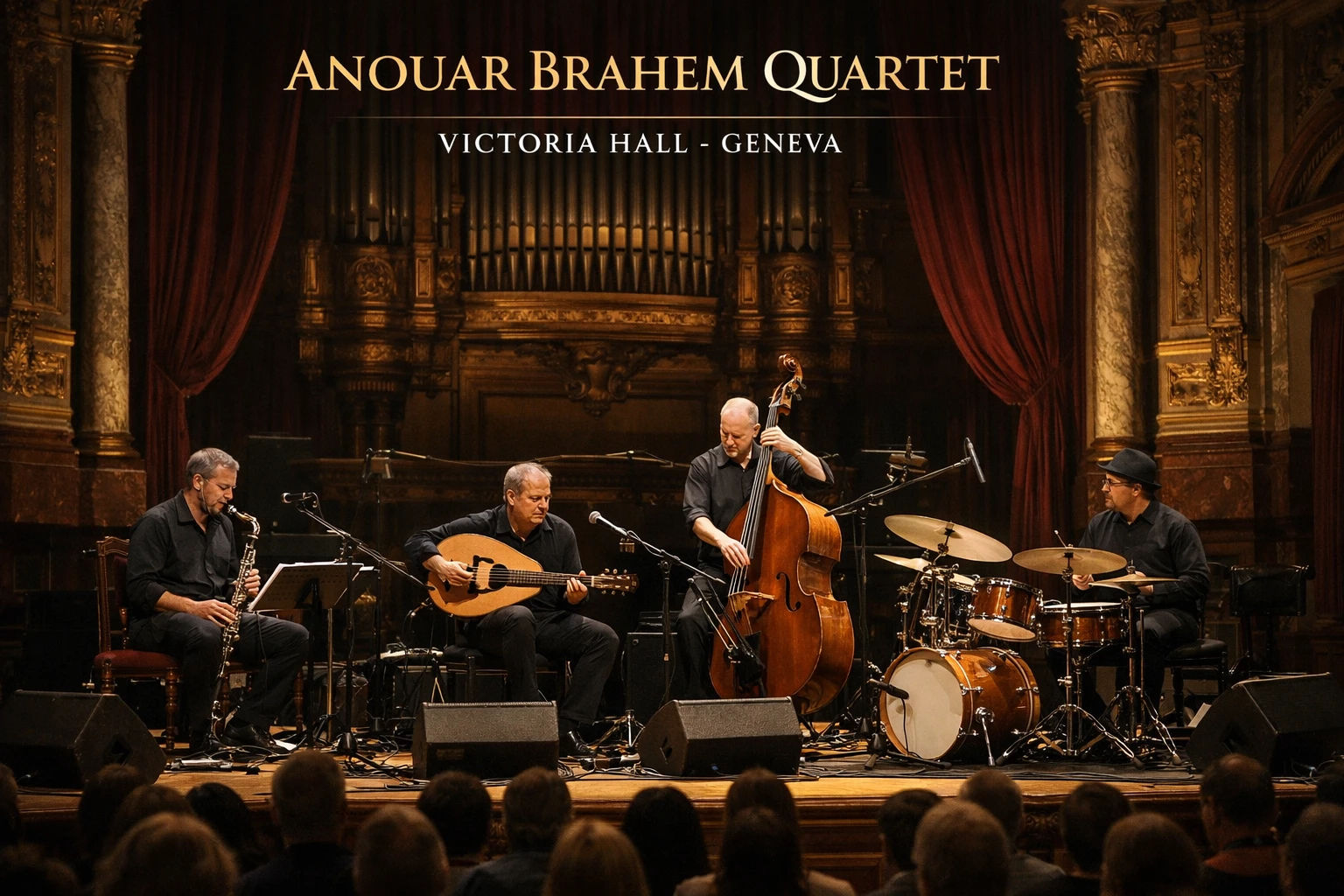
Not every concert justifies careful advance planning. Some do, particularly when the instrument at the centre of the evening is as rare in the hands of a master as the oud is in the hands of Anouar Brahem, and when the venue is as perfectly suited to his music as Victoria Hall in Geneva. On Thursday 14 May 2026 at 20:00, one of the most celebrated and most genuinely singular musicians in the world of instrumental music brings his quartet to Geneva's finest concert room, in what promises to be one of the most memorable evenings of the city's spring cultural season.
The Anouar Brahem Quartet for this concert is the specific combination that made one of the most admired albums in the ECM Records catalogue: Anouar Brahem on oud, Klaus Gesing on bass clarinet and soprano saxophone, Björn Meyer on bass, and Khaled Yassine on darbouka and bendir. This is not a touring group assembled from available musicians. It is a long-standing artistic family whose members know each other's musical instincts with the depth that only years of recording and touring together can produce. The Geneva concert on 14 May is the first of two consecutive Swiss dates: Zurich's Tonhalle-Grosser Saal follows on 15 May.
Tickets are available via the Victoria Hall booking system and through Bandsintown.
Who Is Anouar Brahem? Four Decades of Dissolving Borders Through Music
Tunisia, Paris, and the Oud as a Language for Everything
Anouar Brahem was born in Halfaouine, a neighbourhood of Tunis that became internationally famous through the 1990 film of the same name by Férid Boughedir. He began learning the oud at the age of ten at the National Conservatory of Music in Tunis, studying under the great Tunisian oud master Ali Sriti. By 1981 he had moved to Paris, where the cultural intersection of the Arab world, European contemporary music, and the global jazz scene that the French capital enabled gave his musical thinking its particular shape.
For almost forty years, Anouar Brahem, Tunisian composer and oud master, has been creating music both rooted in a highly sophisticated but ancestral culture and eminently contemporary in its global ambition. That phrase, which has appeared across decades of concert programme notes and album liner texts, captures something essential: Brahem is not a world music artist in the marketing sense, not someone who combines Eastern instruments with Western arrangements to produce something palatable to international audiences. He is a composer of genuine depth whose instrument happens to come from a tradition of extraordinary antiquity, and whose musical thinking refuses to be contained by any single cultural framework.
The oud he plays is the short-necked lute that sits at the centre of Arabic musical culture, an instrument with a history extending back more than two thousand years, fretless in its standard form (allowing the microtonal intervals of Arabic maqam scales), and in the hands of a master capable of a range of expression from the most delicate contemplative whisper to a rhythmic urgency that carries the whole body of the listener. Nobody makes the short-necked oud resonate with more melodious sighs than Brahem, as his Geneva concert description puts it: this is not hyperbole but the assessment of audiences in concert halls across Paris, London, New York, Milan, Dublin, Sofia, and beyond.
The ECM Relationship: Eleven Albums of Architectural Beauty
The record label ECM Records, founded in Munich by Manfred Eicher in 1969, has been home to some of the most significant jazz and contemporary music recordings of the past half-century. Its aesthetic, characterised by extended silence, natural acoustic recording, long compositional arcs, and a refusal of conventional genre categories, was a perfect match for Brahem's sensibility from the moment they began working together.
His eleven albums on ECM span more than three decades of musical development and include some of the label's most admired recordings: Astrakan Café (1991), Khomsa (1995), Thimar (1997, with Dave Holland and John Surman), Le Pas du Chat Noir (2002), Astrakan Café revisited, The Astounding Eyes of Rita (2009), and Blue Maqams (2017, with Django Bates, Dave Holland, and Jack DeJohnette). Each album is a distinct artistic statement, not a continuation of what came before but a genuinely new configuration of musical materials and collaborators.
The Astounding Eyes of Rita (2009) is the album that defines the quartet's current concert identity. Recorded with the same musicians who will perform at Victoria Hall in May 2026, the album was described at its release as one of ECM's most beautifully sustained recordings, a work of exceptional contemplative depth that uses the combination of oud, bass clarinet, bass, and percussion to create a world of sound that is simultaneously Arabic in its melodic sensibility, jazz-like in its improvisatory openness, and classical in its compositional rigour.
The album title comes from a poem by the Palestinian poet Mahmoud Darwish, one of the great literary figures of the 20th century, and the music carries something of poetry's relationship to silence and meaning: each phrase is deliberate, each silence is weighted, and the overall arc of the work builds a sustained emotional experience rather than a series of individual song moments.
Blue Maqams (2017), the most recent full quartet recording, brought together Brahem with Django Bates (piano), Dave Holland (bass), and Jack DeJohnette (drums) in a meeting between the Tunisian maqam tradition and the deepest roots of American jazz. Its release was met with some of the most enthusiastic critical response of Brahem's career, with The Guardian, Le Monde, and Jazzthing all noting the record's extraordinary combination of depth and immediacy.
The Quartet: Four Musicians, One Voice
Anouar Brahem: Oud
The oud is at the centre of everything. It is Brahem's instrument, his compositional vehicle, and the lens through which every musical relationship in the quartet is mediated. The specific quality of his playing, recognised across decades and dozens of concert halls, is its combination of technical mastery and emotional restraint: he does not overwhelm the listener with virtuosity but draws them into a listening space where small movements carry enormous weight.
The short-necked oud he plays, as opposed to the long-necked varieties found in Turkish musical tradition, has a rounder, warmer tone that is particularly well suited to the kind of close musical conversation that the quartet format enables.
Klaus Gesing: Bass Clarinet and Soprano Saxophone
Klaus Gesing is a German multi-instrumentalist whose career has taken him from contemporary classical music through jazz and improvised music into the genre-dissolving space that Brahem's compositions inhabit. His bass clarinet playing, with its extraordinary range from the lowest register's woody darkness to the upper register's plaintive singing quality, is the instrument in the quartet most capable of sustaining melodic lines over long durations, creating a counterpoint to the oud that is simultaneously supportive and independent. His soprano saxophone adds a brighter, more urgent voice for specific compositional moments.
The recorded reviews of the quartet's live performances consistently single out the dialogue between Brahem's oud and Gesing's bass clarinet as the emotional core of the concert experience. One audience member attending an earlier European date noted: "The acoustics of the concert hall along with a perfect sound setup by the technicians allowed four brilliant musicians who were totally connected to each other to create beautiful, contemplative and enriching music, simply sublime."
Björn Meyer: Bass
Björn Meyer is a Swedish bassist and composer whose reputation in the European contemporary music scene has been built across collaborations with artists from across the jazz, electronic, and improvised music worlds. His role in the Brahem quartet is foundational in the structural sense: providing the harmonic grounding that allows the melodic instruments above him to take risks, and finding a rhythmic vocabulary that is both precise and organic. His approach to the bass in this context draws on the Arabic maqam scales that Brahem's compositions inhabit, creating a bass line that is culturally specific rather than generically jazz-inflected.
Khaled Yassine: Darbouka and Bendir
The percussive foundation of the quartet comes from Khaled Yassine, whose instruments are the darbouka (the goblet-shaped drum that is the principal percussion instrument of Arabic music) and the bendir (a frame drum with a snare-like resonance string, used in North African Sufi music). These are not Western drum-kit substitutes. They are instruments with their own specific traditions of technique, ornamentation, and rhythmic language, and Yassine's mastery of them brings an authenticity to the quartet's Arabic musical dimension that a Western percussionist could not replicate.
The combination of Yassine's rhythmic precision and Meyer's bass gives the quartet a pulsing, subtle foundation that is simultaneously present and understated, supporting rather than driving the melodic conversation above it.
Victoria Hall: The Acoustic and the Architecture
A Concert Room That Serves This Music
The Victoria Hall at Rue du Général Dufour 14 in Geneva was built in 1894, designed by John Camoletti in the Victorian classical style, and donated to the city by the British-born politician and philanthropist Sir Daniel Wilson. It has been the premier concert room in French-speaking Switzerland for more than a century, home to the Orchestre de la Suisse Romande's regular season and to guest artists spanning the full history of classical and contemporary music.
For the Anouar Brahem Quartet, the hall's acoustic is particularly important. The music these four musicians make depends entirely on the listener's ability to hear specific nuances: the decay of an oud phrase in silence, the overtones of a bass clarinet note in its lowest register, the breath between one rhythmic pattern and the next. A hall with poor acoustic muddies exactly those details. Victoria Hall's acoustic, refined across more than 130 years of use and appreciated by some of the most acoustically sensitive musicians in the world, preserves them entirely.
The intimate scale of the hall, with approximately 1,500 seats across stalls, circle, and gallery, also matters. This is a room where the human scale of four musicians in conversation with each other remains audible and visible from every seat, without the distance that larger venues impose. Brahem's music, at its most powerful in live performance, works best in exactly this kind of relationship between stage and audience.
Getting to Victoria Hall
Victoria Hall is centrally located in Geneva at Rue du Général Dufour 14, in the Old Town district adjacent to the Parc des Bastions. It is walkable from the Geneva main train station (Gare de Cornavin) in approximately 20 to 25 minutes, or reachable by tram in under 10 minutes. The nearest tram stops are Plainpalais (lines 12, 15) and Stand, both served by multiple lines from the city centre. Taxis and rideshare services are widely available across Geneva.
Geneva in Mid-May: A City Worth Arriving Early to Explore
The Parc des Bastions and the Reformation Wall
The Parc des Bastions, immediately adjacent to Victoria Hall, is the natural extension of an evening at the concert hall into the city's public life. The Reformation Wall (Mur des Réformateurs), a 100-metre bas-relief monument to the principal figures of the Protestant Reformation including Calvin, Farel, Beza, and Knox, runs along the park's southern edge. Geneva's identity as a Reformed city, shaped by John Calvin from 1541 and transformed by that shaping into the civic and diplomatic environment it has become, is nowhere more tangible than in this park. Standing before the stone figures of the Reformation on a May afternoon before an evening concert of Arabic music in an adjacent Victorian concert hall is a specifically Genevan kind of cultural experience.
The Lake, the Jet d'Eau, and the International District
Geneva in mid-May is at one of its finest seasonal moments. The Jet d'Eau, the 140-metre water fountain in Lake Geneva that is the city's most recognised symbol, is in full operation from spring through early autumn. The Quais du Lac on both shores of the lake are animated with the full outdoor life of a warm Swiss spring. The Jardin Anglais has the Horloge Fleurie (Flower Clock) at its most vivid.
The city's role as the headquarters of the United Nations European office, the World Health Organization, the World Trade Organization, the International Committee of the Red Cross, and dozens of other international institutions gives Geneva a cosmopolitan diversity of background, language, and perspective that makes it, in some ways, a natural home for Anouar Brahem's music. This is a city of international encounters, and he is an artist whose entire career has been built on cross-cultural musical dialogue.
Dining and the Neighbourhood Before the Concert
The streets around Victoria Hall and the Plainpalais neighbourhood offer a good range of pre-concert dining options. The Carouge district, one of Geneva's most characterful neighbourhoods and reachable by tram in under 10 minutes from the concert hall area, was built under the Sardinian kings in the 18th century and has a distinctly Mediterranean character, with independent restaurants, cafes, and bars concentrated in the narrow streets around the Piazza. A Thursday evening dinner in Carouge before the 20:00 concert at Victoria Hall is a very satisfying structure for a full Geneva evening.
The 2026 Tour Context: Geneva Before Zurich
The Geneva date on 14 May 2026 is followed by Brahem's Zurich concert at the Tonhalle-Grosser Saal on 15 May. The two-city Swiss swing gives both Geneva and Zurich an opportunity to hear one of the finest small-group instrumental concerts currently touring internationally, in venues that are acoustically and architecturally appropriate for the music. The wider tour extends to São Paulo, Brazil (21 May at the Auditório Ibirapuera for the C6 Festival) and Rotterdam's North Sea Jazz Festival (12 July), placing the Geneva date within a genuinely international itinerary.
For music lovers who have followed Brahem's ECM recordings and want to hear this quartet live, the Victoria Hall concert is one of the few European opportunities available in the current touring cycle. The combination of the specific quartet formation (the Astounding Eyes of Rita lineup), the venue's acoustic quality, and the intimacy of the Victoria Hall configuration makes the Geneva date particularly worth attending.
Practical Information
Date: Thursday 14 May 2026
Start time: 20:00 (8:00 PM)
Venue: Victoria Hall, Rue du Général Dufour 14, 1204 Geneva, Switzerland
Artists:
- Anouar Brahem: oud
- Klaus Gesing: bass clarinet, soprano saxophone
- Björn Meyer: bass
- Khaled Yassine: darbouka, bendir
Programme genre: Jazz Classics / World Music / Contemporary Music / Prestige Artists concert series
Ticket booking: Available via the Victoria Hall box office; Bandsintown; anouarbrahem.com; Songkick
Getting to Victoria Hall:
- On foot from Gare de Cornavin: approximately 20 to 25 minutes
- By tram: lines to Plainpalais or Stand stop (under 10 minutes from city centre)
- By taxi or rideshare: widely available
Parking: Limited on-street parking in the Old Town area; Parking Plainpalais underground car park is approximately five minutes on foot from the hall.
Related Swiss date: Friday 15 May 2026 at Tonhalle-Grosser Saal, Zurich
Weather in Geneva on 14 May: Average 16 to 20 degrees Celsius; pleasant spring evening weather; a light jacket for the walk to and from the venue is sensible.
Music That Asks Only for Your Full Attention
There is a particular kind of listening that Anouar Brahem's music demands: not the analytical attention of a musicology student or the passive absorption of background music, but the full, present, patient listening that allows each phrase to complete itself before the next begins, and that allows the silences between phrases to carry the meaning they are intended to carry.
Victoria Hall in Geneva, on the evening of Thursday 14 May 2026, is the right room and the right city for exactly that kind of listening. Geneva is a city where international cultures have been meeting and producing new things in dialogue for centuries. Anouar Brahem's quartet is precisely that process expressed through four musicians and their instruments, in music that is simultaneously Tunisian and jazz, Arabic and European, ancient and entirely of the present moment.
Reserve your ticket through the Victoria Hall box office or via anouarbrahem.com. Come early enough to find your seat in the right frame of mind. And let one of the most extraordinary instrumental musicians working anywhere in the world show you what the oud, in the right hands, in the right room, with the right companions, is capable of becoming.
Verified Information at a Glance
| Detail | Information |
|---|---|
| Event Name | Anouar Brahem Quartet |
| Event Category | Live Music / Jazz / World Music / Contemporary Instrumental Music / Prestige Concert |
| Date | Thursday 14 May 2026 |
| Start Time | 20:00 (8:00 PM) |
| Venue | Victoria Hall |
| Address | Rue du Général Dufour 14, 1204 Geneva, Switzerland |
| Confirmed Artists | Anouar Brahem: oud |
| Klaus Gesing | bass clarinet, soprano saxophone |
| Björn Meyer | bass |
| Khaled Yassine | darbouka, bendir |
| Programme Genre | Jazz Classics / World Music (Prestige Artists concert series at Victoria Hall) |
| Artist Background | Tunisian composer and oud master; 11 albums on ECM Records including Astrakan Café, Thimar, The Astounding Eyes of Rita (2009), Blue Maqams (2017); collaborators include Dave Holland, John Surman, Jack DeJohnette, Jan Garbarek, Django Bates; four decades of international touring including Paris (14x most performed city), Brussels, Basel, Antwerp |
| Key Albums | The Astounding Eyes of Rita (ECM, 2009) — recorded with this specific quartet; Blue Maqams (ECM, 2017); Thimar (ECM, 1997); Le Pas du Chat Noir (ECM, 2002); Khomsa (ECM, 1995) |
| Ticket Booking | Victoria Hall box office; Bandsintown; anouarbrahem.com; Songkick |
| Getting There | Tram to Plainpalais or Stand stop (under 10 min from Gare de Cornavin); 20–25 min walk from main train station; taxis widely available |
| Related Swiss Tour Date | Friday 15 May 2026, Tonhalle-Grosser Saal, Zurich |
| Subsequent Tour Dates | Thursday 21 May 2026, Auditório Ibirapuera, São Paulo, Brazil (C6 Festival); Sunday 12 July 2026, NN North Sea Jazz Festival, Rotterdam |
| Nearby Geneva Events | Goran Bregović and His Wedding and Funeral Band: Friday 15 May 2026, Victoria Hall, Geneva |
| Festival Mai au Parc | Friday 22 to Sunday 24 May 2026 (free outdoor festival) |
| Whit Monday / Lundi de Pentecôte | Monday 25 May 2026 (public holiday) |
| Average Temperature in Geneva on 14 May | 16–20°C; light jacket recommended for evening |
| Official Artist Website | anouarbrahem.com |
| Official Venue | Victoria Hall, Rue du Général Dufour 14, Geneva |
More Events in Geneva


Event Has Passed - See You Next Time!
Event Details
Date
Time
8:00 PM - 10:30 PM
Location
Victoria Hall, Rue du Général-Dufour 14, 1204 Geneva
Geneva, Switzerland
Price
Not Available