

Event Has Passed - See You Next Time!
Event Details
Date
to
Location
30+ stages citywide: Place de Neuve, Parc des Bastions, Vieille-Ville, Parc La Grange, Rue des Rois, and more — across Geneva and surrounding communes
Geneva, Switzerland
Price
Free Entry
About This Event
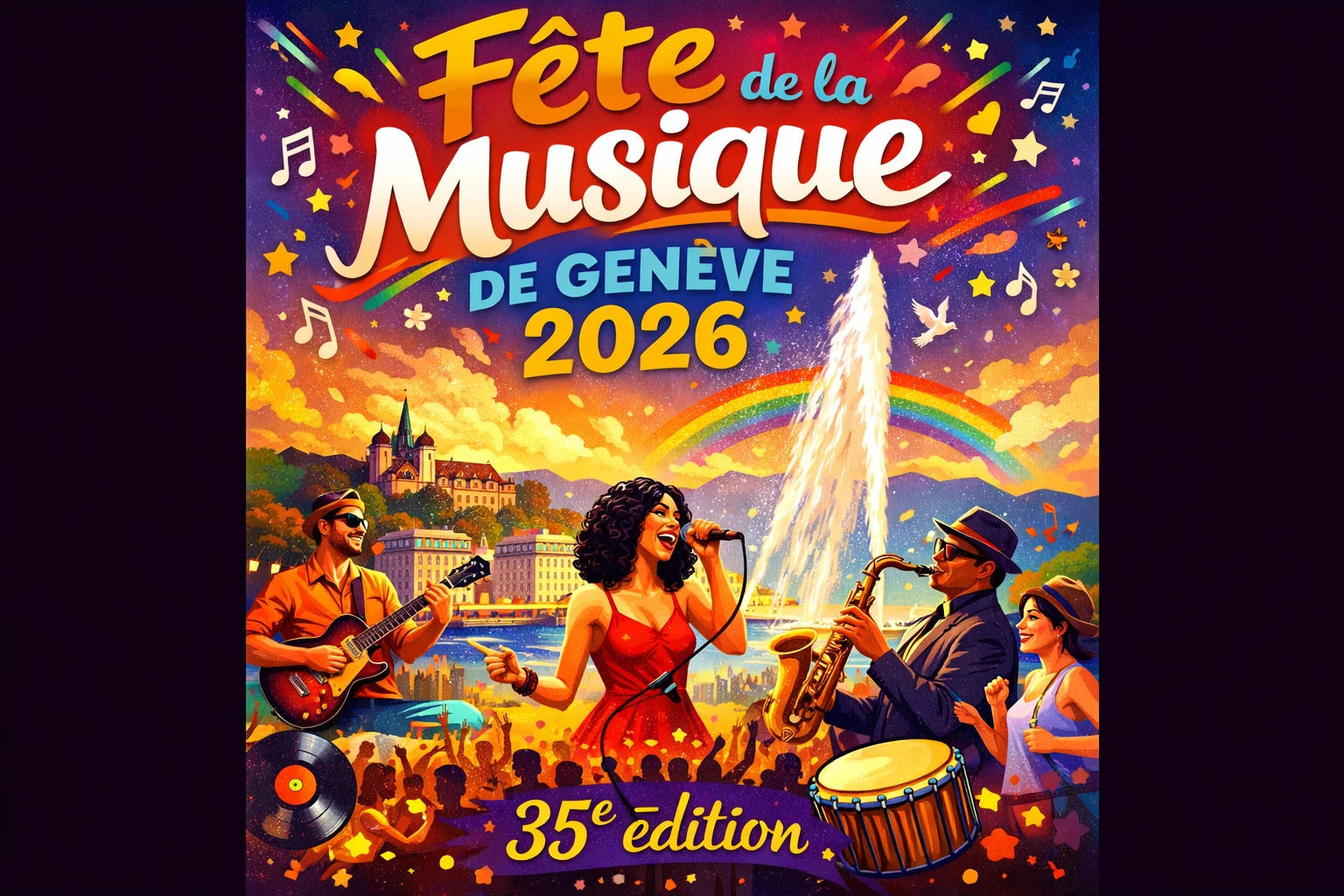
Fête de la Musique de Genève 2026 (35th Edition): Three Days, 600 Free Concerts Across the City
There is a moment in late June in Geneva when the city's normally composed demeanour sets aside completely. Square by square, park by park, from the Place de Neuve to the Parc la Grange on the lake, from the Rive gauche to the Rive droite and out into the surrounding communes of the Grand Genève region, an estimated 600 concerts break out simultaneously across public spaces, courtyards, cafés, streets, and stages. Every performance is free. Everyone is welcome. The Fête de la Musique de Genève 2026 — the 35th edition — runs from Friday June 19 to Sunday June 21, 2026.
The 2025 edition drew close to 200,000 people across its three days. The 35th edition promises the same: hundreds of artists from across Geneva and the wider Grand Genève region performing every musical genre imaginable, at approximately 30 stages and dozens of informal venues across the city, all for free.
The Origins: From French Idea to Geneva Institution
The Fête de la Musique as a concept was born in France in 1982, when French Minister of Culture Jack Lang and music director Maurice Fleuret launched it as a national celebration coinciding with the summer solstice (June 21 — the longest day of the year in the Northern Hemisphere). The idea was elegantly simple: on the day when the sun is at its highest and the evenings are longest, music should be everywhere and it should be free. The French phrase "Fête de la Musique" (Music Festival) contains a pun with "Faites de la Musique" (Make Music) — a deliberate dual meaning that captures the event's philosophy: not just to consume music but to participate in it.
The concept spread rapidly beyond France. Today, the Fête de la Musique is celebrated in more than 120 countries and over 1,000 cities worldwide on or around June 21 — from Berlin to Buenos Aires, from New York to New Delhi — making it one of the most widely observed musical celebrations on the planet.
Geneva adopted the format in 1992 — ten years after the French launch — and the city's edition has grown steadily into what is today the most popular cultural event in Geneva and the largest Fête de la Musique in Switzerland.
The 35th edition in 2026 represents more than three decades of a Geneva tradition that has expanded from a few stages in the city centre into a citywide cultural phenomenon covering the full spectrum of musical life in one of Europe's most musically diverse cities.
The 2026 Programme: 600 Concerts Across Three Days
The Fête de la Musique de Genève has never been a festival with a curated lineup of big names. That is precisely the point. The programming is built from the musical community of the Grand Genève region itself — from pre-inscriptions submitted by local and regional artists between November 2025 and January 2026, supplemented by specific projects commissioned by the programming team and co-productions with Geneva's cultural institutions. The result is a programme that reflects the actual musical diversity of the city and its region, rather than a commercial selection designed around chart position or touring schedules.
The 2026 programme covers:
- Classical music — from solo piano recitals to chamber ensembles to full orchestral performances; Geneva's rich classical tradition reflected across multiple venues including the HEM (Haute école de musique de Genève), historic churches, and public squares
- Jazz and improvised music — acoustic jazz, vocal jazz, free improvisation, and everything between; the city's longstanding jazz culture has deep roots that go back to the 1960s
- Rock, pop, and indie — from unsigned local bands making their public debut to established regional acts; the Place de Neuve and other large stages typically feature the most accessible pop and rock programming
- Hip-hop and spoken word — including the tradition of hip-hop improvisation sessions that have become one of the festival's most popular recurring programmes
- World music — reflecting Geneva's extraordinary cultural diversity as one of the world's most international cities (home to the UN, WHO, Red Cross, and dozens of other international organisations); music from West Africa, Latin America, the Balkans, the Middle East, and Asia regularly features
- Electronic music — from DJ sets in clubs and bars to experimental electronic performances in unconventional spaces; the HEM's Blackbox venue has hosted cutting-edge electronic and spatial sound work in recent editions
- Children's and family music — dedicated programming for families, including participatory workshops and accessible performances at venues like the Maison Rousseau et Littérature
- Dance — dance shows and workshops are programmed alongside the purely musical content, including the popular Grand Bal social dance sessions (contra dance, swing, tango, traditional forms)
The full 2026 programme publishes in the weeks leading up to June 19 via fetedelamusique.ch and the official Geneva cultural events portal (evenements.geneve.ch).
Geneva's Stages: Where the Music Happens
The Fête de la Musique uses Geneva as its venue — which means the stages and performance spaces span an extraordinary range of physical and architectural contexts, from the city's grandest public squares to its most intimate neighbourhood courtyards.
Key venues and spaces across the three days:
Place de Neuve (Rive gauche): The grand square at the foot of the Old Town (Vieille Ville), flanked by the Grand Théâtre de Genève (the city's opera house), the Conservatoire de Musique, and the famous Monument Brunswick — one of Geneva's most architecturally imposing public spaces. Place de Neuve hosts some of the festival's largest outdoor stages and highest-energy programming. The hip-hop improvisation sessions that have become a festival highlight typically take place here in the afternoons.
Promenade Saint-Antoine (Rive gauche): The elevated promenade running alongside the Old Town walls above the lower city, overlooking the Plainpalais and Rive districts. A popular outdoor stage location that fills with afternoon crowds during the festival.
Parc la Grange (Rive droite): The magnificent formal park on the Right Bank lakefront — Geneva's largest public park, housing a Renaissance villa and formal rose gardens, with views across Lake Geneva to the Alps. The Ella Fitzgerald stage at Parc la Grange is one of the festival's summer programming anchors, extending beyond the three Fête days into an outdoor concert series through August. On the festival weekend, the park becomes one of the most atmospherically beautiful music spaces in the city.
HEM — Haute école de musique de Genève: Geneva's prestigious music conservatory opens its spaces for the festival, including its Blackbox — the experimental performance space that hosts avant-garde, electronic, and immersive sonic experiences that represent the festival's most adventurous programming stream.
Maison Rousseau et Littérature: The cultural centre dedicated to Geneva-born philosopher Jean-Jacques Rousseau (1712–1778), whose radical ideas about equality, education, and the social contract shaped the French Revolution and the modern world; the house hosts family workshops, children's concerts, and literary-musical events during the festival.
Neighbourhood squares and communes: Beyond the central venues, the festival extends to the neighbourhoods of Plainpalais, Jonction, Carouge, Pâquis, Saint-Gervais, and the surrounding communes of the Grand Genève region — transforming the local squares, café terraces, community spaces, and streets of each area into informal concert stages.
The Village des Associations: A food and drink village spread across the festival perimeter, run by Geneva's cultural and social associations — providing the practical infrastructure of refreshments, community presence, and the social gathering energy that turns a series of concerts into a genuine public festival.
The City That Hosts the Music
Geneva is not an obvious city for a mass popular musical celebration. It is a city of international diplomacy, financial precision, and ordered prosperity — home to 190 international organisations including the United Nations European headquarters, the World Health Organization, the International Red Cross, and CERN (the European Organization for Nuclear Research, where the World Wide Web was invented in 1989). Its streets on most days carry the purposeful energy of a city that takes its responsibilities seriously.
For three days in late June, none of that disappears — but something else joins it. The city's extraordinary cultural diversity (Geneva's population is roughly 40% non-Swiss, drawn from virtually every nation on earth) becomes audible in the music that fills its public spaces: the Fête de la Musique is in this sense the most accurate sonic portrait of what Geneva actually is as a human community — a place where 200 nationalities coexist, and where each nationality brings its musical traditions.
Key Geneva landmarks in the festival's geography:
- Jet d'Eau — the 140-metre lake fountain visible from much of the Rive droite performance area; a permanent backdrop to the lakefront stages
- Old Town (Vieille Ville) — the medieval heart of Geneva on the hill above Place de Neuve; the Cathédrale Saint-Pierre (where John Calvin preached during the Reformation), the Musée d'Art et d'Histoire, and the Rath Museum are all within walking distance of the main festival stages
- Pont du Mont-Blanc — the main bridge connecting Rive droite and Rive gauche, crossed by festival-goers moving between the Right and Left Bank stages throughout the weekend
- Plainpalais — the large open esplanade on the Left Bank used for festivals, markets, and public events; traditionally a key festival node
Practical Guide: Everything You Need for June 19–21
Dates: Friday June 19, Saturday June 20, Sunday June 21, 2026
Edition: 35th (founded 1992)
Admission: Completely free — every concert, every stage, every performance across all three days
Scale: ~600 concerts and performances across approximately 30 stages and dozens of informal venues
Programme: Published online at fetedelamusique.ch and evenements.geneve.ch in the weeks before the event; the printed festival guide is available at information points in Geneva from the week before
Performance hours:
- Friday June 19: Afternoon into evening (approximately 2:00 PM through midnight)
- Saturday June 20 and Sunday June 21: From approximately 11:00 AM through 20:00h for most outdoor stages; club and indoor venues continue later
Getting to Geneva:
- By air: Geneva Airport (GVA) is a major international hub with direct flights from across Europe and beyond; 20 minutes by train to Geneva Cornavin (main station)
- By train: Geneva Cornavin has direct connections from Zurich (~2.5 hours), Basel (~3 hours), Lausanne (~45 minutes), Lyon (~2 hours), Paris (~3.5 hours by TGV)
- Public transport within Geneva: TPG trams, buses, and the free Mouette lake ferry; all public transport in Geneva is free with a hotel key card (Carte Voirie) — visitors staying in Geneva hotels ride free
Weather: Late June in Geneva averages 22–27°C; June 21 (the summer solstice) is typically one of the warmest and longest days of the year; afternoon thunderstorms are possible; bring a light layer for the evening if the festival runs late into the night.
Accommodation tip: Geneva accommodation can be expensive; book at least 2–3 months ahead for the Fête de la Musique weekend (June 19–21 falls in the same month as the Paléo Festival at Nyon on July 21–26, making late June a slightly quieter period for Geneva hotels than July, but still popular).
Every Genre, Every Square, Every Ear
The Fête de la Musique de Genève 2026 is the event that demonstrates something important about this city: that behind the bank vaults and the UN conference rooms and the watch boutiques, Geneva is a place where music is taken seriously at every level, from the student ensemble at the conservatory courtyard to the jazz quartet at the café terrace to the hip-hop circle in the Place de Neuve.
June 19, 20, and 21, 2026. 600 concerts. Free. Thirty stages and hundreds of spaces across Geneva and the Grand Genève region. The summer solstice weekend. The longest days of the year, filled from afternoon to midnight with every kind of music made by the musicians who actually live here. The 35th time Geneva has done this — and it keeps getting better.
Verified Information at a Glance
| Detail | Information |
|---|---|
| Event | Fête de la Musique de Genève 2026 — 35th Edition |
| Category | Free Open-Air Multi-Genre Music Festival / Citywide Cultural Event |
| Dates | Friday June 19, Saturday June 20, Sunday June 21, 2026 (3 days) |
| City | Geneva (Genève), Canton of Geneva, Switzerland |
| Admission | FREE (all events, all stages, all three days) |
| Scale | ~600 concerts; approximately 30 stages + dozens of informal spaces across Grand Genève |
| 2025 attendance (for reference) | ~200,000 people |
| Founded | 1992 (1st edition); 2026 = 35th edition |
| Organiser | Ville de Genève (City of Geneva), Department of Culture |
| Artist eligibility | Artists based in / active in Grand Genève region |
| Confirmed venues | Place de Neuve; Promenade Saint-Antoine; Parc la Grange (Ella Fitzgerald stage); HEM (Haute école de musique — Blackbox); Maison Rousseau et Littérature; Plainpalais; neighbourhood squares in Jonction, Pâquis, Carouge, Saint-Gervais; surrounding Grand Genève communes |
| Programme content | Classical, jazz, rock, pop, hip-hop, world music, electronic, folk, dance shows, Grand Bal, children's workshops, family events, Village des Associations (food and drink) |
| Programme published | fetedelamusique.ch and evenements.geneve.ch (weeks before June 19) |
| June 21 significance | Summer solstice — the longest day of the year; international Make Music Day observed globally in 120+ countries |
| Nearest airport | Geneva Airport (GVA) — 20 min by train to city centre |
| Official website | fetedelamusique.ch |
Event Has Passed - See You Next Time!
Event Details
Date
to
Location
30+ stages citywide: Place de Neuve, Parc des Bastions, Vieille-Ville, Parc La Grange, Rue des Rois, and more — across Geneva and surrounding communes
Geneva, Switzerland
Price
Free Entry