
Event Has Passed - See You Next Time!
Event Details
Date
Location
Lädeliplatz, Lucerne City Centre, Lucerne
Lucerne, Switzerland
Price
Free Entry
About This Event
Lädeliplatzfestival 2026: Lucerne's Beloved Neighbourhood Festival Returns on May 30
Some of the best festivals in Europe are not the biggest. They are the ones where the square is just right, the sound reaches every corner without effort, the people around you are genuinely there for the music, and the city itself feels like part of the event rather than a backdrop to it. The Lädeliplatzfestival 2026 in Lucerne is precisely that kind of festival.
On Saturday, May 30, 2026, the Lädeliplatz — the lively urban square tucked between the Gewerbehalle and Bar Berlin in one of Lucerne's most characterful neighbourhoods — becomes the stage for one of the most anticipated summer events in the city's independent cultural calendar. This is a festival that belongs to the community it serves: compact, warm, and carrying exactly the kind of energy that makes outdoor music in a beautiful Swiss city something genuinely special.
What Is the Lädeliplatzfestival? Lucerne's Urban Festival Spirit
The Lädeliplatz is the defining feature of this festival — and understanding the square is understanding what the festival is. Located in the Tribschen district of Lucerne, between the Baselstrasse and the creative cluster of the Gewerbehalle arts and creative centre, the Lädeliplatz is one of those urban spaces that has developed a particular character: part community gathering point, part creative hub, home to the kind of independent bars, workshops, and cultural venues that define a neighbourhood's identity rather than simply serving its residents.
The festival was conceived as a "mini-festival" for this specific location — a deliberate choice to bring music and community culture to an urban square that already had the character and the human infrastructure to support it, rather than building a temporary festival village somewhere outside the city. The result is a festival whose atmosphere is inseparable from its location: the Lädeliplatz is not just the venue, it is the reason the festival exists.
The founding vision, connected to Watermusic — one of Lucerne's most respected independent music organisations — was to create an event that combined live music, a flea market spirit (the festival began with a skate and surf flea market element), and the kind of open, community-oriented energy that urban outdoor festivals at their best can produce.
May 30 in Lucerne: The Festival in Context
The Lädeliplatzfestival 2026 falls on the Saturday of the last weekend of May — placing it in what is consistently one of the finest weekends of the Swiss year. Late May in Lucerne is the city at peak spring: the Lake Lucerne (Vierwaldstättersee) is alive and gleaming, the Mount Pilatus and Mount Rigi panoramas that frame the city are sharp and green, the weather invites outdoor life in a way that January and February most definitely do not.
It also places the festival in a genuinely exciting position in the Lucerne cultural calendar. May 30 follows directly after the Kinderland Kids Open-Air (May 24) and falls just before the major summer festivals: the Lucerne City Festival (Stadtfest, June 26–27), the B-Sides Festival (June 18–20) — one of Switzerland's finest alternative and independent music festivals — and the summer giants of Luzern Live (July 17–26) and Lucerne Festival Summer (August 13 – September 13).
In the context of that broader Lucerne cultural summer, the Lädeliplatzfestival functions as one of the first genuine outdoor music celebrations of the season — a festival that announces the arrival of summer in the city before the bigger events take over.
The Lädeliplatz: A Square Worth Knowing
To attend the Lädeliplatzfestival is to spend a day in one of Lucerne's most interesting and least touristically obvious neighbourhoods — and that is part of the value.
The Tribschen area, running south of Lucerne's historic centre along the western shore of the lake and extending into the Baselstrasse corridor, is the part of the city that residents know and tourists typically miss. It is the neighbourhood of Richard Wagner — the composer lived at the Villa Tribschen (now the Richard Wagner Museum) from 1866 to 1872, composing some of his most significant works there, including the Siegfried Idyll — and it is the neighbourhood where Lucerne's creative and independent cultural community has concentrated over the past decade.
The Gewerbehalle — the creative and arts centre that forms one side of the Lädeliplatz — is an important part of this cultural concentration. Originally an industrial workshop building, it has been converted into studios, ateliers, and event spaces that serve Lucerne's independent arts and creative community in the same way that similar post-industrial cultural conversions have transformed districts across European cities. The presence of the Gewerbehalle next to the Bar Berlin across the square gives the Lädeliplatz its particular mixture of working creative life and social energy.
Lucerne: A City That Earns More Than a Day
The Lädeliplatzfestival is a Saturday event — but Lucerne in late May is emphatically a city that rewards more than a single-day visit. With some of the most spectacular urban scenery in Europe (the combination of an intact medieval old town, a mirror-flat Alpine lake, and two of Switzerland's most iconic mountains visible from street level), Lucerne offers days of exploration that the festival weekend makes genuinely easy to plan around.
The Essential Lucerne Experience
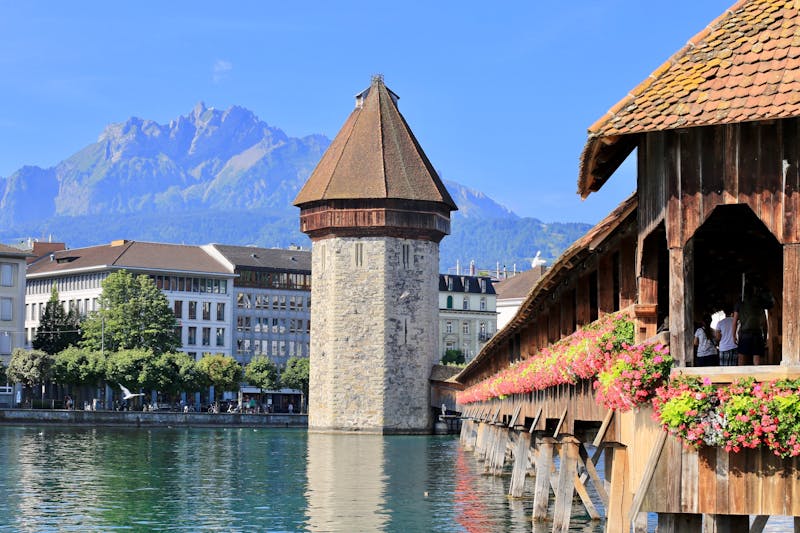
- The Altstadt (Old Town): Lucerne's medieval city centre is one of the best-preserved in Switzerland — a dense cluster of painted facades, covered bridges, and market squares that have changed remarkably little in their essential character over five centuries. The Kapellbrücke (Chapel Bridge), built in 1333 and one of Europe's oldest surviving wooden bridges, is the city's most iconic structure — stretching across the Reuss River with its distinctive water tower and triangular paintings under the roof timbers. The Museggmauer (Musegg Wall), the medieval fortification wall with nine towers still standing above the old town, gives the city its distinctive skyline and can be walked along its top for extraordinary views.
- Lake Lucerne and the Waterfront: The Vierwaldstättersee (Lake of the Four Forest Cantons) is one of the most beautiful lakes in Switzerland — irregular in shape, surrounded by mountains on all sides, and extending more than 40 kilometres into the heart of central Switzerland. From Lucerne's waterfront promenade, the reflections of Mount Pilatus to the south and the Rigi plateau to the east on the lake surface are among the most photographed views in the country. A lake cruise — the steamships of the Schifffahrtsgesellschaft des Vierwaldstättersees (SGV) have been operating on the lake since 1837 — is one of the best possible ways to spend a May afternoon before the festival evening.
- Mount Pilatus: The mountain that rises to 2,132 metres directly south of Lucerne and dominates the city's southern skyline is accessible by a combination of the world's steepest cogwheel railway (the Pilatus Bahn, ascending from Alpnachstad since 1889) and aerial cable cars. In late May, the upper stations are fully accessible and the views from the summit across the Alps, Lake Lucerne, and the Swiss Plateau are genuinely extraordinary. A half-day to Pilatus and back, combined with an afternoon in the old town before heading to the Lädeliplatz for the festival, makes for a genuinely memorable day.
- The KKL and Cultural Venues: The KKL Luzern (Kultur- und Kongresszentrum Luzern) — the extraordinary concert hall designed by Jean Nouvel and opened in 1998, its roof projecting over the lake in one of the most architecturally distinguished public buildings in Switzerland — is Lucerne's cultural centrepiece and the home of the Lucerne Festival Orchestra, the Lucerne Symphony Orchestra, and dozens of the finest chamber and orchestral concerts in the Swiss calendar. Walking past the KKL from the main train station to the old town is to encounter one of the finest examples of late 20th-century cultural architecture in Europe.
- The Richard Wagner Museum: At Villa Tribschen on the lake shore south of the centre — a short walk from the Lädeliplatz neighbourhood — the Richard Wagner Museum occupies the house where Wagner composed the Siegfried Idyll and entertained Nietzsche and Liszt. It is one of the most atmospheric composer museums in Europe and gives the Tribschen neighbourhood its specific cultural gravity.
Getting to Lucerne and to the Lädeliplatz
Arriving in Lucerne:
- From Zurich by train: approximately 50 minutes on a direct InterCity service; trains run very frequently throughout the day
- From Basel by train: approximately 70 minutes on direct services
- From Bern by train: approximately 90 minutes on direct services
- From Geneva by train: approximately 3 hours with a change at Bern
- By car: Lucerne is on the A2 motorway at the crossroads of north-south and east-west Swiss traffic; parking in the city centre is limited — arriving by train is strongly recommended
Getting to the Lädeliplatz:
- The Lädeliplatz is located in the Tribschen/Baselstrasse area, south of the old town
- By foot from Lucerne Hauptbahnhof (main station): approximately 20–25 minutes along the lake shore and through the Tribschen neighbourhood — one of the nicest walks in the city
- By bus: Multiple bus lines serve the Baselstrasse corridor from the main station and the old town; the journey takes approximately 5–7 minutes
- By bicycle: Lucerne has excellent cycling infrastructure; the Tribschen waterfront is directly connected to the city cycle network
A Day That Starts at Pilatus and Ends at the Lädeliplatz
The Lädeliplatzfestival 2026 is not a vast, multi-stage event requiring multiple days of planning and logistics. It is something more valuable: an intimate, community-spirited outdoor festival in one of the most beautiful small cities in Europe, on one of the finest Saturdays of the Swiss year.
Whether you are arriving from Zurich for a day trip, spending a weekend in Lucerne, or making the festival part of a longer Swiss itinerary — Saturday, May 30, 2026 at the Lädeliplatz is a day worth committing to. The lake is at its most beautiful in late May. The square is at its most alive when the music is there. And Lucerne, as anyone who has spent a proper day in it will confirm, is a city that earns every hour you give it.
For the full programme, lineup, and ticket information as it is released, check Bandsintown and the Lädeliplatzfestival's own channels.
Verified Information at a Glance
Verified Information at a Glance
| Detail | Information |
|---|---|
| Event | Lädeliplatzfestival 2026 |
| Category | Outdoor Urban Music Festival / Community Festival / Independent Music Event |
| Date | Saturday, May 30, 2026 |
| Venue | Lädeliplatz |
| Address | Lädeliplatz, Lucerne, Switzerland (between Gewerbehalle and Bar Berlin, Tribschen/Baselstrasse district) |
| City | Lucerne (Luzern), Switzerland |
| Lineup | To be announced — check Bandsintown and official festival channels |
| Ticket Information | To be announced — check bandsintown.com/f/209195 |
| Festival Character | Compact urban outdoor festival; community-oriented; independent music; founded with Watermusic Lucerne |
| Neighbourhood | Tribschen / Baselstrasse creative district |
| Nearest Train Station | Lucerne Hauptbahnhof — approx. 20–25 min walk / 5 min by bus to festival site |
| Lucerne context | Part of a major spring/summer cultural calendar including B-Sides Festival (June 18–20), Lucerne City Festival (June 26–27), Luzern Live (July 17–26), and Lucerne Festival Summer (August 13 – September 13, 2026) |
| Bandsintown listing | bandsintown.com/f/209195 |
Event Has Passed - See You Next Time!
Event Details
Date
Location
Lädeliplatz, Lucerne City Centre, Lucerne
Lucerne, Switzerland
Price
Free Entry