
Event Has Passed - See You Next Time!
Event Details
Date
to
Location
Citywide Porto — Ribeira, Cordoaria, Jardins do Palácio de Cristal, Alfândega, Baixa, Miragaia; fireworks over Douro between Luís I & Arrábida Bridges
Porto, Portugal
Price
Free Entry
About This Event
Festa de São João do Porto 2026: The Night the Whole City Erupts
There is a night in Porto every June when the usual rules of city life simply suspend themselves. Streets that are normally just streets become stages. A million people pour out of their homes, their restaurants, their hotels, and their neighbourhoods, and the entire city — from the Ribeira waterfront to the hilltop lanes of Bonfim, from Cedofeita to Foz do Douro — becomes one continuous, joyful, slightly chaotic, completely irresistible party. That night is São João, and in 2026 it falls on Tuesday June 23, rolling through the midnight fireworks and on toward dawn on Wednesday June 24 — Porto's municipal holiday.
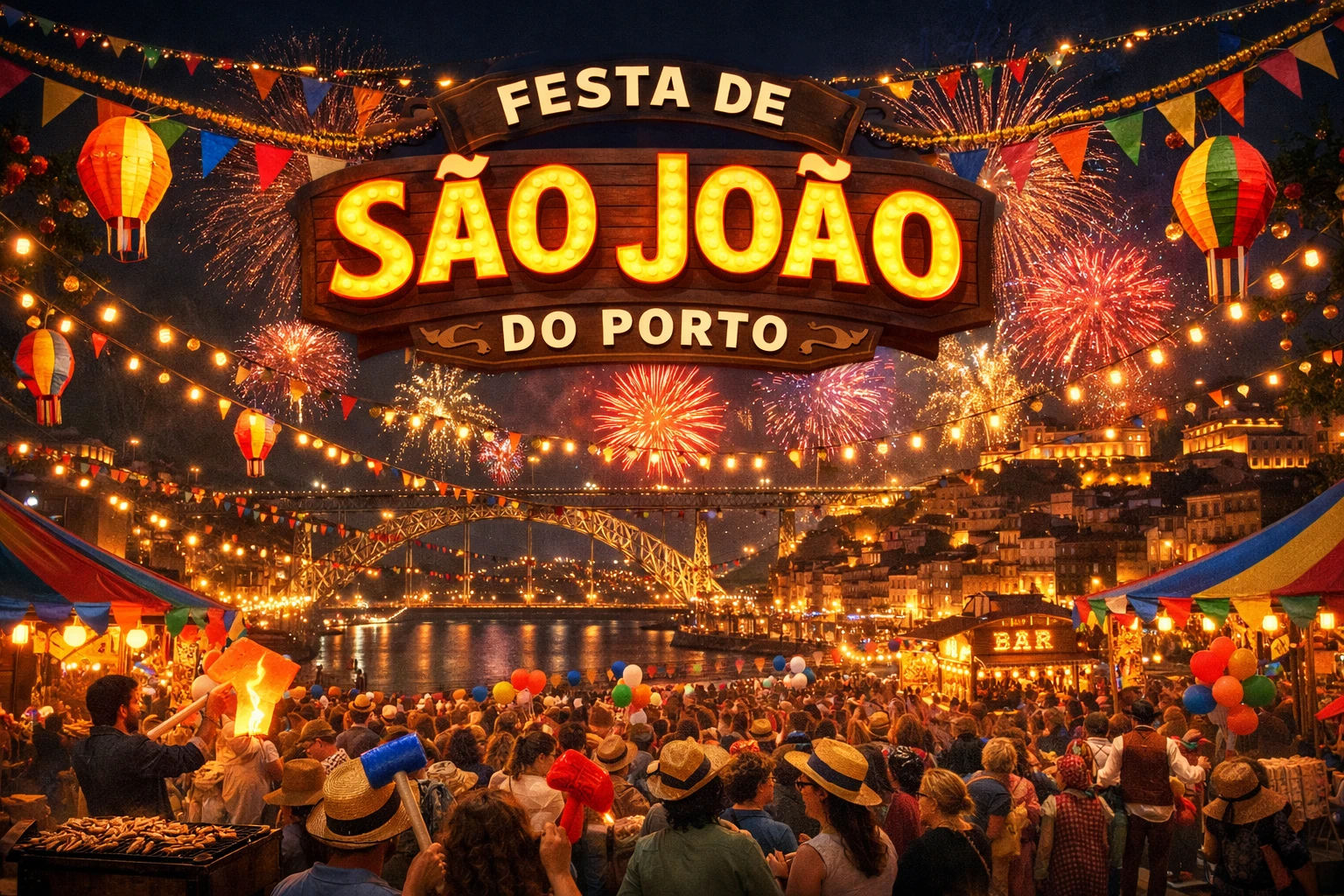
The Festa de São João do Porto is Porto's patron saint festival, honouring Saint John the Baptist — and it is also one of the largest, most authentic, and most genuinely alive urban street celebrations in Europe. Attendance on the main night regularly surpasses one million people in the streets of Porto and Vila Nova de Gaia. Every main event is completely free. The sardines are grilling on every corner from late afternoon. The soft plastic hammers — the famous martelinhos — are being sold by every street vendor. And by midnight, when the fireworks explode over the Douro River and the Ponte Dom Luís I, the noise and the light and the shared joy of a million people looking up from the riverbanks are simply something you cannot get from any description.
Entrada gratuita. Free admission. June 23–24, 2026. Porto, Portugal.
The History of São João: Eight Centuries of Midsummer in Porto
The Festa de São João in Porto is old in the way that the best traditions are old: not preserved in amber but alive and continuously reinvented by each new generation while keeping the core of the thing intact. The feast day of Saint John the Baptist falls on June 24 in the Catholic liturgical calendar — the date traditionally associated with the midsummer solstice period, and with the ancient northern European fire festivals that marked the peak of summer before the calendar reforms of the 16th century shifted the astronomical solstice slightly earlier.
Porto's celebration absorbed and transformed those older pagan traditions over centuries. The bonfire jumping — leaping over small fires for purification and good luck — echoes the pre-Christian summer fire rituals that spread across Europe from Scandinavia to Iberia. The sky lanterns and coloured hot-air balloons that rise above the Douro each June 23 connect to the same tradition of sending light upward into the summer sky. And the garlic flowers (alhos) that are waved and given as gifts in some of the more traditional celebrations connect the night to even older fertility and courtship traditions from rural northern Portugal.
The martelinhos — the soft plastic hammers — are a relatively modern addition to this ancient festive vocabulary, introduced in the 20th century as a more manageable replacement for the real garlic flowers and leek stems that were traditionally used to tap people on the head (originally a courtship ritual; today a shared, democratic, hilarious expression of communal joy in which no one, regardless of age or status, is exempt). Walk through the Ribeira on the night of June 23 and you will be hit on the head by a plastic hammer wielded by a grandmother, a toddler, a group of Norwegian tourists, and a local police officer, more or less simultaneously.
Porto's relationship with São João is deeply personal in a way that distinguishes it from how other Portuguese cities celebrate the June saints. While Lisbon celebrates Santo António (June 13) and Braga has its own Festa de São João, Porto's June 23 celebration has a specific intensity that comes from the city's own cultural character: northern, proud, communal, slightly resistant to outside fashions, and capable of a degree of collective joy that surprises even people who thought they had seen large-scale celebrations before.
The Main Night: June 23 into June 24, 2026
The peak of the Festa de São João 2026 is the night of Tuesday June 23, beginning in the late afternoon and continuing through the midnight fireworks and on toward dawn. The entire city is the venue. No single arena, no barrier, no ticket.
How the night unfolds:
- Late afternoon (from ~18:00): The sardine grills go up across the Ribeira, Bonfim, Massarelos, and every other neighbourhood; the smell of charcoal and grilled fish fills the city hours before dark; caldo verde (the traditional green soup of kale and potato) appears at street stalls alongside the sardines; street vendors selling martelinhos, manjericos (basil pots in decorated terracotta), and paper flowers set up on every major corner
- Evening (~20:00–23:00): The Ribeira waterfront begins to fill; the Dom Luís I Bridge — the iron arch bridge connecting Porto and Gaia — becomes a river of people; the lanes of Bonfim, Cedofeita, and Foz do Douro fill with festarolas (neighbourhood street parties) in every square and courtyard; the rusgas — traditional street bands in colourful costumes representing their bairro (neighbourhood) — begin their parades through the streets with accordions, brass instruments, and drummers; small bonfires crackle in squares, with brave revellers leaping over them for luck
- Around midnight: Everything stops. The martelinhos pause. The bonfires dim. The rabelo boats on the Douro pull back from the riverbanks. And the fireworks begin — a spectacular display over the Douro River and the Ponte Dom Luís I, viewed by hundreds of thousands of people from the Ribeira, the Gaia waterfront, the Fontainhas terrace, and every other vantage point along the river; the fireworks are biodegradable and eco-conscious in their design
- After midnight: The major concert on Avenida dos Aliados — Porto's grand central boulevard — begins around 1am, with live music continuing until dawn; the Ribeira parties continue; the festarolas in the residential neighbourhoods carry on until people finally drift home
- Dawn on June 24: A traditional ritual brings revellers from the Ribeira along the river to the Foz do Douro beach for a dawn swim and sunrise — the natural close of the longest night of the Porto year
The Five Traditions You Cannot Miss
These are the essential, defining experiences of São João do Porto — the things that make this night completely unlike any other:
The Martelinho (Plastic Hammer)
Buy one immediately. You will be hit; you will hit others. It sounds strange in description and feels completely natural in the street. The martelinho is sold everywhere for approximately €1–2 and is the universal São João greeting. There is no age requirement, no social barrier, and no offence taken. It is simply what people do.
The Sardinha Assada (Grilled Sardine)
The grilled sardine is the essential food of São João in both Porto and Lisbon — the same tradition running through June across Portugal. In Porto, the sardines are served on bread at street stalls and outdoor tables throughout the Ribeira, Bonfim, and every other neighbourhood. June is the peak of the sardine season and the fish are at their fattest and most flavoursome. A plate of two sardines with bread typically costs €3–5 at street stalls.
The Fireworks at Midnight
The midnight fireworks over the Douro and the Ponte Dom Luís I are the emotional centre of the entire night — the moment when the noise and movement of a million people pauses and looks up together. The best viewing positions are the Ribeira quay and the Cais de Gaia on the opposite bank; the Miradouro da Serra do Pilar in Gaia (on the upper level of the Dom Luís I Bridge) offers an elevated panorama. For the most dramatic perspective, book a rabelo boat cruise in advance — the river between the bridges during the fireworks, looking back at the city, is one of the most extraordinary viewpoints in Porto.
The Rusgas (Neighbourhood Parades)
The rusgas are the living heart of the neighbourhoods' connection to São João — groups of local residents dressed in traditional or themed costumes, marching through their bairro's streets with music, colour, and noise. Each rusga is organised by and for its neighbourhood, and watching them parade is as close as you can get to seeing what São João looks like from the inside rather than from the outside. The Bonfim and Campanhã rusgas are traditionally the most celebrated.
Jumping the Bonfires
Small bonfires are lit in squares and open spaces across the city on the night of June 23. Jumping over a bonfire — saltar a fogueira — is an ancient tradition that predates the Catholic feast day: it is said to bring purification and good luck, and on this night, in Porto, it needs no further justification than the fact that everyone is doing it and the fire is small and manageable and the night is warm.
The Rabelo Boat Regatta — June 24
The celebrations continue into the afternoon of Wednesday June 24, 2026 (the municipal holiday) with one of the most visually beautiful traditions in Porto's calendar: the Regata de Barcos Rabelos — the race of traditional rabelo boats on the Douro River.
Rabelo boats are the flat-bottomed wooden vessels that were historically used to transport barrels of port wine down the Douro from the Douro Valley quintas to the wine lodges of Vila Nova de Gaia — the flat, wide hull and large square sail of the rabelo were specifically designed for the treacherous conditions of the upper Douro, before the river's rapids were tamed by dams in the 20th century. Today, the lodges maintain working rabelo boats primarily for ceremonial purposes and the São João regatta.
The 2026 Regatta takes place on the afternoon of June 24, starting at approximately 16:00, running from Cabedelo to the Ponte Dom Luís I. It can be watched from either bank of the Douro — the Ribeira quay and the Cais de Gaia both provide excellent views — or from the higher vantage point of Fontainhas. The sight of a dozen ornate, flag-decked rabelo boats racing down the Douro under the iron arch of the Dom Luís I Bridge, with the hillside city of Porto and the lodge district of Gaia on either bank, is one of the finest free spectacles Porto offers at any time of year.
Porto in June: The City Around the Festival
São João does not happen in a neutral city — it happens in Porto in June, which is one of the finest versions of Porto available. The weather in late June is warm and settled (typically 24–30°C), the days are long (sunset around 21:30), and the city's combination of medieval and Baroque architecture, the Douro river life, and the Atlantic proximity creates a sensory richness that the festival both draws on and amplifies.
Key Porto landmarks and experiences for São João visitors:
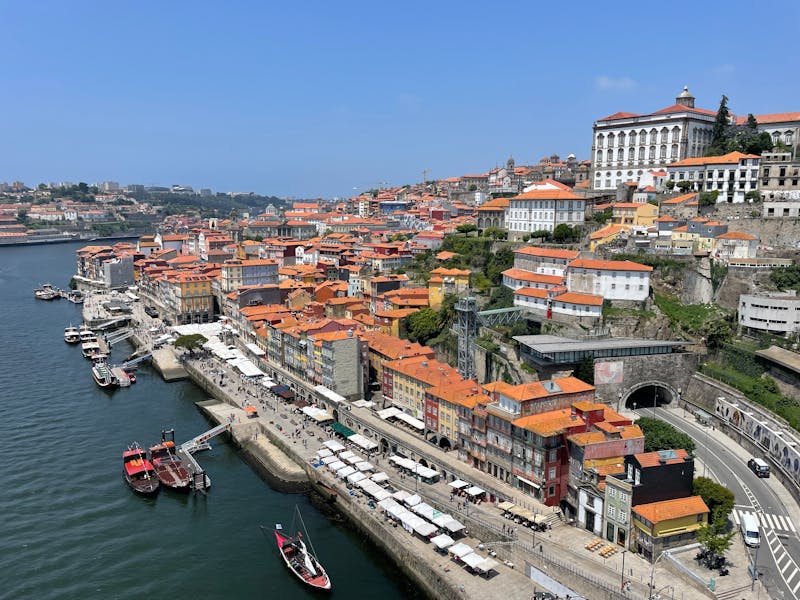
- Ribeira district: The UNESCO World Heritage waterfront; the epicentre of São João night; the medieval houses along the Douro quay are draped with decorations from early June; the Praça da Ribeira is the natural gathering point as the night builds
- Ponte Dom Luís I: The iron arch bridge designed by Théophile Seyrig (a collaborator of Gustave Eiffel), opened in 1886; the upper deck is a pedestrian walkway and one of the finest urban panoramas in Portugal; crossing it at midnight, with the fireworks above and the river below, is an experience specific to Porto's São João
- Avenida dos Aliados: Porto's grand central boulevard, with the Câmara Municipal (City Hall) at its northern end; the site of the major official concert in the early hours of June 24; the neoclassical buildings lining the avenue are illuminated during the festival
- Bonfim neighbourhood: The residential hillside district east of the old town; one of the most authentic São João neighbourhoods, with strong rusga traditions and festarolas that feel genuinely local rather than tourist-oriented
- Vila Nova de Gaia: The municipality on the south bank of the Douro; the Cais de Gaia waterfront and the Serra do Pilar miradouro both provide outstanding fireworks views; the port wine lodges along the Gaia riverside are part of the São João landscape
- Foz do Douro: The beach at the mouth of the Douro; the destination for the traditional dawn walk that closes the São João night
Practical Guide to Festa de São João do Porto 2026
Main night: Tuesday June 23 into Wednesday June 24, 2026 (evening of June 23 through dawn of June 24)
Public holiday: Wednesday June 24, 2026 (Dia de São João — Porto municipal holiday)
Full season: June 1–30, 2026 (build-up events throughout June)
Attendance: Over 1 million people on the main night
Admission: Free — all main street events, concerts, fireworks, rusgas, bonfires, and the Ribeira celebrations
Fireworks: Midnight, June 23/24, over the Douro River and Ponte Dom Luís I; biodegradable
Major concert stage: Avenida dos Aliados, around 1:00am, June 24
Rabelo Boat Regatta: Wednesday June 24, ~16:00, Douro River (Cabedelo to Ponte Dom Luís I)
Key locations: Ribeira district, Douro riverfront, Ponte Dom Luís I, Avenida dos Aliados, Bonfim, Cedofeita, Foz do Douro, Vila Nova de Gaia waterfront
Practical tips:
- Book accommodation in Porto for June 23–24 well in advance; the city is extremely full; downtown Ribeira and Baixa apartments book out months ahead
- If you want a table at a riverside restaurant on June 23 evening, reserve in advance
- For the midnight fireworks, arrive at the Ribeira or Gaia riverfront by 21:00–22:00 to find a good position; it gets extremely dense by 23:00
- Rabelo boat cruises for São João night (with fireworks view from the water) must be booked weeks in advance; check the Porto tourism operators
- Carry cash; street stalls are cash only
- Comfortable walking shoes; Porto's streets are cobblestoned and hillside lanes can be steep
- Martelinho: €1–2 from street vendors; sardines at stalls: approximately €3–5 for two
- Bring a light layer for after midnight; June evenings cool down slightly after midnight even in Porto
Getting around Porto on São João night:
- Walk; the Ribeira, Bonfim, Baixa, and the Dom Luís I Bridge are all within walking distance of each other
- Porto Metro runs late on São João night (check schedules at metrodoporto.pt for 2026 extended hours)
- Taxis and rideshares are extremely difficult to find after midnight on June 23–24; plan to walk or use the metro
Nearest airport: Porto Francisco Sá Carneiro Airport (OPO) — approximately 30 minutes by metro (Line E/violet to Trindade)
Official event reference: visitporto.travel; agoraporto.pt
June 23, 2026: Porto's Greatest Night
One million people. Sardines on the grill. Plastic hammers in every hand. The sky full of paper lanterns and balloons drifting south over the Douro. And at midnight, the fireworks beginning above the Dom Luís I Bridge while the whole city looks up together. The Festa de São João do Porto 2026 is not a festival you attend — it is something you become part of, whether you mean to or not.
June 23 into June 24, 2026. Porto. Free. A million people. Every street a party. Midnight fireworks over the Douro. Sardines, martelinhos, rusgas, and bonfires. The Ribeira. The Dom Luís I Bridge. The long walk to Foz at dawn. This is Porto being completely, joyfully, magnificently itself.
Verified Information at a Glance
| Detail | Information |
|---|---|
| Event | Festa de São João do Porto 2026 (Festas de São João / St John's Festival Porto) |
| Category | Traditional Urban Catholic Patron Saint Festival / Summer Street Celebration |
| City | Porto, Portugal |
| Main night | Tuesday June 23, 2026 (evening) into Wednesday June 24, 2026 (dawn) |
| Public holiday | Wednesday June 24, 2026 (Dia de São João — Porto municipal holiday) |
| Full season | June 1–30, 2026 |
| Attendance | Over 1 million people (main night) |
| Admission | Free (all main street events, fireworks, concerts) |
| Fireworks | Midnight June 23/24 over Douro River and Ponte Dom Luís I; biodegradable |
| Major concert | Avenida dos Aliados, ~1:00am June 24 |
| Rabelo Boat Regatta | Wednesday June 24, ~16:00, Douro River |
| Traditions | Martelinhos (plastic hammers, ~€1–2); sardinhas assadas (~€3–5 per plate); bonfire jumping; sky lanterns; rusgas (neighbourhood street bands); festarolas; manjerico basil pots; caldo verde soup; Vinho Verde and port wine |
| Key locations | Ribeira district, Douro riverfront, Ponte Dom Luís I, Avenida dos Aliados, Bonfim, Foz do Douro, Vila Nova de Gaia waterfront, Fontainhas |
| Patron saint | São João Baptista (Saint John the Baptist) — Porto's patron saint |
| Organiser | Câmara Municipal do Porto / Agora Porto |
| Official references | visitporto.travel; agoraporto.pt |
| Nearest airport | Porto Francisco Sá Carneiro Airport (OPO) — ~30 min by metro to city centre |
| June weather | 24–30°C days; 18–22°C evenings; essentially no rainfall in late June; sunset ~21:30 |
Event Has Passed - See You Next Time!
Event Details
Date
to
Location
Citywide Porto — Ribeira, Cordoaria, Jardins do Palácio de Cristal, Alfândega, Baixa, Miragaia; fireworks over Douro between Luís I & Arrábida Bridges
Porto, Portugal
Price
Free Entry