

Event Has Passed - See You Next Time!
Event Details
Date
Location
Europe Square, Batumi Boulevard & City Centre, Batumi
Batumi, Georgia
Price
Free Entry
About This Event
Georgia Independence Day 2026 in Batumi: Your Complete Guide to Damoukideblobis Dge
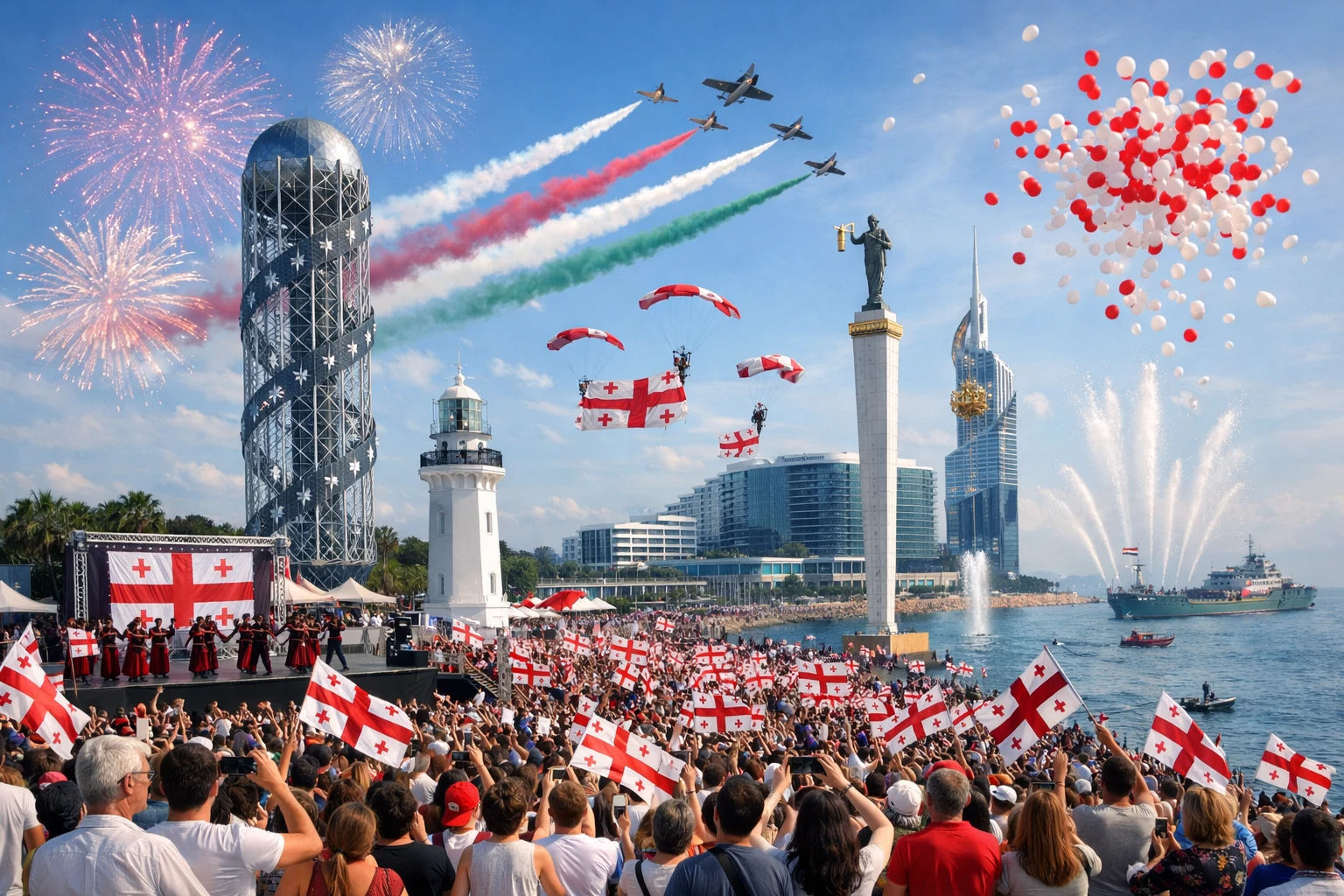
There are national holidays that feel like an obligation, and then there are days when an entire country seems to exhale with genuine joy. Georgia's Independence Day, known in Georgian as დამოუკიდებლობის დღე (Damoukideblobis Dge), falls on Tuesday 26 May 2026, and it is unambiguously the second kind. In Batumi, the jewel of the Black Sea coast and the capital of the autonomous region of Adjara, the day transforms the seafront boulevard and the iconic Alphabet Tower into the setting for one of the most vivid, warm, and emotionally resonant public celebrations anywhere in the South Caucasus.
Military exhibitions, traditional Georgian folk dance performances, craft and wine fairs, children's activities, open-air concerts, and fireworks over the Black Sea all come together in a celebration that manages to be simultaneously patriotic and welcoming, historically serious and genuinely fun. For visitors arriving in Batumi in late May 2026, Independence Day offers something rare: the chance to see a city express its identity in a way that is completely authentic and freely open to anyone who wants to join in.
All events are free to attend.
The History Behind May 26: Why This Date Matters
Georgia's First Declaration of Independence in 1918
To understand why May 26 carries the emotional weight it does for Georgians, you need to go back more than a century, to a moment when a small nation on the southern edge of the Caucasus Mountains chose to announce itself to the world.
In the chaotic aftermath of the Russian Revolution of 1917, the Russian Empire collapsed, and the peoples of the Caucasus found themselves, briefly, in a position to determine their own futures. Georgia, Armenia, and Azerbaijan formed a loose federation known as the Transcaucasian Democratic Federative Republic on 22 April 1918. It lasted barely five weeks. Ottoman pressure, political divisions, and ethnic tensions made unity impossible to sustain.
On 26 May 1918, with the federation dissolving around them, the Georgian National Council convened in Tiflis (now Tbilisi) and made a decisive choice. Noe Zhordania, the leading Georgian Menshevik and future head of government, read out the Act of Independence and proclaimed the Democratic Republic of Georgia. The declaration stated, with remarkable clarity for its era: "The Democratic Republic of Georgia equally guarantees to every citizen within her limits political rights irrespective of nationality, creed, social rank or sex."
For 1918, those were extraordinary words. In a year when most of Europe was still fighting the First World War, Georgia established a multi-party democratic system, granted universal suffrage, initiated land reform, founded Tbilisi State University, and earned recognition from Germany, France, Italy, Austria, Switzerland, and several other European powers.
The republic was short-lived. In February 1921, the Soviet Red Army invaded, and by March Georgia had become a Soviet republic. The government, led by Zhordania, moved to France and continued to work in exile. France, Britain, Belgium, and Poland recognised it as the only legitimate government of Georgia until the 1930s.
During the Soviet decades, 26 May was clandestinely observed by Georgians who refused to forget what it represented. Large-scale public commemoration returned on 26 May 1989, when pro-independence demonstrators gathered in Tbilisi to mark Independence Day for the first time since 1922. Two years later, on 9 April 1991, Georgia officially restored its independence from the Soviet Union, explicitly grounding that restoration in the 1918 Act. The 1991 referendum had asked citizens directly whether they wanted independence restored on the basis of the 26 May 1918 declaration.
Today, May 26 is the national day of Georgia, observed as an official public holiday across the entire country. Georgia's state independence day is observed not only within the country but across the globe at the historical time of the 1918 Declaration of Independence, 17:10, with the playing of the national anthem "Tavisupleba," whose title means simply "liberty."
How Batumi Celebrates: The Full Independence Day Experience
Batumi is Georgia's second city and its most cosmopolitan, a subtropical port on the Black Sea coast that has developed over the past two decades into one of the most dynamic and architecturally striking cities in the South Caucasus. Its Old Town, with its ornate 19th-century facades and narrow lanes, sits in cheerful proximity to a modern boulevard lined with contemporary towers, outdoor sculptures, palm trees, and the sea.
On Independence Day, the heart of the celebrations is the Alphabet Tower and Boulevard area, and all events are free.
Morning: Military Exhibitions and the Craft Fair
The day begins with military exhibitions that have become one of the most popular Independence Day traditions in Batumi and across Georgia. On 26 May, residents and visitors have the opportunity to view military equipment, weapons, and gear at exhibitions held in 21 cities and municipalities simultaneously, including Batumi. For families with children, who genuinely love exploring military hardware at close range, this is one of the most immediately engaging elements of the morning programme.
The Craft and Wine Fair opens at 12:00 along the Boulevard area. Local artisans display traditional Georgian crafts, with wine tasting stations and food stalls operating throughout the afternoon. Georgian craft traditions are extraordinarily rich, encompassing gold and silverwork, intricate textile weaving, ceramic painting, woodcarving, and the distinctive cloisonné enamel technique known as minankari. Tasting Georgian wine at an outdoor fair in May sunshine on the Black Sea coast, with the Alphabet Tower behind you and the sound of the sea in front, is an experience that stays with you.
Afternoon: Children's Activities and Folk Performance
Children's activities including face painting, puppet shows, and games run throughout the afternoon, making the celebration genuinely family-oriented rather than a purely adult civic occasion. This inclusiveness is characteristic of Georgian public festivals more broadly, where multiple generations share the same space and the same pride.
At 18:00, the Enver Khabadze State Academic Ensemble "Batumi" performs on the main stage. This is one of the most respected folk dance and music ensembles in the Adjara region, performing the traditional dances, songs, and instrumental pieces of Georgian folk culture with the technical precision and physical athleticism that Georgian dance is world-famous for. Georgian folk dance is among the most spectacular in the world: the men perform extraordinary leaping, spinning, and combat-inspired sequences, while the women glide across the stage with an almost supernatural stillness and grace. Seeing the Ensemble perform on Independence Day, outdoors beside the Boulevard, is one of the great free cultural experiences the city offers.
An immersive underground performance near the Boulevard, complete with mysterious masks, movement, and music, adds an avant-garde counterpoint to the folk programme, reflecting Batumi's character as a city that holds traditional Georgian culture and contemporary artistic experimentation in genuine balance.
Evening: Fireworks Over the Black Sea
The day closes with fireworks over the Black Sea. Batumi's fireworks displays, visible from the full length of the Boulevard, reflect off the dark surface of the sea in a way that gives them a particular visual scale. National landmarks across the country are illuminated in red and white, the colours of the Georgian flag, and Batumi's own skyline, a striking mixture of contemporary towers and the spiralling form of the Alphabet Tower, is at its most visually dramatic after dark.
The Alphabet Tower: Symbol of Independence Day Batumi
A Monument to Georgian Language and Identity
The choice of the Alphabet Tower as the central gathering point for Independence Day in Batumi is not coincidental. Constructed in 2011, designed by Spanish architect Alberto Domingo Cabo, the Alphabet Tower stands 130 metres tall and is located on Batumi Boulevard near the "Ali and Nino" kinetic sculpture and the Ferris wheel. Its double helix structure features all 33 letters of the Georgian alphabet, each four metres tall, arranged in a form that deliberately echoes the structure of DNA. That biological metaphor is the point: the Georgian alphabet is not simply a writing system but a fundamental strand of Georgian identity, survival, and continuity.
Georgian is one of the world's most distinctive languages, belonging to the Kartvelian language family with no established relationship to any other language group on earth. The Georgian script itself, one of only 14 original scripts in the world, was developed in the 5th century and has remained in continuous use ever since. It survived Persian invasion, Mongol destruction, Russian annexation, and Soviet-era cultural suppression. When Georgians gather around the Alphabet Tower on Independence Day, they are celebrating the same resilience that the 1918 Act of Independence expressed in words.
The tower's panorama bar and rotating restaurant offer views across the Black Sea and the Batumi skyline from a height that gives the city's geography sudden clarity. The observation deck is open to visitors and provides a memorable vantage point both before and after the Independence Day celebrations at street level.
Batumi Boulevard: The Setting That Makes It All Work
The Independence Day celebrations extend along the full length of the Batumi Boulevard, a seven-kilometre seaside promenade that is the social and cultural heart of the city. Lined with more than 40,000 trees planted at different times across its history, the Boulevard includes historic alleys, a cycling path, fountains, sculptures, and constant views of the Black Sea.
The Boulevard's cultural heritage monument status reflects its role not just as a promenade but as a living archive of the city's development across more than a century. Three colourful fountains installed in 1977 still operate near the central entrance. A 150-metre-long labyrinth paved with sea pebbles leads to the "Dream Column" installation. The lighthouse at the northern end of the Boulevard, with the first building dating from 1863, predates the Boulevard itself.
On Independence Day, the full length of the Boulevard becomes a public gathering space. The sea provides a constant, democratic backdrop. There are no grandstands or premium viewing areas for the fireworks. Everyone sees the same sky.
Georgian Culture to Experience in Batumi on Independence Day
Food and Wine: The Tastes of Adjara
Adjara, the autonomous region of which Batumi is the capital, has its own distinctive culinary traditions within the broader context of Georgian cuisine. The most famous Adjaran contribution to Georgian food culture is Adjarian Khachapuri, a boat-shaped bread filled with melted cheese and topped with a raw egg and a knob of butter. It is one of the most photographed and most consistently satisfying dishes in Georgian cooking, and it is available at almost every restaurant and bakery in Batumi.
The Craft and Wine Fair on Independence Day gives visitors direct access to artisan food producers and winemakers from across Georgia. Georgia has an 8,000-year winemaking tradition, the oldest in the world, and its distinctive qvevri method of fermenting wine in large clay vessels buried underground produces amber wines with a character found nowhere else. Tasting Georgian wine for the first time, outdoors in late May sunshine, is an experience worth building a trip around.
Churchkhela, a traditional Georgian sweet made by dipping strings of walnuts in thickened grape juice, hangs in colourful curtains at market stalls across Batumi and is widely available on Independence Day. Khinkali, the distinctive Georgian dumpling filled with spiced meat and broth, and Mtsvadi, skewered and grilled meat eaten in the open air, are equally central to the festive food culture of the day.
Music, Dance, and the Georgian Folk Tradition
Georgian polyphonic singing is inscribed on the UNESCO Representative List of the Intangible Cultural Heritage of Humanity. The three-voice harmonies of Georgian traditional song, one of the oldest continuous musical traditions in Europe, can be heard on Independence Day in Batumi in choral performances, street singing, and the repertoire of the State Academic Ensemble.
Georgian folk dance, equally extraordinary, will be on full display in the Ensemble's evening performance. The tradition encompasses dozens of distinct regional styles, with the Adjaran dances particularly known for their vigour and the dramatic contrast between male athleticism and female grace. Watching Georgian dance live, outdoors, on Independence Day, is one of those experiences where no video footage or description adequately prepares you for what you actually see.
Practical Travel Guide: Visiting Batumi for Independence Day 2026
Getting to Batumi
Batumi is served by Batumi International Airport (BUS), with direct flights operating from Istanbul, Kyiv, Warsaw, Vienna, Riga, Tel Aviv, and several other European cities. From Tbilisi, the train journey to Batumi takes approximately five and a half hours on the overnight sleeper service, or around four hours on the faster daytime express. The train from Tbilisi is one of the most pleasant rail journeys in the South Caucasus, passing through Kutaisi and following river valleys between the Caucasus mountains. Marshrutka minibuses also connect the two cities in approximately five to six hours and are considerably cheaper.
Getting Around Batumi
Batumi is a walkable city. The Old Town, the Boulevard, the Alphabet Tower, and most hotels are within comfortable walking distance of each other. The city also has a reliable network of shared taxis (marshrutky) and regular taxis for journeys further afield. Renting a bicycle from one of the Boulevard's cycle hire points is an excellent way to cover the full length of the seafront on Independence Day, when the Boulevard will be busy with pedestrians and the atmosphere is festive.
Where to Stay
Batumi has accommodation at every price point. The Sheraton, Hilton, and Radisson Blu are located along the Boulevard for those who want maximum comfort and direct sea views. A wide range of mid-range hotels and guesthouses are available in and around the Old Town and the Boulevard area, all within walking distance of the Independence Day celebrations. Booking in advance for late May is advisable, as this is the beginning of Batumi's summer high season and Independence Day weekend draws visitors from across Georgia.
What to Wear and When to Arrive
Late May in Batumi is warm and sunny, with average temperatures between 18 and 24 degrees Celsius. Light summer clothing is appropriate for the day, with a light layer for the evening after sunset. The Boulevard can be very busy on Independence Day, so arriving early for the craft fair and military exhibitions (from noon) gives you the best access to everything before the evening crowds build for the folk performance and fireworks.
Money and Payments
Georgia's currency is the Georgian Lari (GEL). ATMs are widely available in Batumi, and most hotels and restaurants accept cards. At the Craft and Wine Fair, smaller artisan vendors may prefer cash, so having some Lari on hand is practical. All Independence Day events and outdoor celebrations are completely free.
Language
Georgian is the official language of Georgia and of Adjara. Younger Batumians often speak some English, and Russian remains widely understood among older residents. Basic Georgian phrases are warmly appreciated: "Gamarjoba" (hello), "Madloba" (thank you), and "Gaumarjos" (the traditional toast, meaning roughly "to victory" or "cheers") will earn immediate smiles.
Beyond Independence Day: What to See in Batumi
The days around Independence Day give visitors time to explore Batumi's remarkable range of attractions.
The Batumi Old Town is a quarter of ornate 19th-century facades, wrought-iron balconies, and narrow lanes that open unexpectedly onto small squares. The Piazza Square, modelled loosely on an Italian prototype, is lined with cafes and restaurant terraces and is particularly lively in the evening. The Gonio Fortress, a Roman-era fortification approximately 12 kilometres south of Batumi, is one of the oldest in Georgia and is believed to be the burial site of the Apostle Matthias. The Mtsvane Kontskhi (Green Cape) Botanical Garden, created in 1912, covers 111 hectares of subtropical and tropical plant collections on the hillside north of the city.
The Ali and Nino kinetic sculpture on the Boulevard, depicting the two protagonists of the great Caucasian love story, slowly merges and separates throughout the day in a movement that has made it one of the most photographed works of public art in Georgia. The Batumi Technological University tower, the Radisson Blu Hotel tower, and the Sheraton tower form a contemporary skyline that sits in deliberate and productive tension with the historic Old Town just behind it.
A Day That Belongs to Everyone
Georgia's Independence Day on Tuesday 26 May 2026 in Batumi is an invitation that needs no special qualification to accept. It does not matter whether you know Georgian history or are discovering it for the first time. It does not matter whether you have come specifically for the holiday or simply found yourself in Batumi on one of the most significant dates in the Georgian calendar. The celebrations around the Alphabet Tower and the Boulevard are designed to be open, inclusive, and shared.
Batumi on Independence Day is more than a celebration. It is a living story being written in real time, by the artists, the dancers, the veterans, the children, and every visitor who joins in. The city has been building toward this day for over a century, from the 1918 declaration that announced Georgia to the world, through the Soviet decades when the date was observed in defiance rather than ceremony, to the post-independence era in which May 26 has become what it always should have been: a day of genuine pride, warmth, and collective joy.
Be in Batumi on May 26. Walk the Boulevard in the morning sunshine. Taste the wine at the craft fair. Watch the Ensemble perform at the foot of the Alphabet Tower as the evening light turns gold on the Black Sea. Stay for the fireworks. You will be in the right place at exactly the right time.
Verified Information at a Glance
| Detail | Information |
|---|---|
| Holiday Name | Independence Day of Georgia (Damoukideblobis Dge / დამოუკიდებლობის დღე) |
| Event Category | National Public Holiday / Cultural Festival / Civic Celebration |
| Date | Tuesday 26 May 2026 |
| Official Status | National public holiday in Georgia; observed annually since the restoration of independence |
| Historical Origin | Commemorates the Act of Independence adopted on 26 May 1918 by the National Council of Georgia, establishing the Democratic Republic of Georgia |
| Primary Celebration Location in Batumi | Alphabet Tower and Batumi Boulevard area |
| Admission | All events free of charge |
| Confirmed Programme Elements | Military equipment exhibition open to all ages (morning) |
| Craft and Wine Fair from 12 | 00 (noon) – traditional crafts, wine tasting, food stalls |
| 18 | 00 – Grand performance by the Enver Khabadze State Academic Ensemble "Batumi" (folk dance, traditional instruments, vocal ensembles) |
| Ceremonial Significance | At 17:10, the Georgian national anthem "Tavisupleba" (meaning "Liberty") is played simultaneously across Georgia and at Georgian communities worldwide, marking the exact historical time of the 1918 Declaration |
| Military Exhibitions | Held simultaneously in 21 Georgian cities and municipalities including Batumi |
| Key Landmarks | Alphabet Tower (130m, 33 Georgian letters, Boulevard), Batumi Boulevard (7km seaside promenade), Old Town, Europe Square |
| Alphabet Tower | Constructed 2011, designed by Alberto Domingo Cabo; rotating restaurant, panorama bar, observation platform; located on Batumi Boulevard near "Ali and Nino" sculpture and Ferris wheel |
| Getting to Batumi | Batumi International Airport (BUS) with direct international connections; train from Tbilisi approx. 4–5.5 hours |
| Weather on 26 May | Average 18–24°C; warm and sunny; light summer clothing appropriate |
| Currency | Georgian Lari (GEL); ATMs widely available; outdoor market vendors prefer cash |
| Official Tourism Website | visitbatumi.com / georgia.travel |
Event Has Passed - See You Next Time!
Event Details
Date
Location
Europe Square, Batumi Boulevard & City Centre, Batumi
Batumi, Georgia
Price
Free Entry