

Event Has Passed - See You Next Time!
Event Details
Date
Location
Churches & Public Spaces citywide, Batumi
Batumi, Georgia
Price
Free Entry
About This Event
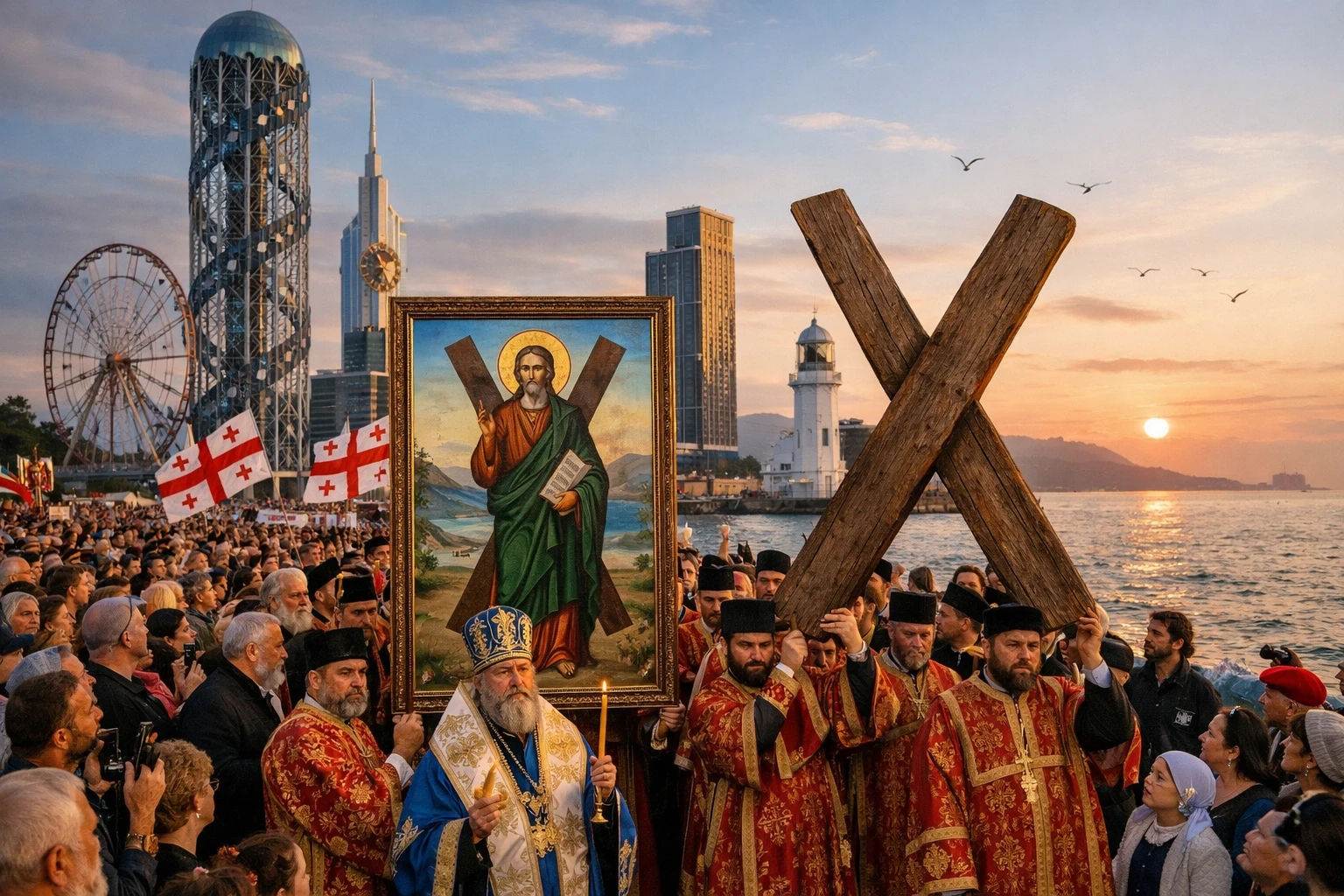
St. Andrew the First-Called Day 2026 in Batumi: A Complete Guide to Andriaoba in Georgia's Black Sea Capital
There is something quietly extraordinary about a country that designates a public holiday not to a battle or a political milestone but to the arrival of an apostle on its shores. On Tuesday 12 May 2026, Georgia observes St. Andrew the First-Called Day, known in Georgian as Andriaoba (ანდრიაობა). It is one of 18 official national public holidays in Georgia, and it carries a particular resonance in Batumi and the surrounding Adjara region, because according to the tradition of the Georgian Orthodox Church, this is the precise land where Andrew first set foot on Georgian soil and began the work that would eventually make Christianity the defining thread of Georgian identity.
For visitors and pilgrims in Batumi on Andriaoba, the day offers something that few public holidays anywhere in the world can match: a chance to stand in the place where the story is said to have begun, to attend solemn liturgies in churches that have served this community across turbulent centuries, and to experience the particular quality of Georgian Orthodox faith, which is not quiet or inward-looking but warmly communal, aesthetically rich, and deeply woven into everyday life.
This guide covers everything you need to know about Andriaoba 2026 in Batumi, from the history of Saint Andrew's connection to Adjara, to the church services, local traditions, and practical travel information that will help you make the most of this remarkable occasion.
Who Was Saint Andrew the First-Called? The Apostle Georgia Claims as Its Own
First Among the Twelve
The title "First-Called" is not ceremonial. It marks a specific moment in the Gospel of John: Andrew was the first of the twelve Apostles to be called by Jesus, summoned from his work as a fisherman on the Sea of Galilee before even his brother Simon Peter received the call. The Greek word that gives him his title in Eastern Christian tradition is Protokletos, meaning simply "the first one called." It is a distinction that places him at the very beginning of the apostolic tradition, and one that Georgian Orthodox Christianity has kept alive and central to its identity for more than a thousand years.
Andrew's missionary activities after the death and resurrection of Christ are described in various historical and ecclesiastical sources. He is credited with spreading the Gospel to numerous regions of the ancient world, including Greece, Romania, Russia, and the South Caucasus. He was crucified in Patras, on the Greek Peloponnese, around 60 AD, on an X-shaped cross that has since become his symbol and the basis of the Scottish national flag, the Saltire. His feast day in the Western church and most of the Orthodox world falls on 30 November.
In Georgia, however, the calendar treats Saint Andrew differently. The Georgian Orthodox Church marks two feast days in honour of Saint Andrew: 12 May and 13 December. The former date, dedicated to Andrew's arrival in Georgia, is a public holiday in Georgia. December 13 is observed as a religious feast but carries no public holiday status. It is May 12 that the entire country acknowledges as a national day.
The Georgian Tradition: Andrew Arrives in Adjara
The story of how Saint Andrew came to Georgia, and specifically to the Adjara region where Batumi now stands, is one of the most treasured narratives of the Georgian Orthodox Church. According to the tradition of the Georgian Orthodox Church, Andrew arrived in the Ajara region, in the south-west of present-day Georgia, having been told to go to Georgia by the Virgin Mary. The church regards him as the first preacher of Christianity in the region and the founder of the Georgian church.
According to the official church account, Andrew preached across Georgia, carrying with him an acheiropoieta of the Virgin Mary, an icon believed to be created "not by human hand," and founded Christian communities believed to be the direct ancestors of the church. He is said to have erected a pillar on the site that would later become the Svetitskhoveli Cathedral in Mtskheta, Georgia's ancient capital, and this pillar, the "life-giving pillar," gives the cathedral its name and remains the most sacred site in Georgia to this day.
This is why Andriaoba carries its deepest meaning in Adjara. If the tradition is correct, then every church in Batumi stands on ground that Andrew himself walked. The Black Sea coast that stretches along the Boulevard was the shoreline he approached. The mountains that rise behind the city were the landscape he entered. Whether one approaches this as history, as faith, or as cultural memory, the connection gives the day a particular weight that visitors consistently find moving.
Andriaoba as a National Holiday: What May 12 Means for Georgia
Since 2019, May 12th also marks Georgia's consecration to the Virgin Mary. The declaration was the initiative of the Georgian Orthodox Church and was backed by the government. After being addressed by government, parliament convened an extraordinary session on 8 May 2019 and passed the bill in its third and final hearing. This layering of two sacred dedications onto a single date reflects the intertwined nature of Orthodoxy, national identity, and Georgian civic life in a way that is difficult to convey through simple description but immediately apparent to anyone who spends time in Georgia around a major religious holiday.
Georgia recognises 18 official nationwide public holidays in 2026, confirmed by official government sources and enshrined in Georgian labour law. On these days, government offices, schools, banks, and most businesses are closed. For visitors to Batumi, the practical effect is that the city takes on a different rhythm: quieter in some respects, more communal in others, with the churches at the heart of the day's activity rather than the cafes and the Boulevard promenade that normally dominate Batumi's social life.
The holiday is marked with special liturgies held in churches in honour of Saint Andrew throughout Georgia. In Batumi, those churches carry their own extraordinary history, shaped by the particular and turbulent religious identity of the Adjara region.
The Churches of Batumi: Where Andriaoba Is Observed
The Cathedral of the Mother of God: The Spiritual Heart of Adjara
The most important religious site for Andriaoba observations in Batumi is the Cathedral of the Mother of God, known in Georgian as the Batumis Ghvtismshoblis Sakhelo Bis Eklesia. Originally constructed as a Roman Catholic church between 1898 and 1903, it is a notable example of Gothic Revival architecture on Georgia's Black Sea coast. The church was commissioned by the wealthy Zubalashvili brothers, prominent Georgian Catholic businessmen, and designed by Polish architect Aleksander Rogojski. During the Soviet era, the building was closed to worshippers and repurposed as a high-voltage laboratory. In 1989, amid the period of Perestroika and religious revival, the structure was transferred to the Georgian Orthodox Church.
Today, the Cathedral of the Mother of God functions as the principal Georgian Orthodox cathedral in Batumi. It serves as the seat of the Georgian Orthodox bishop of Batumi and Lazeti and hosts regular liturgical services, including the Divine Liturgy, baptisms, and weddings. The cathedral also plays a central role in major religious celebrations in Adjara, particularly the feasts dedicated to the Virgin Mary, which attract large numbers of local worshippers and visitors from other regions of Georgia.
On Andriaoba, the Cathedral hosts the main liturgical observances, beginning with the morning Divine Liturgy and continuing with prayer services that draw both local parishioners and visiting pilgrims. The Gothic Revival interior, with its soaring nave and stained glass, provides an atmosphere of considerable beauty that is rare on the Black Sea coast and makes attendance at the service a memorable experience even for those unfamiliar with Orthodox Christian liturgy.
Batumi Sameba Church: High Above the City
For those who want a more contemplative approach to Andriaoba, the Batumi Holy Trinity Cathedral (Sameba Church), situated approximately eight kilometres from the city centre at an altitude of 400 metres, offers one of the most dramatically sited religious experiences in Adjara. Batumi Holy Trinity Cathedral is located in Adjara, about 8 kilometers from Batumi, on Mount Trinity. The construction of the Monastery Complex started on September 7, 2002. There are wonderful views of Batumi and the Black Sea from the yard of the Cathedral. Behind the cathedral, there is the nunnery.
The Holy Trinity Church today stands as a symbol of endurance and spiritual strength, echoing the resilience of its faithful community through the ages. Liturgical prayers are held every Saturday, bringing together believers in an ambiance of peace and serenity. On major feast days, including Andriaoba, additional services are held. The view from the church grounds, across the rooftops of Batumi to the Black Sea, is extraordinary on a clear May morning, and the drive or taxi journey up the hillside passes through subtropical forest that in mid-May is luminously green.
The Apostolic Connection: Why Adjara Is Sacred Ground
The significance of Andriaoba in Batumi and Adjara goes beyond the specific traditions around Saint Andrew. The entire region of Adjara is understood within Georgian Orthodox tradition as apostolic ground, visited not just by Andrew but also connected to other figures from the earliest decades of Christianity.
Other apostles claimed by the church to have preached in Georgia include Simon the Canaanite, better known in the West as Simon the Zealot, said to have been buried near Sokhumi, and Saint Matthias, said to have preached in the southwest of Georgia and to have been buried in Gonio, a village not far from Batumi.
This connection to Saint Matthias draws serious religious visitors to Gonio-Apsaros Fortress, located approximately 15 kilometres south of Batumi on the Black Sea coast, just four kilometres from the Turkish border. The fortress territory has a tomb which some claim is the burial site of the Apostle Matthias, the twelfth disciple of Jesus who was accepted into Christ's inner circle in place of Judas Iscariot. The grave of Saint Matthias, one of the twelve apostles, is believed to be inside the Gonio fortress, though this is unverifiable as the Georgian government currently prohibits digging near the supposed graveside. Other archaeological excavations are however taking place on the grounds of the fortress, focusing on Roman layers.
Gonio Fortress was built by the Romans in the 1st century AD. It then fell under Byzantine rule before being captured by the Ottoman Turks in 1547. Gonio Fortress remained under Turkish control until 1878 when, in accordance with the Treaty of San Stefano, the whole of Adjara was placed under the protectorate of the Russian Empire. The fortress occupies 4.5 hectares and its walls, rising to five metres in places, enclose a remarkable layering of Roman, Byzantine, and Ottoman architectural history.
On Andriaoba, a visit to Gonio Fortress in the afternoon, after the morning liturgy in Batumi, creates a pilgrimage circuit that connects the two apostolic traditions of the region. From Batumi, municipal bus number 16 and minibuses numbers 33 and 88 run to Gonio; taxis serve the route as well. The site's address is typically listed as 55 Apsarosi/Apsaros Avenue, Gonio. Admission is reported at 3 to 10 GEL and the site is open from approximately 10:00 to 18:00, though visitors should verify current hours closer to their visit.
The Religious Character of Adjara: A History Worth Understanding
Visiting Batumi on Andriaoba requires some appreciation of the particular religious history of the Adjara region, which is unlike any other part of Georgia. According to legend, preaching the Christianity in Georgia started from Adjara after Andrew the Apostle in the 1st century AD. Subsequently, Turkey, which dominated there for almost three centuries, strenuously pursued Islamisation of the Christian population. Today the number of Muslims in Adjara makes about 30%, and they mostly live in rural areas. Adjarians are tolerant toward the representatives of all faiths living in the Republic. The followers of each belief enjoy the right of religious freedom provided and guaranteed by the Constitution. The religions there are Orthodox, Muslim, Catholic, Judaic, and others. There is a temple for every faith in Batumi, including a synagogue and a Catholic church.
This religious pluralism gives Batumi a character that is distinctive within Georgia. The city centre contains an Orthodox church, a mosque, a synagogue, a Catholic church, and an Armenian Gregorian church within walking distance of each other, a proximity that reflects centuries of coexistence and the particular geography of a port city on the intersection of empires. On Andriaoba, this history adds a layer of meaning to the Orthodox observances: the Christian faith being celebrated has survived Persian invasion, Ottoman occupation, Soviet-era religious suppression, and the forced Islamisation of generations of Adjarians.
Many Adjarian families converted back to Orthodox Christianity after the Soviet period. The churches of Batumi have witnessed an extraordinary revival since 1991, and on major feast days like Andriaoba, that revival is visible in the numbers of worshippers, many of them young, who fill the Cathedral of the Mother of God and the other Orthodox churches of the city.
Andriaoba and the Double Holiday of 12 May
It is worth noting that since 2019, 12 May carries a second sacred dimension. The government's decision to declare Georgia a domain of the Virgin Mary on this date was not universally welcomed, with some civil society groups expressing concern about the entanglement of church and state. But for the majority of Georgia's Orthodox faithful, the double designation of Andriaoba and the Day of Consecration to the Virgin Mary on the same date is a natural expression of the church's understanding of its own origins: Andrew came to Georgia specifically at Mary's direction, and so the two dedications belong together.
In Batumi, where the principal cathedral is itself dedicated to the Mother of God, this connection has particular local resonance. The feast is observed with additional solemnity in the Cathedral on 12 May, and the bishop of Batumi and Lazeti celebrates the Liturgy in the presence of clergy from across the diocese.
How to Spend Andriaoba in Batumi: A Suggested Day
Morning (from 9:30 AM): Attend the Divine Liturgy at the Cathedral of the Mother of God on Batumi's Cathedral Square. Services on major feast days typically begin around 9:30 AM and last two to two and a half hours. Non-Orthodox visitors are welcome to enter and observe, provided they dress appropriately: women should cover their heads and wear skirts or dresses that cover the knees; men should wear trousers rather than shorts. Candles are available inside the church for a small donation.
Late morning: Walk to the Batumi Boulevard for coffee and the particular beauty of a May morning along the Black Sea. The Boulevard's 40,000 trees are fully leafed in mid-May, the fountains are running, and the sea has an early summer warmth to it that makes the seafront one of the most pleasant places in the South Caucasus at this time of year. The Alphabet Tower, visible from most of the Boulevard, provides a geographical anchor and its rotating restaurant offers a memorable mid-morning coffee stop.
Afternoon: Take a taxi or public bus to Gonio-Apsaros Fortress for the apostolic history, the Roman walls, and the symbolic tomb of Saint Matthias. Allow 90 minutes to two hours for the site. Admission is low cost and the museum within the fortress provides excellent context for the archaeology.
Evening: Return to central Batumi for dinner. The Piazza Square, modelled on an Italian prototype, is lined with restaurant terraces and fills with local families on public holidays. Traditional Adjarian Khachapuri, the boat-shaped cheese bread with egg that is Adjara's most celebrated contribution to Georgian cuisine, is the obvious choice. Georgian wine, available everywhere, completes the picture.
Practical Travel Guide: Visiting Batumi for Andriaoba 2026
Date: Tuesday 12 May 2026
Getting to Batumi: Batumi International Airport (BUS) has direct connections from Istanbul, Warsaw, Vienna, Riga, Kyiv, Tel Aviv, and several other European cities. From Tbilisi, the daytime express train takes approximately four hours; the overnight sleeper is around five and a half hours. Marshrutka minibuses connect Tbilisi and Batumi in five to six hours at lower cost.
Getting around Batumi: The city is walkable across its central area. The Cathedral of the Mother of God is in the city centre, approximately 20 minutes on foot from the Boulevard and the Alphabet Tower. Taxis are inexpensive by European standards. The Argo cable car, operating from the city centre to a hilltop restaurant and viewpoint, is a pleasant way to see the city from above and is typically open on public holidays.
What is open on Andriaoba: As a national public holiday, government offices, schools, and banks are closed. Most restaurants, cafes, tourist attractions, and the Gonio Fortress museum site remain open. The Boulevard and its facilities operate normally.
Dress code for churches: Women: head covered, skirt or dress below the knee. Men: trousers (not shorts). Shawls or wraps are usually available at church entrances for visitors who need them.
Weather in Batumi on 12 May: Average temperatures of 17 to 22 degrees Celsius. Warm and subtropical, with the possibility of brief afternoon showers. Light summer clothing with a thin layer for evening is appropriate.
Currency: Georgian Lari (GEL). ATMs are widely available in Batumi. Credit cards are accepted at most hotels and restaurants. Smaller vendors and church donations prefer cash.
Language: Georgian is the official language. Russian is widely understood by older residents. English is spoken at most hotels and by younger Batumians working in tourism.
Accommodation: May is the beginning of Batumi's summer high season. Booking two to three months in advance is recommended, particularly for the Ascension Day long weekend that follows on 29 May. The Boulevard area has the highest concentration of hotels at all price points, including the Sheraton, Hilton, and Radisson Blu for those who want seafront luxury, and a wide range of mid-range guesthouses and boutique hotels in and around the Old Town.
Beyond Andriaoba: Batumi in Mid-May
The days around Andriaoba on 12 May give visitors an excellent base from which to explore everything Batumi and Adjara have to offer. The Khariton Akhvlediani Adjara State Museum in central Batumi houses a collection covering the region's history from prehistoric times through the Soviet era, with particular strength in the medieval and Hellenistic periods. The Botanical Garden of Batumi, created in 1912 and covering 111 hectares of subtropical and tropical plant collections, is at its most beautiful in May and is well worth a full morning.
The mountain villages of Adjara, accessible by road from Batumi in approximately 90 minutes, offer a completely different experience from the seaside city: traditional stone watchtowers, wooden churches, and the extraordinary gorge landscape of the Machakhela National Park. The Makhuntseti waterfall, one of the largest in Adjara, and the nearby medieval Makhuntseti Bridge, a single-arch stone structure of exceptional elegance, make for a rewarding half-day excursion from Batumi.
And then there is Georgia's Independence Day on 26 May, just two weeks after Andriaoba, when Batumi comes alive with military exhibitions, folk dance performances, craft and wine fairs, and fireworks over the Black Sea. Combining both holidays into a single mid-May trip to Batumi gives you a genuinely rich cross-section of Georgian civic and religious culture, in one of the most beautiful and increasingly confident cities on the Black Sea coast.
Saint Andrew the First-Called came to this land almost two thousand years ago, at least according to a tradition that has shaped an entire civilisation's understanding of itself. On 12 May 2026, Batumi will mark that arrival with prayer, liturgy, and the particular warmth of a community that genuinely means what it celebrates. You are welcome to join it.
Verified Information at a Glance
| Detail | Information |
|---|---|
| Holiday Name | St. Andrew the First-Called Day (Andriaoba / ანდრიაობა) |
| Event Category | National Public Holiday / Georgian Orthodox Religious Feast / Pilgrimage Occasion |
| Date in 2026 | Tuesday 12 May 2026 |
| Official Status | One of Georgia's 18 official national public holidays; enshrined in the Georgian Labour Code |
| Secondary Designation | Since 2019, 12 May also marks Georgia's Day of Consecration to the Virgin Mary |
| Historical Basis | Commemorates the arrival of the Apostle Andrew in the Adjara region of present-day Georgia, making him the founder of the Georgian Orthodox Church per church tradition |
| Second Feast Day | 13 December (not a public holiday) |
| Primary Church for Observations in Batumi | Cathedral of the Mother of God (Batumis Ghvtismshoblis Sakhelo Bis Eklesia), Cathedral Square, central Batumi; constructed 1898–1903, transferred to the Georgian Orthodox Church in 1989; seat of the Bishop of Batumi and Lazeti |
| Secondary Church | Batumi Holy Trinity Cathedral (Sameba Church), Mount Trinity, approximately 8 km from Batumi city centre, altitude 400 metres |
| Morning Liturgy | Begins approximately 9:30 AM at the Cathedral of the Mother of God; duration approximately 2 to 2.5 hours |
| Related Pilgrimage Site | Gonio-Apsaros Fortress, 15 km south of Batumi, believed burial site of the Apostle Matthias; open approximately 10:00–18:00; admission 3–10 GEL; buses 16, 33, 88 from Batumi; address: 55 Apsarosi Avenue, Gonio |
| What Is Closed | Government offices, schools, banks, most businesses |
| What Remains Open | Churches, museums, tourist attractions, restaurants, Gonio Fortress, Boulevard and seafront facilities, the Argo cable car |
| Average Temperature on 12 May in Batumi | 17–22°C; subtropical; light summer clothing with one thin layer for evening |
| Currency | Georgian Lari (GEL) |
| Getting to Batumi | Batumi International Airport (BUS); train from Tbilisi approx. 4–5.5 hours |
| Church Dress Code | Women: head covered, skirt/dress below knee; Men: trousers (not shorts) |
| Official Tourism Website | visitbatumi.com / georgia.travel |
Event Has Passed - See You Next Time!
Event Details
Date
Location
Churches & Public Spaces citywide, Batumi
Batumi, Georgia
Price
Free Entry