

Event Has Passed - See You Next Time!
Event Details
Date
to
Location
Historic Centre citywide: Rossio da Sé to Largo D. João Peculiar, Braga
Braga, Portugal
Price
Not Available
About This Event
Braga Romana 2026: Five Days Inside Bracara Augusta at Portugal's Greatest Historical Festival
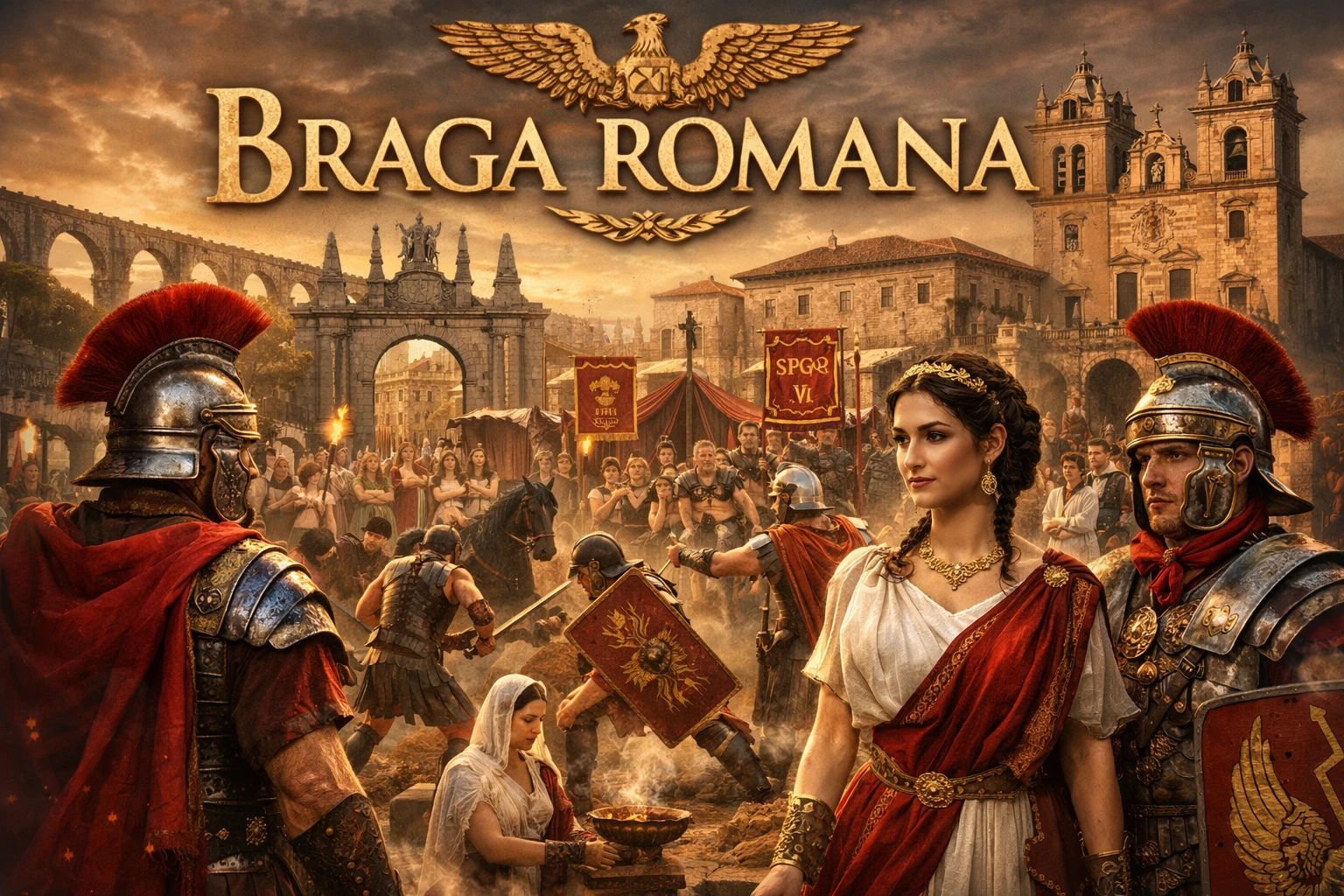
Some cities wear their history on their sleeves. Braga wears it on every stone, every street corner, every square. Founded by the Romans around 16 BC under Emperor Augustus and named Bracara Augusta in his honour, Braga served as the capital of the Roman province of Gallaecia and one of the most strategically significant cities on the Iberian Peninsula. More than two millennia later, the city returns to that identity every May for Braga Romana, the annual historical recreation festival that turns the entire historic centre into a living, breathing version of the ancient city it once was.
The XXII Edition of Braga Romana – Reviver Bracara Augusta takes place from Wednesday 20 to Sunday 24 May 2026. This year's edition carries the theme "Bracara Augusta: Antes de Roma" ("Bracara Augusta: Before Rome"), an invitation to explore the territories, cultures, communities, and practices that preceded the city's Roman foundation. It is an ambitious and intellectually serious expansion of the festival's usual remit, pushing the lens back beyond the Roman era itself to examine the Bracari and Gallaeci peoples who inhabited this land before the legions arrived and whose presence shaped everything that followed.
Over five days and more than 70 hours of programming spread across six stages and thirteen thematic zones, the festival brings together approximately 3,000 participants including students, artists, community associations, and cultural groups from Portugal and beyond. Entry to the outdoor programme is free. This is one of the most generously accessible and genuinely immersive historical festivals in Europe, and 2026 is its 22nd edition.
The History Behind the Festival: Why Braga and Rome Belong Together
Bracara Augusta: Capital of Gallaecia
To understand why Braga Romana exists with the fervour it does, you need to understand what Bracara Augusta actually was. Founded as a Roman colony around 16 BC, the city was established by Emperor Augustus himself as a strategic base for the pacification and administration of the northwestern Iberian Peninsula. It grew rapidly into a major urban centre, the capital of the Roman province of Gallaecia, a region spanning modern northern Portugal and Spanish Galicia.
At its peak, Bracara Augusta was one of the most important Roman cities in Iberia, with a grid street plan, public baths, a theatre, a forum, temples, an amphitheatre, and a sophisticated water supply system. It lay at the intersection of major Roman roads connecting Astorga, Porto, Vigo, and the rest of the peninsula, making it a hub of military, commercial, and cultural activity. The city held the same administrative significance as Augusta Emerita (modern Mérida) in Lusitania, and its citizens enjoyed full Roman rights and the dignity of the Augustan title.
This extraordinary past is not merely archival. Braga's historic centre sits above and around the remains of Bracara Augusta. Roman ruins surface constantly: the Termas Romanas (Roman Baths) beneath the city centre, the Teatro Romano (Roman Theatre) on the Alto da Cividade hill, the Fonte do Ídolo (Idol Fountain), the Domus da Sé beneath the cathedral complex, and the D. Diogo de Sousa Museum of Archaeology, which houses the finest collection of Roman artefacts from the region under one roof. Walking through Braga during Braga Romana means walking through a city that has never entirely stopped being Bracara Augusta.
The Festival's Foundation and Growth
Braga Romana began as an initiative to revive the memory of Bracara Augusta and has grown steadily from a modest local event into one of Portugal's most celebrated historical festivals. By its 20th edition in 2024, it was presenting itself as a significant community action, placing at the disposal of the general public opportunities for more effective contact with the memory of Roman civilisation in the Braga territory.
The 22nd edition in 2026, with its new theme pushing beyond the Roman era itself, represents a genuine intellectual evolution. By asking what came before Rome, the festival invites visitors to encounter the Bracari and Gallaeci peoples, their mythology, their rituals, their material culture, and their relationship to the landscape in a way that no previous edition has done so directly. This is living history at its most ambitious.
The 2026 Theme: "Bracara Augusta: Before Rome"
The choice of "Bracara Augusta: Antes de Roma" as the 2026 theme is more than an artistic decision. It is a historiographical one. The standard Roman narrative of Braga begins with Augustus. But the Bracari and Gallaeci peoples who inhabited the region for centuries before the legions arrived had their own complex social structures, religious practices, agricultural systems, and aesthetic traditions that left their mark on the Roman city that was built on and around their settlements.
By focusing on this pre-Roman layer, the 2026 edition creates space to explore Castrejo culture (the Iron Age hilltop settlements of the northwest), the relationship between the Bracari and the arriving Romans, the syncretism of local and Roman religious traditions, and the material continuities between pre-Roman and Roman life in the region. The festival's open call for artistic projects specifically requested proposals evoking the daily life of Bracara Augusta alongside mythology, rituals, gastronomy, arts, leisure, aesthetics, sport, health, and political life, as well as contemporary approaches that dialogue with these universes.
The result will be a programme that layers the pre-Roman and Roman worlds across the same streets and squares, asking visitors to see the foundation of the city as a process rather than a single event.
What Happens at Braga Romana: The Full Festival Experience
The Roman Market
One of the most beloved and consistently impressive elements of Braga Romana is the Mercado Romano, the Roman market that occupies a central zone of the historic centre throughout the festival. Hundreds of stalls recreate the commerce of a Roman city: craftsmen demonstrating metalworking, pottery, weaving, and leatherwork; food vendors preparing dishes inspired by Roman recipes; merchants offering reproductions of Roman jewellery, clothing, and household objects.
The market is not a tourist prop. It is a working recreation in which the vendors are expected to maintain period-appropriate presentation and engage with visitors in character. The result is a commercial space that functions simultaneously as an educational environment, an artisan market, and a genuinely entertaining piece of living theatre.
Processions and the Opening Ceremony
The festival's ceremonial programme opens with the Actio Condendi Bracaram Augustam, the founding ritual of Bracara Augusta, held in the Praça Municipal. This ceremony, one of the most visually dramatic in the festival calendar, commemorates the symbolic foundation of the city and includes the lighting of the holy fire by high priests, the enactment of Roman religious rituals, and the formal declaration that Bracara Augusta has, for these five days, been reborn.
The processions that move through the city throughout the festival represent some of the largest and most spectacular organised events in Portuguese cultural life. The Bracara Augusta Triumphalis, a grand march through the old streets with hundreds of costumed participants including legionaries, senators, priests, citizens, slaves, merchants, and representatives of the pre-Roman indigenous cultures, draws the biggest crowds of any single festival event. Past editions have seen the mayor and municipal officials participate dressed in the elaborate clothing of Roman nobles, the city's civic authority literally lending its body to the re-enactment.
On the evening of 23 May, a thematic parade moves through the historic centre bringing together local schools and community groups, a spectacular demonstration of the festival's deep roots in the Braga community.
Gladiatorial Combat, Chariot Races, and Military Displays
For visitors who want the more dramatic and visceral elements of Roman public spectacle, Braga Romana delivers comprehensively. Gladiatorial battles, chariot races, and equestrian shows are held at Largo do Pópulo, one of the festival's most consistently spectacular venues, across multiple days. These are full performance recreations with trained participants, authentic (or authentically reproduced) equipment, and the kind of theatrical intensity that makes the Roman games make sense as entertainment in a way that reading about them never quite achieves.
The military camp is another consistent highlight, allowing visitors to explore the daily life of Roman legionaries through interactive demonstrations of weapons, armour, tactics, and camp organisation. Legionary drills, formation exercises, and weapons demonstrations by groups in historically researched equipment give the festival a physical reality that distinguishes it from purely theatrical historical recreation.
The Pedagogical Areas and Interactive Workshops
Braga Romana operates as a genuinely educational festival, not just a spectacular one. Over 160 hands-on activities are offered across the five days, covering mosaic making, jewellery, pottery, Roman dance, ancient games, Latin language workshops, Stoic philosophy discussions, Roman cooking demonstrations, and Greek-Roman mask construction. These activities are designed for both school groups, who visit during weekday mornings, and general public visitors, who access them on weekend afternoons.
The Lyceus Romanus, recreated in the area of the Domus do Seminário de Santiago, offers visitors a space for various forms of Roman-style pedagogy: Latin language lessons, archaeology workshops, and introductions to the arts and crafts of the period. It is the kind of experience that makes Roman history feel like an active inheritance rather than a dead archive.
The D. Diogo de Sousa Archaeological Museum
The D. Diogo de Sousa Museum of Archaeology at Rua dos Bombeiros Voluntários is one of the finest Roman archaeology collections in Portugal and a central component of the Braga Romana experience. During the festival, the museum runs the exhibition "Bracara Augusta: 2040 Years of History," providing deep archaeological context for everything visitors are experiencing on the streets outside. The exhibition covers the life, architecture, and social organisation of the ancient Roman city, using objects recovered from excavations across the city's territory.
The Interactive Installation "The Legacy of Bracara" at Largo D. João Peculiar uses artificial intelligence to transform visitors into Roman citizens, combining historical data with contemporary technology to create an immersive experience that sits at the outer edge of what a historical festival can do.
The Roman Theatre and Archaeological Sites
Perhaps the most profound element of Braga Romana is its relationship to the actual Roman archaeology beneath the city's feet. The Teatro Romano on the Alto da Cividade hill, the Termas Romanas beneath the central city, the Fonte do Ídolo (the carved rock spring that served as a religious site in Roman Braga), and the Domus da Sé are all integrated into the festival programme, with guided visits, theatrical performances staged within and around the ruins, and the particular atmospheric power of standing inside a Roman structure that has been in continuous proximity to human life for two thousand years.
The Fonte do Ídolo deserves special mention for the 2026 edition given the theme of pre-Roman cultures: it is precisely the kind of site where Roman and indigenous religious practices met and merged, a carved rock spring that shows both Roman dedicatory inscriptions and traces of pre-Roman cult practice.
Braga During the Festival: The City as Stage
The Historic Centre Transformed
From the Rossio da Sé to the Largo D. João Peculiar, across six stages and thirteen thematic zones, the entire historic centre of Braga becomes the festival stage. The city's purple tones, which give Braga Romana its distinctive visual identity, appear on banners, costumes, and decorations that line the streets from the first day of the festival. Walking through Braga during Braga Romana and not being in the festival is essentially impossible: the two coexist completely.
The Praça Municipal, Braga's grand 18th-century civic square, hosts the most formal ceremonial events. The Sé de Braga, the ancient cathedral that has stood on or near the site of a Roman temple for nearly a thousand years, provides a backdrop that makes the Roman associations of the city viscerally apparent. The Arco da Porta Nova, the 18th-century arch that marks the entrance to the historic centre, serves as a natural gateway to the festival world beyond.
Food, Wine, and the Roman Gastronomy Area
The Tabernae (Roman taverns) recreated in the festival area serve food and drink in keeping with Roman culinary tradition, or at least interpretations of it: olives, cured meats, cheeses, bread, fish preparations, and wines served in terracotta vessels. Roman cuisine was considerably more sophisticated than most people imagine, relying heavily on garum (fermented fish sauce), honey, spices from the eastern Mediterranean, and an extraordinary range of preserved foods. The festival's food programme does not shy away from this complexity.
For those who want contemporary Braga dining alongside the festival experience, the concentration of restaurants around the Praça da República (the Arcada), the Rua do Souto, and the streets between the Sé and the Praça Municipal is excellent. Braga has one of the more rewarding restaurant scenes in northern Portugal, with particular strength in traditional Minho regional cooking: roast veal, caldo verde, bacalhau prepared in dozens of ways, and the local Vinho Verde that is at its most lively in the late spring heat.
Practical Travel Guide: Visiting Braga Romana 2026
Festival dates: Wednesday 20 May to Sunday 24 May 2026
Theme: "Bracara Augusta: Antes de Roma" (Bracara Augusta: Before Rome)
Edition: XXII (22nd edition)
Venue: Historic Centre of Braga, from Rossio da Sé to Largo D. João Peculiar; six stages, thirteen thematic zones
Admission: The outdoor programme and street events are free. Some specific performances and visits to archaeological sites may require tickets or timed entry bookings. Check bragaromana.cm-braga.pt for confirmed entry requirements for individual events closer to the festival dates.
Getting to Braga: From Porto Campanhã or Porto São Bento by train, approximately 50 minutes on Alfa Pendular, slightly longer on regional services, with frequent departures throughout the day. From Lisbon by direct Alfa Pendular, approximately three hours. From Madrid and other international origins, Porto Francisco Sá Carneiro Airport is the natural entry point, with metro connection to Porto Campanhã and trains onward to Braga.
Getting around Braga during the festival: The historic centre is compact and entirely walkable. Road access to the central areas may be restricted during festival days due to the processions and street events; arriving on foot or by public transport from the train station (approximately 15 minutes' walk) is the most practical approach.
Accommodation: Late May is increasingly popular for Braga Romana visits, with demand from both domestic Portuguese visitors and international cultural tourists growing each year. Booking three to four weeks in advance is advisable. The area around the Praça da República and the historic centre puts you within walking distance of all festival venues. Guimarães (22 kilometres, 30 minutes by train) and Porto (55 minutes) can also serve as bases for day trips to the festival if Braga accommodation is limited.
Weather in Braga in late May: Average temperatures of 20 to 25 degrees Celsius during the day, cooling to around 14 to 16 degrees in the evening. Light, comfortable clothing is appropriate for the festival days, with a thin layer for the evenings. The late May period in Braga is generally dry and sunny, though brief afternoon showers are always possible in Minho.
Children: Braga Romana is an exceptionally family-friendly festival. The pedagogical areas, hands-on workshops, interactive installations, gladiatorial displays, and the general theatrical atmosphere of the street programme are all highly engaging for younger visitors. School groups are accommodated during weekday mornings; weekend afternoons are designed for general public access to all activities.
Official website: bragaromana.cm-braga.pt
Official Facebook page: facebook.com/BragaRomana
Before Rome, After Rome, and Everything Between
Braga Romana is not the kind of festival that needs a hard sell. Twenty-two editions of consistent growth, 3,000 participants, more than 70 hours of programming across 13 thematic zones, and a city that is genuinely, irreducibly Roman beneath its medieval and Baroque surface: all of that is its own argument.
The 2026 edition, with its theme of "Bracara Augusta: Before Rome," adds something new to an already mature and sophisticated event. By looking behind the Roman foundation to the cultures and peoples who came before, the festival asks its visitors to see Braga not as a place where Roman history happened, but as a place where multiple layers of human history continue to coexist, visible in the soil beneath the streets and in the faces of the citizens who walk above them every day.
From 20 to 24 May 2026, the city puts on purple, lights the holy fire, marches its legions through the ancient streets, and invites you to be, for five extraordinary days, a citizen of Bracara Augusta. That is an invitation worth accepting.
Verified Information at a Glance
| Detail | Information |
|---|---|
| Event Name | Braga Romana – Reviver Bracara Augusta 2026 |
| Edition | XXII (22nd edition) |
| Event Category | Historical Recreation Festival / Cultural Festival / Living History Event |
| Dates | Wednesday 20 May 2026 to Sunday 24 May 2026 (five days) |
| Theme | "Bracara Augusta: Antes de Roma" (Bracara Augusta: Before Rome) |
| Location | Historic Centre of Braga, Portugal |
| Main Zones and Stages | Six stages and thirteen thematic zones spanning from Rossio da Sé to Largo D. João Peculiar |
| Admission | Outdoor street programme and main events free of charge; individual archaeological site visits and specific performances may require tickets or timed booking |
| Scale | Approximately 3,000 participants; over 70 hours of programming |
| Key Programme Elements | Actio Condendi Bracaram Augustam – founding ritual ceremony at Praça Municipal |
| 160+ hands-on workshops | mosaic making, pottery, Roman cooking, Latin language, archaeology, ancient games, Stoic philosophy |
| "Bracara Augusta | 2040 Anos de História" exhibition at D. Diogo de Sousa Archaeology Museum |
| Key Archaeological Sites Open During Festival | Termas Romanas, Teatro Romano, Fonte do Ídolo, Domus da Sé, D. Diogo de Sousa Museum |
| Getting to Braga | Train from Porto approx. 50 minutes; train from Lisbon approx. 3 hours; Porto Airport is closest international hub |
| Official Website | bragaromana.cm-braga.pt |
| Official Facebook | facebook.com/BragaRomana (24,500+ followers) |
| Average Temperature in Braga in Late May | 20–25°C daytime; 14–16°C evening |
Event Has Passed - See You Next Time!
Event Details
Date
to
Location
Historic Centre citywide: Rossio da Sé to Largo D. João Peculiar, Braga
Braga, Portugal
Price
Not Available