
Event Has Passed - See You Next Time!
Event Details
Date
Location
Citywide, Braga
Braga, Portugal
Price
Free Entry
About This Event
Liberty Day 2026 in Braga: Your Complete Guide to Dia da Liberdade in Portugal's Cultural Heart
There are national holidays that feel like a formal obligation, and there are days that feel genuinely alive. In Portugal, Saturday 25 April 2026 belongs entirely to the second category. Dia da Liberdade, Freedom Day, marks the anniversary of the Carnation Revolution of 1974, the peaceful military uprising that ended 48 years of authoritarian dictatorship under the Estado Novo regime and opened Portugal's long-closed doors to democracy, free speech, free elections, and the full rights of modern citizenship.
In Braga, the day carries an extra layer of significance in 2026. The city has just concluded its year as Portuguese Capital of Culture 2025, a title that infused 12 months of exceptional cultural programming across every venue and public space in the city. The afterglow of that year, the partnerships formed, the audiences built, the artists who discovered Braga as a destination, continues into 2026. Liberty Day in Braga on 25 April 2026 falls on a Saturday, creating a natural long weekend for visitors and residents alike, in a city that is still very much in the mood to celebrate.
Red carnations, open-air concerts, civic speeches, cultural programmes, and the particular warmth of a country that does not take its democracy for granted come together in one of Portugal's most historically and architecturally rich cities. This is what 25 de Abril in Braga looks like.
The History of Dia da Liberdade: Why This Date Changes Everything
Portugal's Longest Dictatorship
To understand why April 25 resonates the way it does in Portugal, you need to understand what came before it. The Estado Novo, the "New State" established under António de Oliveira Salazar beginning in 1933, was the longest-lasting authoritarian regime in Western Europe in the 20th century. By the time it fell in April 1974, Portugal had been living under censorship, political repression, secret police surveillance through the PIDE (Polícia Internacional e de Defesa do Estado), and the weight of colonial wars in Angola, Mozambique, and Guinea-Bissau for over four decades.
Books were censored with blue pencils before publication. Newspapers could not print certain words or cover certain events. Political opposition was imprisoned, often in the notorious Peniche fortress or the Aljube prison in Lisbon. Emigration, both legal and clandestine, had been draining the country's youth for generations. Portugal, at the edge of Western Europe and at the end of a long colonial adventure, was exhausted.
On the morning of 25 April 1974, the Movimento das Forças Armadas (MFA), a group of military officers who had developed their political consciousness partly through the colonial wars they were being ordered to fight, launched a coup. The signal for the uprising was broadcast on radio at 12:25 AM: the broadcast of the song "E Depois do Adeus" by Paulo de Carvalho, followed at 12:20 AM by "Grândola, Vila Morena" by José Afonso, a song that had been banned under the regime for its associations with workers' solidarity and left-wing politics. Both songs remain, 52 years later, the anthems of April 25 and are played across the country every year on the anniversary.
The Carnations That Named a Revolution
What happened next gave the revolution its name. As military units took up positions across Lisbon, ordinary citizens poured into the streets. A florist on her way to the Lisbon wholesale market encountered the soldiers and gave them her carnations. The flowers were red, the colour of the season, and the soldiers placed them in the barrels of their rifles. The image spread across the city: carnations in gun barrels, flowers instead of bullets, spring instead of violence. The Carnation Revolution did not fire a single shot in its essential moments. It was, as revolutions go, a miracle.
By the end of the day on 25 April 1974, the Estado Novo had effectively fallen. Political prisoners were released. The censorship apparatus was dismantled. Portugal's colonial wars ended within months. Free elections were held in 1975 for the first time since 1926. Women voted for the first time on equal terms with men. And on 2 April 1976, a new democratic constitution came into force, one still in place today.
The Portuguese endured the longest authoritarian regime in Europe, which lasted for almost six decades. For the generation that lived through it, April 25 is not simply a holiday. It is the day Portugal's history divided into a before and an after.
Liberty Day 2026 in Braga: A Saturday Celebration
The Motto: "All Freedom Is a Restlessness"
In 2025, Braga held the title of Portuguese Capital of Culture, a designation that brought 12 months of exceptional cultural programming, international partnerships, and civic engagement to the city. The April 25 celebrations in Braga that year operated under the motto "All Freedom Is a Restlessness", emphasising, as Braga 25 put it, "its dynamic and challenging nature. Freedom requires constant vigilance, continuous renewal and a deep sense of responsibility, far from being an absolute and immutable good."
That motto still resonates in 2026. The conversations and cultural debates opened during Braga's Capital of Culture year continue to shape how the city engages with its public life. April 25, 2026 arrives in a city that has spent the previous twelve months thinking seriously and publicly about what culture, democracy, and civic participation actually mean, not just as historical achievements but as ongoing responsibilities.
Because 25 April 2026 falls on a Saturday, it creates a natural long weekend. The impact on working schedules is smaller than in years when Freedom Day lands mid-week, and the Saturday timing means events and activities can extend into the evening hours without the constraint of a working day the following morning. For visitors planning to be in Braga for the occasion, the weekend framework gives more flexibility for combining the official commemorations with the city's many other attractions.
Official Ceremonies and Commemorations
Across Portugal, Dia da Liberdade is marked with a mix of official ceremonies and grassroots activities. National and local authorities typically hold flag-raising events, wreath-layings, and formal speeches that recall the events of 25 April 1974 and reflect on the current state of democracy.
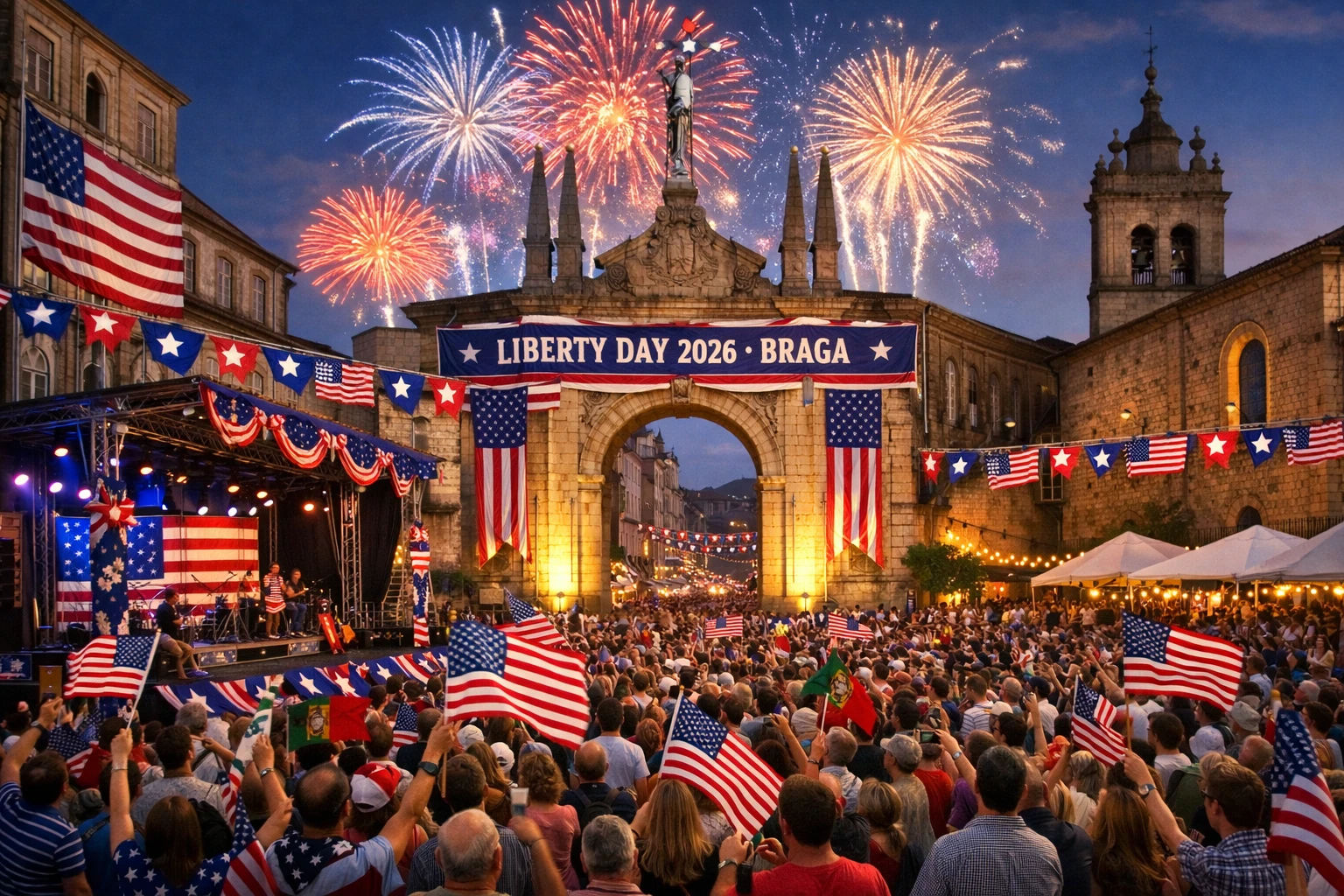
In Braga, the municipal commemorations typically take place at the Praça da República (locally known as the Arcada), the city's principal civic square, and at other historic public spaces in the centre. The Praça da República, with its arcaded cafes and the central fountain, is the natural gathering point for the city's public life, and on Liberty Day it becomes the stage for formal observances that mix civic dignity with genuine popular participation.
Local authorities, elected officials, university representatives, and civil society organisations participate in ceremonies that acknowledge both the historical significance of April 25 and its ongoing relevance. Speeches address the state of Portuguese democracy, the values that the Carnation Revolution established, and the responsibilities those values impose on the present generation.
The Cultural Dimension: Concerts, Exhibitions, and the April Tradition
Beyond the formal ceremonies, Liberty Day in Braga fills the afternoon and evening with cultural programming that reflects the city's status as one of Portugal's most active cultural centres.
The songs of April are unavoidable and entirely welcome. "Grândola, Vila Morena" and "E Depois do Adeus" are played across the city and sung in public spaces. These are not merely nostalgic signals. They are genuinely beautiful pieces of music: José Afonso's "Grândola" in particular is a masterwork of Portuguese folk song, built on three-voice polyphony and a lyrical architecture of considerable sophistication, whose association with the revolution gives it an emotional charge that 52 years have not diminished.
Open-air concerts in public squares are a fixture of Braga's Liberty Day, drawing performances from local and regional artists alongside occasional national names. The Theatro Circo, Braga's historic theatre on Avenida da Liberdade, holds special programming on and around April 25. The theatre itself is worth noting for its symbolic geography: the avenue on which it stands, the Avenida da Liberdade, shares its name with the main boulevard of Lisbon where the famous April 25 marches take place each year, a naming that is no coincidence in a country where the memory of freedom is woven into civic geography.
The GNRation building on Travessa do Carmo, home to the Café-Concerto RUM by Mavy and Braga's most innovative digital arts venue, typically programmes events connected to the April 25 theme in the spirit of its commitment to using culture as a vehicle for civic engagement.
The Carnation Tradition in Braga's Streets
Every year on April 25th, red carnations appear across Portugal. You will see them pinned to jackets, tucked into shop windows, and handed out during parades and celebrations. In Braga, volunteers and civic organisations typically distribute carnations in the historic centre during the morning and early afternoon, continuing the tradition that began spontaneously in the streets of Lisbon in 1974.
The blue pencil, once used by censors to strike offending passages from books and newspapers before publication, has become another symbol of the day: its presence in exhibitions and public displays is a reminder of what freedom of expression actually cost before April 25. The murals and street art that mark Braga's urban landscape, some commemorating the revolution directly and others carrying its spirit into contemporary contexts, provide a visual dimension to the day's observances that extends beyond the official programme.
Braga's Deep Roots: A City of History Meeting a Day of Democracy
The Roman Foundation and Medieval Layers
The irony of Liberty Day in Braga is that it takes place in a city whose history of institutional authority runs extraordinarily deep. Founded as Bracara Augusta by the Romans around 16 BC, Braga served as the capital of the Roman province of Gallaecia and was one of the most important administrative centres on the Iberian Peninsula. The Termas Romanas beneath the city centre, the Teatro Romano on the Alto da Cividade hill, and the Fonte do Ídolo all speak to a city where power has always been taken seriously.
The medieval church took root equally deeply. The Sé de Braga, begun in the 12th century and one of the oldest cathedrals in Portugal, made Braga the archbishopric of Portugal, giving the city the ecclesiastical authority that earned it the name "Rome of Portugal." The tombs of Dom Henrique and Dona Teresa, parents of Portugal's first king, lie within its walls. The archbishops of Braga wielded political as well as religious power for centuries.
What makes April 25 in Braga so interesting as an experience is the dialogue between this long history of institutional authority and the holiday's celebration of its overthrow. Walking from the Sé to the Praça da República on Liberty Day, past centuries of church and civic architecture, with carnations in your hand and "Grândola" audible from somewhere across the square, is a genuinely complex cultural experience.
The University City and Its Democratic Energy
Braga is home to the University of Minho, with a student population that keeps the city intellectually alive and culturally active in ways that older, more sedately touristy Portuguese cities are not. The university's presence shapes Liberty Day in Braga in particular ways: student groups organise debates, cultural events, and public discussions that engage with the holiday's political and historical dimensions from a perspective of active civic participation rather than simple commemoration.
The debate tradition that Braga established so prominently during its Capital of Culture year, including the "Cenários" programme of structured discussions on culture, democracy, and civic life at GNRation and Theatro Circo, extends naturally into the April 25 commemorations. The holiday is not just observed in Braga. It is discussed, questioned, and renewed.
What to See and Do in Braga on and Around 25 de Abril 2026
The Historic Centre on a Public Holiday
As a national public holiday, banks, government offices, and most businesses are closed on 25 April. Tourist attractions, museums, restaurants, cafes, and cultural venues remain open, though some may operate on adjusted Saturday schedules. Visiting Braga on Liberty Day gives access to the city at a particular human register: the Praça da República fills with people who are genuinely enjoying a free day rather than hurrying through on a workday schedule, and the cafes under the arcades are unusually lively from late morning onward.
The Sé de Braga is open to visitors throughout the year and deserves a minimum of 90 minutes to do justice to the cathedral and its treasury museum, which contains an extraordinary collection of Portuguese sacred art spanning eight centuries. The D. Diogo de Sousa Museum of Archaeology provides the Roman context that makes the city's ancient past as a capital of empire tangible and specific. Both are worth visiting on 25 April as context for a city that has repeatedly reinvented itself across entirely different political systems.
The Bom Jesus do Monte sanctuary, eight kilometres east of the city centre, is reachable by a funicular dating from 1882 and offers panoramic views across the Minho valley that are particularly beautiful in the late April light. A morning at Bom Jesus followed by an afternoon in the historic centre for the Liberty Day ceremonies and concerts is a genuinely satisfying way to structure the day.
Food and Wine on Dia da Liberdade
The concentration of restaurants in Braga's historic centre around the Praça da República, the Rua do Souto, and the streets between the Sé and the Praça Municipal means that finding a good meal on Liberty Day is not a problem. Most restaurants remain open on the public holiday, and the festive atmosphere of the day encourages longer, more relaxed meals than usual.
Braga sits in the Minho region, one of Portugal's most productive wine areas and the home of Vinho Verde, the young, slightly sparkling white wine that is at its best in the spring and early summer warmth that late April brings. Bacalhau (salt cod) in its dozens of preparations, caldo verde (the traditional kale soup with chouriço), and roast veal are all regional staples that appear on menus across the city. The famous Pudim Abade de Priscos, a rich egg yolk pudding with pork fat and port wine that was invented by a 19th-century abbot from Braga, is the city's most distinctive and unexpectedly delicious culinary contribution to Portuguese gastronomy.
For those interested in drinking the wines of the Minho region more deliberately, several wine bars and restaurants in the city specialise in local producers and the broader range of Portuguese wine, which is increasingly recognised internationally as one of the world's most interesting and undervalued wine cultures.
Practical Travel Guide: Visiting Braga for Liberty Day 2026
Date: Saturday 25 April 2026
Holiday status: Official national public holiday in Portugal. Banks, government offices, and most non-tourist businesses are closed. Restaurants, cafes, museums, and tourist attractions generally remain open.
Getting to Braga from Porto: Train from Porto Campanhã or Porto São Bento, approximately 50 minutes on Alfa Pendular services, slightly longer on regional trains. Trains run frequently including on public holidays. The last trains back to Porto from Braga on Saturday evenings run late, allowing comfortable attendance at evening events.
Getting to Braga from Lisbon: Direct Alfa Pendular service, approximately three hours. Porto Francisco Sá Carneiro Airport is the most convenient international hub for Braga, with a metro connection to Porto Campanhã and then trains onward.
Getting around Braga: The historic centre is compact and entirely walkable. The Sé, the Praça da República, the GNRation building, and the Theatro Circo are all within a 15-minute walk of each other. Bom Jesus do Monte is reachable by taxi or by the dedicated bus service from the city centre.
Accommodation: Late April is an active tourist period in Braga. The proximity of Liberty Day on Saturday 25 April to the upcoming Miguel Araújo concert at Theatro Circo on Wednesday 29 April and the opening of Braga Romana on 20 May creates a particularly full cultural month. Booking accommodation a few weeks in advance is advisable.
Weather: Late April in Braga brings reliable spring warmth, with average daytime temperatures of 17 to 22 degrees Celsius. Light, comfortable clothing is appropriate, with a thin layer or light jacket for the evening. The Minho region can see brief afternoon showers, so a compact umbrella is worth carrying.
What to wear: Many Portuguese people wear or pin a red carnation on April 25. Participating in this tradition as a visitor is entirely welcomed and is a small but meaningful gesture of solidarity with what the day represents.
The songs: If you want to participate fully in a public celebration of Dia da Liberdade, learning to recognise "Grândola, Vila Morena" and "E Depois do Adeus" before arriving is worthwhile. Both are readily available on all streaming platforms and YouTube, and hearing them played outdoors in a Portuguese city square on April 25 is a genuinely moving experience.
Official Liberty Day information: cm-braga.pt (Braga Municipality website); visitportugal.com
A Day That Keeps Earning Its Celebration
Freedom is not a given. Portugal's experience of losing it for nearly 50 years and then winning it back through a revolution that chose flowers over bullets is a reminder, more relevant than ever in 2026, that democracy requires exactly the active engagement that Braga's Liberty Day celebrations embody.
As Braga's own motto for the April 25 commemorations put it: "All Freedom Is a Restlessness." Freedom requires constant vigilance, continuous renewal and a deep sense of responsibility, far from being an absolute and immutable good. On a Saturday afternoon in late April, in the square below the medieval Sé, with a carnation in your hand and the sound of "Grândola" rising above the rooftops, that proposition feels both serious and entirely joyful.
Braga on Dia da Liberdade 2026 is a city celebrating something it means. And that, in a world with no shortage of performative commemoration, is rare enough to be worth the journey.
Verified Information at a Glance
| Detail | Information |
|---|---|
| Holiday Name | Dia da Liberdade / Freedom Day / Liberty Day |
| Event Category | National Public Holiday / Civic Commemoration / Cultural Festival |
| Date in 2026 | Saturday 25 April 2026 |
| Day of Week | Saturday (creating a natural long weekend) |
| Official Status | One of Portugal's official national public holidays; observed annually since 1974 |
| Historical Basis | Commemorates the Carnation Revolution of 25 April 1974, the peaceful military coup that ended the Estado Novo dictatorship and opened Portugal's transition to democracy |
| Revolution Name | Carnation Revolution (Revolução dos Cravos) |
| Songs of April 25 | "Grândola, Vila Morena" by José Afonso and "E Depois do Adeus" by Paulo de Carvalho (the radio signals for the 1974 uprising) |
| Symbol | Red carnation (placed in soldiers' rifle barrels on 25 April 1974) |
| Braga 2025–2026 Context | Braga served as Portuguese Capital of Culture 2025; April 25 celebrations operated under the motto "All Freedom Is a Restlessness" |
| Typical Programme Elements in Braga on 25 April | Official ceremonies and flag-raising at Praça da República; wreath-laying at civic monuments; public speeches by municipal and political representatives; open-air concerts; cultural programming at Theatro Circo, GNRation, and public squares; carnation distribution |
| Key Venues | Praça da República (Arcada), Theatro Circo (Avenida da Liberdade 697), GNRation (Travessa do Carmo), Sé de Braga, Avenida Central |
| What Is Closed | Banks, government offices, most non-tourist retail businesses |
| What Remains Open | Museums, tourist attractions, restaurants, cafes, cultural venues; check individual venues for adjusted Saturday public holiday hours |
| Getting to Braga | Train from Porto approx. 50 minutes; from Lisbon approx. 3 hours (Alfa Pendular) |
| Average Temperature on 25 April in Braga | 17–22°C; light spring clothing; compact umbrella advisable |
| Official Municipal Website | cm-braga.pt |
| Tourism Information | visitbraga.pt / visitportugal.com |
| Nearby Events in Late April 2026 | Miguel Araújo concert at Theatro Circo (29 April 2026, 21:30); Braga Romana XXII Edition (20–24 May 2026) |
Event Has Passed - See You Next Time!
Event Details
Date
Location
Citywide, Braga
Braga, Portugal
Price
Free Entry