

Event Has Passed - See You Next Time!
Event Details
Date
to
Location
Braga Sé Cathedral, Historic Centre streets & Churches citywide, Braga
Braga, Portugal
Price
Free Entry
About This Event
Semana Santa in Braga 2026: Portugal's Most Spectacular Holy Week Experience
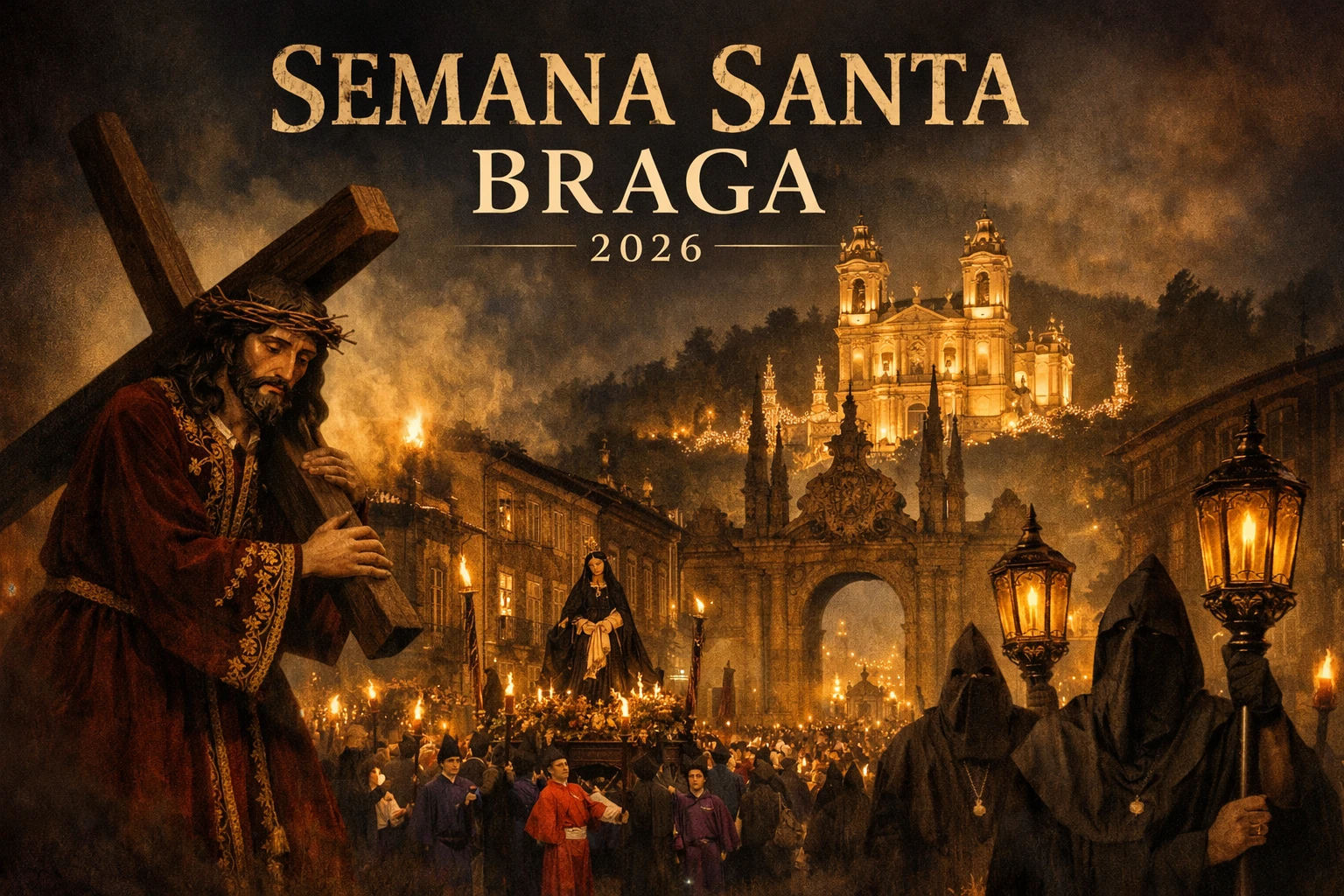
There is nothing quite like Holy Week in Braga. Of all the cities in Portugal, this is the one where the ancient rhythms of Christian passion play out with the most theatrical force, the most historical depth, and the most genuine communal participation. In 2026, Holy Week in Braga runs from Sunday 29 March (Palm Sunday) to Sunday 5 April (Easter Sunday), drawing what the organisers consistently estimate at 100,000 or more visitors to the streets of this extraordinary northern Portuguese city. Declared of National Interest for Intangible Cultural Heritage in 2011, integrated into the European Network of Holy Week and Easter Celebrations, and awarded the Gold Medal of Municipal Merit, Braga's Semana Santa is not simply a religious event. It is one of the most profound and visually overwhelming cultural experiences in Europe.
For visitors, pilgrims, and travellers who have not yet witnessed what happens in the streets of Braga during the days between Palm Sunday and Easter Sunday, the 2026 edition is the invitation. The full programme spans eight days of processions, liturgies, theatrical performances, visits to the Seven Churches, and the ancient traditions of the farricocos. Some of it will move you to silence. All of it will stay with you.
The History Behind Braga's Holy Week: Why This City and No Other
A 2,000-Year Arc from Roman Capital to Sacred Centre
Braga's relationship with faith runs as deep as its relationship with time. Founded by the Romans around 16 BC as Bracara Augusta, the capital of the province of Gallaecia, the city became one of the most important ecclesiastical centres in the Iberian Peninsula during the early centuries of Christianity. The Archdiocese of Braga is the oldest in Portugal and one of the oldest in the Iberian Peninsula, giving the city a theological tradition and a liturgical identity that is measurably different from the rest of the country.
The Bracarense Rite, the liturgical tradition specific to Braga's cathedral, is one of the rarest surviving examples of pre-Tridentine Western Christian liturgy. It predates the standardisation of the Roman Rite that followed the Council of Trent in the 16th century and contains elements found nowhere else in the Catholic world. During Holy Week, the cathedral ceremonies according to the Bracarense Rite are available only in Braga and represent a direct link to the earliest centuries of Christian worship in Iberia.
The Holy Week Commission, formally established in 1933, took the accumulated tradition of medieval processions and civic penitential rituals and organised them into the structured, formally managed event that draws more than 100,000 visitors annually today. But the roots of individual processions go back considerably further: the Ecce Homo Procession, for example, traces its origins to the 15th century. Of all those held in Portugal, Holy Week in Braga is the most imposing and most popular, attracting many tourists to the city. Visitors are essentially looking for the great nocturnal processions which are characterised by hundreds of extras and harmoniously combine elements of the liturgy and popular religiosity, as well as ancient traditions and innovation.
The Full 2026 Programme: Day by Day
The Saturday Before Palm Sunday: Procession of the Lord of the Steps (Senhor dos Passos)
Holy Week in Braga begins not on Palm Sunday itself but the Saturday before it, with the Procession of the Lord of the Steps (Senhor dos Passos). This nocturnal procession carries the image of Senhor dos Passos from the Church of Santa Cruz to the Church of the Seminário, passing through the Angel Street, Largo de Santiago (where the choir sings the Miserere), and Largo de São Paulo. The Saturday night before Palm Sunday is like a first vigil, of penitential character, preparing the Holy Week, as the following Saturday, the Easter Vigil will be the festive celebration of the triumph of Jesus over death.
This procession opens with the farricocos, one of the most striking and ancient elements of Braga's Holy Week. The farricocos enter with coarse penitential robes, barefoot and hooded, ropes around the waists, as once the public penitents, holding staffs and waving suspended torches in the pitch darkness, some lifting fogaréus (bowls with pine cones on fire). The effect is extraordinary: the darkness, the fire, the hooded figures, and the sound of wooden rattles in the night create an atmosphere that carries the full weight of centuries of penitential tradition.
Palm Sunday, 29 March 2026: Blessing of the Palms and the Grand Procession
The Blessing and Procession of the Palms takes place on Palm Sunday (29 March 2026) at 11:00, a worldwide-unique Bracarense Rite ceremony at the cathedral's doors, with olive branches blessed and waved by thousands, followed by Passion readings from St. Mark.
The afternoon brings the Grand Procession of the Steps, described as a dramatic re-enactment of Christ's Passion with 500 or more participants in allegorical tableaux including the Last Supper, the trial scenes, and hooded penitents with orchestral hymns, culminating in the Sermon of the Encounter at Santa Cruz Church. This is a grand procession that represents the Stations of the Cross with theatrical living tableaux.
Holy Monday to Holy Tuesday: Perpetual Prayer and the Lausperene
The weekdays of Holy Week in Braga are given over to the Lausperene, the rotation of the Blessed Sacrament exposed for perpetual adoration through the city's parishes. The perpetual prayer schedule runs across more than 20 parishes from March through April 17. Visitors can follow the schedule, published in the official programme at semanasantabraga.com, to join worshippers at whichever parish is hosting the adoration on a given morning or evening.
This quieter element of Holy Week is perhaps the most accessible for visitors who are not themselves Catholic but who want to understand the interior life of the week alongside its spectacular exterior. The parishes of Braga, from the great collegiate churches around the Praça da República to the smaller neighbourhood churches tucked into residential streets, open their doors and fill with candlelight for this continuous prayer vigil.
Holy Wednesday, 1 April 2026: Thou Shalt Be My People
On Holy Wednesday (1 April 2026) at 21:30, the Biblical Pageant "Thou Shalt Be My People" is performed at Saint Victor Church, a theatrical living tableau dramatising Old Testament covenants with 200 actors in period costumes, emphasising themes of divine promise and human frailty.
This theatrical performance is one of the more unusual elements of Braga's Holy Week and one of the most accessible for visitors who come to the week as cultural observers rather than religious pilgrims. The scale of the production, with 200 performers in period costume enacting scenes from the Hebrew scriptures, transforms the forecourt and surroundings of São Vítor Church into a living stage.
Holy Thursday, 2 April 2026: Chrismal Mass, Ecce Homo, and the Seven Churches
Holy Thursday is the fullest and most liturgically dense day of the week. At 10:00, the Archbishop consecrates sacramental oils in the Chrismal Mass, celebrated amid full clergy in what is one of the most formally elaborate ceremonies of the entire week.
The afternoon and evening bring the Visitation of the Seven Churches, the tradition of visiting seven specific churches in the city during Holy Thursday afternoon, mirroring the Seven Stations of Rome. Visitors can use the interactive map on the official Holy Week website to check the Seven Churches locations, which include the Sé Primaz and Misericórdia among others. This meditative pilgrimage through the streets of Braga offers a form of participation in Holy Week that is deeply devotional without requiring full liturgical engagement.
The nocturnal Ecce Homo Procession on Holy Thursday evening is one of the most theatrically powerful events of the entire week. The image of the Lord "Ecce Homo" (or "Lord of the green cane") represents the Christ proclaimed to be the King and the Roman Governor made him ridiculous by putting a green cane in his hand as a sceptre. That's how Pilate introduced him to the crowd, saying: "Behold the Man!" The procession includes historical figures such as Pontius Pilate and Roman soldiers alongside mourning women, and since 2004 has incorporated allegories of the fourteen works of mercy alongside historical figures linked to the foundation of the Misericórdia.
Once the procession withdraws, the Via Sacra follows, with people singing the "Martírios (Martyrs)" and visiting, in order, eight calvaries spread throughout the city, representing the eight stations of Christ on his way to Calvary.
Good Friday, 3 April 2026: The Burial Procession
Good Friday brings the gravest and most solemn event of the entire week: the Lord's Burial Procession, a sombre nocturnal march from Sé Cathedral with veiled images of the Dead Christ, torches, and Latin chants like "Heu! Heu! Domine!", evoking medieval Jerusalem customs preserved uniquely in Braga.
This stately procession, the most solemn and touching of all, carries throughout the city streets the coffin of the dead Lord. It is preceded by a platform with a bare cross and followed by the Lady of Sorrows. Accompanied by the various brotherhoods, knights of the Sovereign Orders of Malta and the Holy Sepulchre of Jerusalem, the Cathedral Chapter members, various corporations and authorities. As a sign of mourning, the Delegates and Members of Brotherhoods walk with covered heads. To show their pain, the allegorical figures wear a mourning veil. The rattles of the farricocos are silent. The flags and banners with mourning stripe drag along the floor.
The silence of the farricocos' rattles on Good Friday is one of the most affecting details of the entire week. The instruments that opened Holy Week with noise and fire are now mute in the face of death. The contrast is complete and deliberate.
Holy Saturday, 4 April 2026: The Easter Vigil
Holy Saturday night brings the liturgical turn from darkness to light. The Easter Vigil and Resurrection Procession on Holy Saturday (4 April 2026) at 21:00 is described by St. Augustine as "the mother of all Vigils," featuring fire blessings, nine Old Testament readings, baptisms, and a triumphant march with the unveiled Sacrament, exploding in light and Hallelujah choruses.
The Vigil begins in darkness, with the blessing of the new fire at the door of the cathedral. The Paschal candle is lit from that fire, then other candles, gradually filling the dark church with light as the nine readings unfold. Baptisms are performed during the liturgy, with adults received into the church at the most symbolically charged moment of the Christian year. The procession that follows, carrying the Blessed Sacrament unveiled through streets that twenty-four hours earlier were carrying a coffin, is the complete reversal of Good Friday's grief.
Easter Sunday, 5 April 2026: The Resurrection
Easter Sunday in Braga, as across the Catholic world, is the day of joyful celebration following the solemnity of the previous week. The main morning Mass at the Sé de Braga is attended by the Archbishop and full cathedral clergy, with the full panoply of the Bracarense Rite in its most festive register. Bells that were silent from the evening of Holy Thursday ring out across the city from the cathedral's towers as sunrise approaches.
The Eight Calvaries and the Via Sacra: Walking Braga's Stations
One of the most distinctive and underappreciated elements of Braga's Holy Week is the eight calvaries scattered across the city. These hilltop shrines offer reflective hikes with Via Crucis paths, providing panoramic views of the Minho landscape and serving as spaces for Lenten Lausperene prayer vigils.
These are not mere markers on a route. Each calvary is a physical hilltop shrine with its own architectural character, its own views across the surrounding landscape, and its own history within the city's devotional geography. Walking the full circuit of all eight during Holy Week is an act of physical pilgrimage that gives a completely different perspective on Braga than any museum or cathedral visit can provide.
The Via Sacra that follows the Thursday night Ecce Homo Procession connects these calvaries in a sequence that takes participants from the city centre into the residential neighbourhoods beyond, experiencing Braga as a city where the ancient pilgrimage routes are still embedded in the street plan.
Practical Information for Visitors
Attending the Processions
All processions are free to watch from the streets. The major nocturnal processions, particularly the Ecce Homo on Holy Thursday and the Burial Procession on Good Friday, draw enormous crowds to the streets of the historic centre. Arriving at least 90 minutes before a major procession's scheduled start time is strongly recommended to secure a good viewing position along the route.
The interactive map on the official Holy Week website (semanasantabraga.com) allows visitors to check the route for each procession, the Seven Churches locations, the eight calvaries, and the perpetual prayer schedule at each parish. Downloading the full programme in advance and planning your days around the events that most interest you is the best approach to managing a week with so much happening simultaneously.
Access to Cathedral Ceremonies
The Bracarense Rite ceremonies at the Sé de Braga, including the Chrismal Mass on Holy Thursday morning and the major liturgies throughout the week, are generally open to the public, with no ticket required. The cathedral fills quickly for the principal ceremonies, so arriving early and being prepared for a standing place in the nave is realistic for the most popular services. Appropriate dress for a Catholic liturgical setting is expected: quiet clothing, heads covered for women, shoulders covered for all.
Getting to Braga
Braga is reached from Porto by train in approximately 50 minutes from Porto Campanhã or Porto São Bento, with frequent services running throughout the day including late evening services after the nocturnal processions. From Lisbon, direct Alfa Pendular services take approximately three hours. Porto Francisco Sá Carneiro Airport is the most convenient international hub.
Holy Week (Semana Santa) runs from March 29 to April 5 in 2026, with religious processions particularly notable in Braga. Accommodation books out well in advance for Holy Week in Braga, which is the city's single busiest week of the year. Booking accommodation two to three months in advance is strongly advisable. Porto and Guimarães (30 minutes from Braga by train) can serve as alternative bases if Braga accommodation is fully booked.
What to Eat During Holy Week
Portuguese Holy Week food traditions include bacalhau in its many preparations, which is the traditional Good Friday dish across the country. In Braga, the regional specialities of the Minho, from caldo verde to roasted veal and the extraordinary Toucinho do Céu egg and almond dessert, are available across the city's restaurants throughout the week. Most restaurants remain open during Holy Week, with Good Friday seeing some closures among smaller family-run establishments.
Vinho Verde, the young green wine of the Minho region, is the ideal accompaniment to the Minho's spring food culture, and the restaurants around the Praça da República and the streets between the Sé and the city's historic centre offer concentrated dining options at every price point.
Beyond the Processions: Braga's Holy Week Cultural Programme
Holy Week in Braga extends beyond the processions into a wider cultural programme of concerts, exhibitions, and lectures organised around the theme of the Passion. The official cultural programme for 2026 is confirmed at semanasantabraga.com, and typically includes sacred music concerts at the Sé de Braga and other historic churches, exhibitions at the D. Diogo de Sousa Museum of Archaeology and other cultural institutions, and academic and theological events hosted by the University of Minho.
For visitors who want to extend their engagement with Braga beyond the Holy Week week itself, the Bom Jesus do Monte sanctuary eight kilometres from the city centre, the Termas Romanas beneath the historic centre, and the extraordinary concentration of Baroque and Romanesque religious architecture throughout the city all provide context for understanding Braga as the deeply, specifically Catholic city that Holy Week reveals it to be.
Braga's Holy Week as a Journey
Braga's Semana Santa does not ask you to believe anything. It asks you to be present, to allow 700 years of accumulated tradition to wash over the streets around you, to follow the farricocos with their torches into the dark, to stand in silence as the Burial Procession carries the dead Christ through a city that has been performing this act of grief for longer than any living person can remember.
Whether you come as a pilgrim, as a cultural traveller, as a photographer drawn by the extraordinary visual drama of the nocturnal processions, or simply as someone who wants to experience one of Europe's great living traditions before the world changes again, Braga's Holy Week in 2026 will give you more than you are expecting. Plan early, book accommodation months ahead, arrive before the crowds for the major processions, and let Portugal's most spectacular religious event do what it has been doing for centuries.
Verified Information at a Glance
| Detail | Information |
|---|---|
| Event Name | Semana Santa de Braga 2026 (Holy Week in Braga) |
| Event Category | Religious Festival / Intangible Cultural Heritage / National Cultural Event |
| Dates | Sunday 29 March 2026 (Palm Sunday) to Sunday 5 April 2026 (Easter Sunday); pre-week opening procession on Saturday 28 March 2026 |
| Location | Historic Centre of Braga and surrounding churches, Portugal |
| Official Recognition | Declared of National Interest for Intangible Cultural Heritage, Portugal (2011); Inscribed in Braga's Municipal Intangible Heritage; Gold Medal of Municipal Merit; Member of the European Network of Holy Week and Easter Celebrations |
| Annual Visitors | 100,000 or more |
| Admission | All street processions are free to attend; cathedral liturgical ceremonies are free and open to the public |
| Full 2026 Programme (confirmed) | Sat 28 March: Procession of Lord of the Steps (Senhor dos Passos) – nocturnal, farricocos, fogaréus |
| Sun 29 March (Palm Sunday) | Blessing of the Palms (Bracarense Rite, 11:00, Sé de Braga); Grand Procession of the Steps (afternoon) |
| Mon 30 – Tue 31 March | Lausperene (perpetual adoration) rotating across city parishes |
| Wed 1 April (Holy Wednesday) | Biblical Pageant "Thou Shalt Be My People" at São Vítor Church, 21:30 (200 actors) |
| Thu 2 April (Holy Thursday) | Chrismal Mass with Archbishop, 10:00; Seven Churches visitation (afternoon); Ecce Homo Procession (evening); Via Sacra with eight calvaries (after procession) |
| Fri 3 April (Good Friday) | Lord's Burial Procession (nocturnal, from Sé Cathedral; torches; Latin chants; farricocos silent) |
| Sat 4 April (Holy Saturday) | Easter Vigil and Resurrection Procession, 21:00 |
| Sun 5 April (Easter Sunday) | Solemn Resurrection Mass at Sé de Braga (morning) |
| Unique Features | Bracarense Rite (pre-Tridentine liturgy unique to Braga's Cathedral); Farricocos (hooded penitents with fogaréus and wooden rattles); eight calvaries across the city; Seven Churches pilgrimage |
| Official Website | semanasantabraga.com |
| VisitPortugal Listing | visitportugal.com |
| Getting to Braga | Train from Porto approx. 50 minutes; from Lisbon approx. 3 hours (Alfa Pendular) |
| Accommodation Note | Holy Week is Braga's busiest week of the year; booking 2–3 months in advance is strongly recommended |
| Good Friday (3 April) | Some smaller businesses may close; most tourist attractions and restaurants remain open |
| Easter Monday (6 April) | National public holiday in Portugal; schools, banks, and government offices closed |
Event Has Passed - See You Next Time!
Event Details
Date
to
Location
Braga Sé Cathedral, Historic Centre streets & Churches citywide, Braga
Braga, Portugal
Price
Free Entry