

Event Details
Date
to
Location
Lazareti Cultural Centre, Frana Supila 8, Dubrovnik / Theatre Sloboda, Dubrovnik
Dubrovnik, Croatia
Price
from €17 to €30
About This Event
Linđo Folklore Ensemble Dubrovnik 2026: Sixty Years of the City's Most Beloved Cultural Tradition
There are experiences in Dubrovnik that money can buy, and there are experiences that a city gives to those who know where to look. The Linđo Folklore Ensemble falls squarely in the second category. Founded in 1964 on the initiative of the Atlas Travel Agency and performing regularly since 1965, the ensemble has become what the people of Dubrovnik simply call the good spirit of the city. Over more than sixty years, its performances have drawn more than two million national and international visitors across approximately 3,500 shows, have taken Croatian folk culture to audiences in around twenty countries across Europe and beyond, and have anchored the city's cultural identity in ways that no summer festival, no UNESCO designation, and no travel magazine recommendation has ever needed to explain.
In 2026, the Linđo Folklore Ensemble performs in Dubrovnik from May through October, with special performances during the Dubrovnik Summer Festival from 10 July to 25 August. Performances take place at the Lazareti complex at the eastern entrance to the Old Town and at the Revelin Fort Terrace, with shows beginning at 21:30. Tickets are priced from €17 to €30 depending on the date and venue.
For visitors arriving in Dubrovnik who want to understand the city they are in rather than simply photograph its walls, an evening at Linđo is not optional. It is essential.
The Linđo Dance and Its Origins: A Folk Tradition Born from Stone and Sea
What Linđo Actually Is
The word Linđo has two meanings in Dubrovnik. It is the name of the ensemble, and it is also the name of the dance that gives the ensemble its identity. The Linđo dance is a traditional folk circle dance that has been part of the cultural life of the Dubrovnik region for centuries, originating in the rural areas of Konavle and Primorje, the hinterland territories south and north of the city that were historically part of the Republic of Ragusa.
The dance is characterised by its upbeat tempo, its energetic movements, and above all by its signature instrument: the lijerica, a traditional three-stringed bowed instrument unique to the Dalmatian coast and the Dubrovnik region, whose reedy, insistent sound is as unmistakably local as the city's limestone streets. The lijerica is not an instrument you will find in a symphony orchestra or in any other folk tradition in the world. It belongs specifically and entirely to this corner of the Adriatic, and hearing it played live during a Linđo performance is, for most visitors, the first encounter with a sound that has no equivalent anywhere else.
The Linđo dance and the lijerica that accompanies it were inscribed on Croatia's List of Intangible Cultural Heritage, reflecting the same recognition that prompted Linđo in 2013 to initiate the Inter-city Intangible Cultural Cooperation Network under the patronage of UNESCO, the Croatian Ministry of Culture, and the Ministry of Tourism.
From Republic of Ragusa to the Modern Stage
The folk traditions that Linđo draws on are the inheritance of the villages and coastal communities that surrounded and supplied the great maritime republic. The Republic of Ragusa maintained its independence from the 14th century until 1808, when Napoleon's forces absorbed it into the French Empire. During those centuries, the city's relationship with its hinterland communities produced a distinctive folk culture that preserved elements of Croatian, Venetian, and Ottoman influence in a particular Ragusan synthesis that is unlike anything in the rest of Dalmatia.
When the Linđo ensemble was established in 1964, the founding vision was to collect, preserve, and perform the finest examples of this local folk heritage rather than a generalised version of Croatian folklore. The ensemble's first tour was to Italy in 1966, and from that early success, the international programme expanded to include performances in approximately twenty countries across Europe and beyond. Today the ensemble's costume holdings comprise 1,500 handmade folk costumes, most of which are original, rare, and extremely valuable, assembled and maintained over six decades of deliberate collection.
The Ensemble Today: 300 Young People, 60 Years of Tradition
Who Dances in Linđo
The permanent team of the Linđo Folklore Ensemble consists of 200 to 300 young men and women aged 12 to 28, with the ensemble's total membership across its history exceeding 3,000 individuals. The combination of a relatively young performing age range with a repertoire that demands both technical precision and emotional authenticity creates a particular energy in performances: you are watching people for whom the traditions being performed are not history but active inheritance.
The ensemble rehearses five days a week throughout the year, a commitment that reflects the seriousness with which Linđo approaches its role as both a performing organisation and a cultural institution. Alongside the dance and music programme, the ensemble maintains a publishing programme, a library of international symposium proceedings and work collections, and the Linđo Heritage project, which brings workshops on traditional instruments, songs, and dances to kindergartens and elementary schools, ensuring that the folk culture does not simply survive but is actively transmitted to the next generation.
The ensemble has accumulated an extraordinary record of recognition across its six decades. In 1973, it was awarded the Gold Medal and Gold Record at the International Dijon Folklore Festival in France. In February 2012, it was acknowledged as an Ambassador for Peace by the International Institute for Peace Through Tourism (IIPT). More recently, it was awarded a prize for exceptional achievements in the preceding one-year period. Linđo's performances have been broadcast by ten different television stations and recorded on CDs and DVDs, maintaining the ensemble's global reach beyond its live performance seasons.
The 2026 Performance Season: May Through October
When and Where to See Linđo
The Linđo Folklore Ensemble performs regularly in Dubrovnik from May through October, with the season's intensity increasing as the summer visitors arrive and the city enters its busiest cultural period.
The principal performance venues for the 2026 season are the Lazareti complex and the Revelin Fort Terrace.
The Lazareti is one of the most atmospheric and historically significant locations in the entire Old Town. Built in the 16th century as quarantine facilities for travellers and goods arriving in the Republic of Ragusa from the east, the complex sits at the eastern entrance to the city, just outside the Ploče Gate. Today its arched stone halls and open courtyards serve as a cultural and arts centre, and its proximity to the sea, with the sound of the Adriatic audible during performances, gives evening shows there a quality that no indoor venue can replicate. Performances at Lazareti begin at 21:30.
The Revelin Fort Terrace at Culture Club Revelin on Sv. Dominika bb (Fort Revelin) provides an alternative setting whose historical weight is equally impressive. Revelin is a massive defensive bastion built in the 15th and 16th centuries to protect the eastern approach to the city, and its exterior terrace, used by Linđo for summer performances, offers views toward the Adriatic and across the Old Town walls with a theatrical grandeur that the best stage designer could not improve on.
Special Performances During the Dubrovnik Summer Festival
The peak of the Linđo season coincides with the Dubrovnik Summer Festival, which runs from 10 July to 25 August 2026 in its 77th edition. During the festival period, Linđo's performances carry additional weight: they are part of a city-wide programme of theatrical, musical, and dance events that has been running continuously since 1950 and that is recognised as one of the great cultural festivals of the Mediterranean.
In 2025, confirmed summer performance dates at Fort Revelin included 14 July, 24 July, 15 August, and 22 August, with tickets priced at €17 to €30. The 2026 specific performance calendar will be confirmed via the Linđo website at lindjo.hr and through the official festival ticketing platform at dubrovnik-festival.hr. Given the pattern of previous seasons, visitors in July and August should expect multiple Linđo performances per month at both Lazareti and Revelin.
The Repertoire: Croatia from Coast to Interior
More Than Just the Linđo Dance
While the Linđo dance of the Dubrovnik hinterland gives the ensemble its name and its signature, the repertoire performed across a full show is considerably broader, drawing from folk traditions across Croatia's distinct geographic and cultural regions.
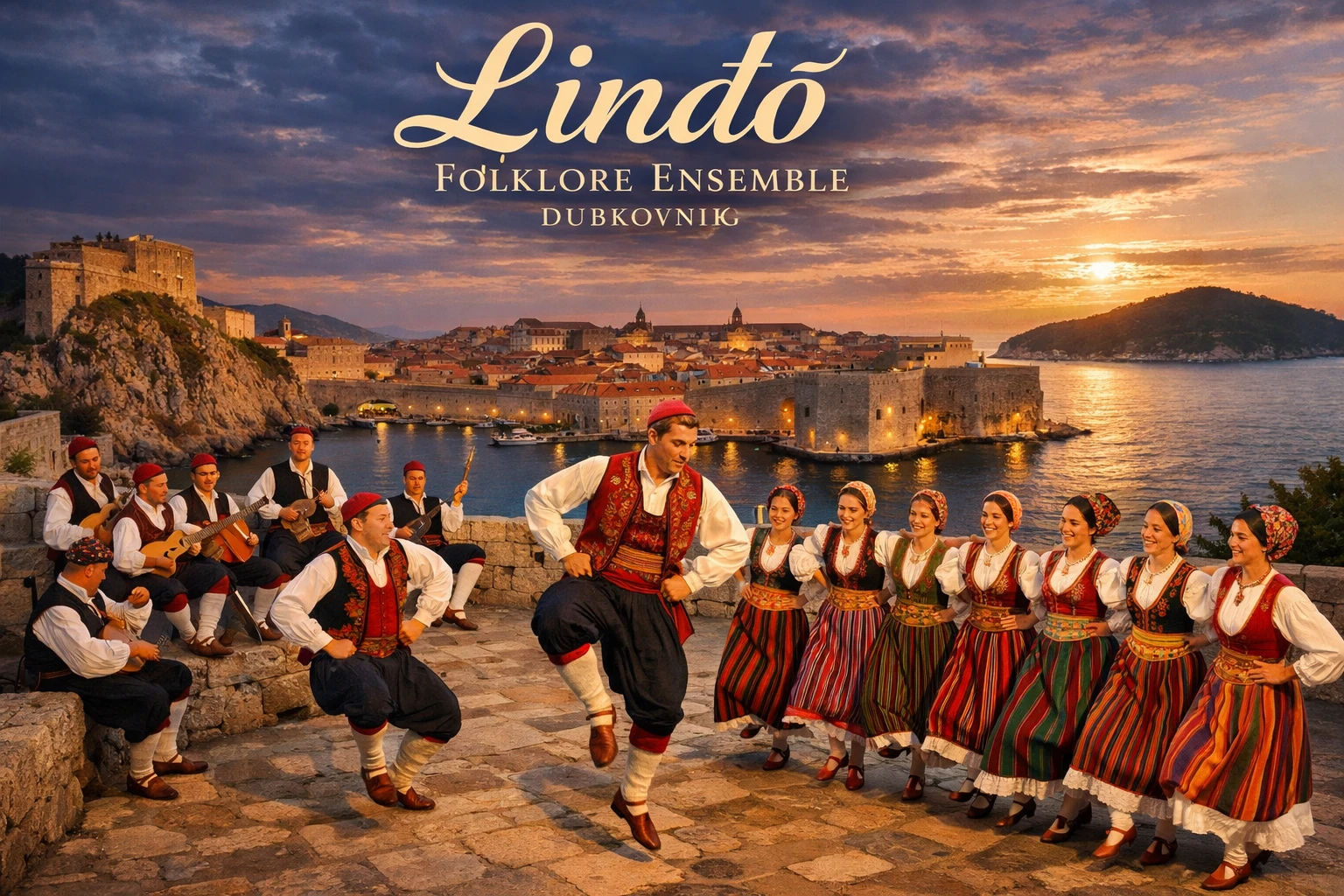
A typical Linđo performance moves through several sections, each representing a different Croatian region: the dances and songs of the Dubrovnik coastal areas including the Linđo circle dance and lijerica music; the traditions of inland Dalmatia, with its fiercer rhythms and more direct vocal style; the music and dance of Slavonia in eastern Croatia, where the tamburica ensemble tradition produces some of Croatian folk music's most exuberant and technically demanding material; and the traditions of the Adriatic islands, with their distinctive harmonies and dance forms.
Each section is performed in the appropriate regional costume, drawn from the ensemble's 1,500-piece collection. The visual impact of a Linđo performance is considerable even before the music begins: the costumes, many of them genuinely antique and all of them handmade, represent a level of material investment and curatorial care that reflects the ensemble's understanding of what it is preserving.
The music itself combines singing, the lijerica, and a broader instrumental complement that varies by regional section. The vocal tradition of the Dubrovnik area includes both solo and group singing in the two-voice style characteristic of the Dalmatian coast, where harmonies are constructed differently from the Western European harmonic system, producing intervals and textures that sound ancient and specific to this place.
The Linđo Heritage Project: Keeping the Tradition Alive
Workshops, Schools, and Living Continuity
One of the most important dimensions of Linđo's work that is invisible to summer visitors is the ensemble's commitment to cultural transmission through education. The Linđo Heritage project brings workshops on traditional instruments, songs, and dances to kindergartens and elementary schools in Dubrovnik and the surrounding region, ensuring that the folk traditions the ensemble performs are not simply maintained as a performance repertoire but actively learned by children who can carry them forward.
This distinction matters. A folk tradition that exists only on stage is a performance tradition. A folk tradition that exists in the hands and voices of children learning it at school is a living culture. Linđo's educational work attempts to maintain the second kind, and in a city that attracts millions of tourists each year and whose own population is relatively small, that intention requires consistent and sustained effort.
The ensemble also runs the lijerica workshops, which teach the unique three-stringed instrument to young people in the region who might not otherwise encounter it. The lijerica's distinctiveness means that there is no broader international teaching tradition to draw on: it must be transmitted locally or it is not transmitted at all.
Dubrovnik Around the Linđo Performance: Making a Full Evening
The Old Town Before the Show
The 21:30 start time of Linđo's performances is perfectly calibrated to the rhythms of Dubrovnik's summer evenings. The day's tourist heat has passed by mid-evening, the long Mediterranean twilight creates extraordinary light across the limestone of the Old Town walls and the terracotta rooftops beyond, and the city's restaurants and cafes are at their most alive in the hours between seven and nine.
The Stradun (Placa), the main limestone-paved boulevard of the Old Town, is the natural gathering point for an evening that leads toward a Linđo performance. The cafes at the Stradun's eastern end, near the Orlando's Column and the Church of St Blaise, fill with visitors and locals from early evening, and the walk from the Stradun eastward through the Ploče Gate to the Lazareti complex takes approximately ten minutes through streets whose architecture shifts gradually from the grandeur of the main artery to the quieter residential character of the eastern quarter.
For dining before the show, the streets around Gundulićeva Poljana (the open-air market square) and the narrow lanes south of the Stradun offer a concentrated range of restaurants serving Dalmatian cuisine at various price points. Fresh Adriatic fish, peka (meat or fish slow-cooked under an iron bell), prstaci (date mussels, though their collection is now restricted), and the local Malvazija and Pošip white wines of the Dalmatian islands are the appropriate culinary accompaniment to an evening that will end with Dubrovnik's oldest living folk tradition.
The Wall Walk: Before the Performance
The Dubrovnik city wall walk is one of the finest two-hour cultural experiences available anywhere on the Mediterranean, covering approximately two kilometres around the full perimeter of the Old Town with views both inward across the city's rooftops and outward over the Adriatic. In summer the wall walk opens from 8:00 AM and operates until the late afternoon; in spring and autumn hours vary. A morning wall walk followed by a day of sightseeing and an evening Linđo performance is the ideal structure for a complete Dubrovnik day.
Fort Lovrijenac, the dramatic promontory fortress just west of the Old Town's Pile Gate, is worth visiting in the afternoon before a Linđo evening. Its inscription, "Non bene pro toto libertas venditur auro" (Freedom must not be sold for all the gold in the world), was the motto of the Republic of Ragusa and remains the most concise statement of what this city has historically stood for.
Lokrum Island, 15 minutes from the Old Town harbour by regular boat service, offers a nature reserve of forested limestone with sea pools, botanical garden remnants, and the ruins of a Benedictine monastery. In May and June, before the summer crowds intensify, it is a particularly beautiful destination for a morning visit.
Practical Information for the 2026 Linđo Season
Performance period: May through October 2026, with special performances during the Dubrovnik Summer Festival (10 July to 25 August 2026)
Principal venues:
- Lazareti complex, eastern entrance to the Old Town (Ploče Gate area), Dubrovnik
- Revelin Fort Terrace, Culture Club Revelin, Sv. Dominika bb, Dubrovnik
Performance start time: 21:30
Ticket prices: €17 to €30 (price may vary by date, venue, and advance purchase timing)
Ticket booking: lindjo.hr; dubrovnik-festival.hr for Summer Festival dates; also bookable through experience platforms and hotel concierge services
Getting to Dubrovnik: Dubrovnik Airport (DBV), approximately 20 kilometres from the Old Town, has direct flights from London, Amsterdam, Frankfurt, Paris, Vienna, and many other European cities. Airport buses to the Old Town take approximately 30 to 40 minutes.
Getting to Lazareti: From the Old Town's Stradun, walk eastward through the old streets, through the Ploče Gate, and follow the waterfront path for approximately five to ten minutes. The Lazareti complex is immediately outside the gate on the right.
Getting to Revelin Fort: Fort Revelin is located at the eastern end of the Stradun, immediately adjacent to the Ploče Gate entrance to the Old Town. From the Stradun, the walk takes less than five minutes.
Accommodation: May and June offer considerably better value and availability than July and August. In peak summer, accommodations in and near the Old Town should be booked months in advance. Lapad Bay and Babin Kuk peninsula have good three and four-star hotel options with regular bus connections to the Old Town.
Weather: Dubrovnik in May averages 20 to 24 degrees Celsius. July and August average 28 to 32 degrees, with evenings remaining warm. A light layer may be useful for late evening performances in May and June.
Sixty Years and Still the Good Spirit of the City
The Linđo Folklore Ensemble has given more than two million people their most direct and immediate encounter with Croatian folk culture in one of the world's most beautiful settings. After 60 years, more than 3,500 performances, 1,500 handmade costumes, 3,000 members across generations, and performances on four continents, it remains what it has always been: Dubrovnik's most authentic cultural offering, the one that belongs specifically and entirely to this place and nowhere else.
When the lijerica begins to play in the Lazareti courtyard as the Adriatic night deepens, when the dancers in their antique costumes begin the circle of the Linđo with the energy and precision that 60 years of dedicated rehearsal produces, you are not watching a tourist attraction. You are watching a city know itself, in the oldest and most honest language it has.
Check the 2026 performance calendar at lindjo.hr and book your evening in Dubrovnik with Linđo at its centre. It is, as the people of this city have been saying for six decades, unmissable.
Verified Information at a Glance
| Detail | Information |
|---|---|
| Ensemble Name | Linđo Folklore Ensemble (Folklorni Ansambl Linđo) |
| Event Category | Folk Dance and Music Performance / Living Cultural Heritage / Traditional Arts |
| Founded | 1964 (auditions); performing since 1965 |
| Performance Season 2026 | May through October 2026 |
| Special Performances | During Dubrovnik Summer Festival, 10 July to 25 August 2026 (77th edition) |
| Principal Venues | Lazareti complex, eastern entrance to Old Town, Dubrovnik (21:30 start) |
| Fort Revelin Terrace, Culture Club Revelin, Sv. Dominika bb, Dubrovnik (21 | 30 start) |
| Performance Start Time | 21:30 |
| Ticket Price | €17 to €30 (varies by date and venue) |
| Ticket Booking | lindjo.hr; dubrovnik-festival.hr; hotel concierge; experience booking platforms |
| Ensemble Scale | 200–300 active performers aged 12 to 28; over 3,000 total members across history |
| Costume Collection | 1,500 handmade original folk costumes |
| Performance Record | Approximately 3,500 performances; more than 2,000,000 visitors |
| International Tours | Around 200 promotional tours in approximately 20 countries |
| Signature Dance | Linđo circle dance, originating in Konavle and Primorje (Dubrovnik hinterland) |
| Signature Instrument | Lijerica (traditional three-stringed bowed instrument, unique to the Dubrovnik region) |
| Heritage Recognition | Croatian List of Intangible Cultural Heritage; UNESCO-patronised Inter-city Intangible Cultural Cooperation Network; Ambassador for Peace by IIPT (2012); Gold Medal and Gold Record, International Dijon Folklore Festival, France (1973) |
| Educational Programme | Linđo Heritage project bringing workshops on traditional instruments, songs, and dances to kindergartens and elementary schools in Dubrovnik |
| Average Annual Performances | More than 100 per year |
| Official Website | lindjo.hr |
| Summer Festival Integration | dubrovnik-festival.hr; Summer Festival runs 10 July to 25 August 2026 |
| Getting to Dubrovnik | Dubrovnik Airport (DBV); direct flights from London, Amsterdam, Frankfurt, Paris, Vienna, and many European cities; airport bus to Old Town approx. 30–40 minutes |
| Average Temperature in Dubrovnik | May 20–24°C; July–August 28–32°C; light layer recommended for May evening performances |
Event Details
Date
to
Location
Lazareti Cultural Centre, Frana Supila 8, Dubrovnik / Theatre Sloboda, Dubrovnik
Dubrovnik, Croatia
Price
from €17 to €30