

Event Has Passed - See You Next Time!
Event Details
Date
Location
Citywide, Geneva, Switzerland
Geneva, Switzerland
Price
Free Entry
About This Event
Whit Monday in Geneva 2026: Your Complete Guide to Lundi de Pentecôte in Switzerland's Most International City
Some public holidays arrive as a straightforward day off. Others invite you to actually do something with the time you have been given. Whit Monday, Lundi de Pentecôte, falls on Monday 25 May 2026 in the Canton of Geneva, and in one of Europe's most beautifully situated cities, positioned between the Jura mountains and the Alps with the deepest lake in the country stretching at its feet, a day off in late May is a gift worth planning for.
Whit Monday is a statutory national public holiday in the Canton of Geneva, one of several that the city-canton observes in addition to Switzerland's only federal public holiday, the first of August. In 2026, it falls at the very beginning of summer's approach: the days are long, the lake is warming, the terraces of the Old Town are fully deployed, and the mountains visible from the lakeside are still capped with snow in a combination that is unique to this latitude and this geography.
Whether you are a Geneva resident looking for the best way to spend a Monday free of work obligations, or a visitor who has deliberately timed a stay to coincide with a quieter version of the city, this guide covers everything worth knowing about Whit Monday 2026 in Geneva.
The Meaning Behind Whit Monday: A Christian Feast Embedded in Swiss Life
The Theological Origin and Its European Calendar
Whit Monday, known in French as Lundi de Pentecôte and in German as Pfingstmontag, is the day after Pentecost Sunday, which falls fifty days after Easter Sunday. In 2026, with Easter falling on Sunday 5 April, Pentecost Sunday is on 24 May and Whit Monday is therefore on 25 May 2026. The date shifts each year according to the Easter calculation, but it always lands in late May or early June, placing it reliably in the most pleasant weeks of the European spring.
The theological significance of Pentecost is the descent of the Holy Spirit upon the disciples of Jesus Christ, as described in the Acts of the Apostles. This event, understood in Christian tradition as the birth of the church, has been commemorated liturgically since the 4th century and became one of the principal feasts of the Christian calendar across all denominations. The Monday following Pentecost Sunday was designated as a holiday in the Catholic tradition and was largely retained by Protestant and Reformed churches, making it genuinely ecumenical in its civic observance.
In Switzerland, Whit Monday is observed as a public holiday in the large majority of cantons. Whit Monday is celebrated in all cantons except Neuchâtel, Solothurn, Valais, and Zug. The Canton of Geneva is firmly in the majority: Whit Monday is confirmed as a statutory national public holiday in Geneva, meaning that schools, government offices, banks, and most businesses are closed.
Geneva's Particular Relationship with the Reformed Tradition
There is a specific historical irony in Geneva's observation of Whit Monday. Geneva was the city of John Calvin, one of the principal architects of the Protestant Reformation, whose theological tradition was considerably more austere in its approach to religious festivals than the Catholic calendar. Under the Calvinist Reformed tradition that Calvin established in Geneva from 1541, many of the Catholic feast days were abolished as theologically unjustified and culturally corrupting.
Yet Whit Monday has persisted in Geneva's public holiday calendar across five centuries of Reformed Christianity, secularisation, and the city's transformation into one of the world's most cosmopolitan international centres. This is partly because the broader Swiss confederation maintained Pentecost Monday even as other holidays were debated, and partly because the civic and social value of a late-May holiday proved itself regardless of its theological origins. Today, Geneva's Whit Monday is observed by a city population that is genuinely diverse in its religious composition, including Catholic, Protestant, Orthodox, Muslim, Jewish, Buddhist, and secular citizens, for whom the day functions as a shared civic pause rather than a specifically Christian observance.
Whit Monday 2026 in Geneva: What Happens on the Day
What Is Open and What Is Closed
As a statutory public holiday, Whit Monday in the Canton of Geneva closes a specific set of institutions and businesses:
Closed on 25 May 2026: Government offices and administration. Schools at all levels. Banks and financial institutions. Most shops in the city centre (though this depends on individual businesses and there are exceptions for some retailers in tourist areas). Post offices. Some restaurants and businesses may also choose to close.
Typically open on 25 May 2026: Museums and cultural institutions, which treat public holidays as normal operating days or sometimes run special programming. Restaurants and cafes, particularly in the Old Town and along the lakefront, which benefit from the increased foot traffic of a public holiday. Hotels and accommodation services. The main tourist attractions of the city: the Jet d'Eau, the Flower Clock, the Cathedral of Saint-Pierre, and the Palais des Nations visitor entrance. Public transport, operating on a Sunday/holiday timetable rather than the weekday schedule, though well-connected across the city and surrounding region.
Visitors should check individual museum and attraction websites for specific holiday hours, as some institutions adjust their timetables or close for a mid-week break that does not align with the public holiday.
The Lake, the Parks, and the May Atmosphere
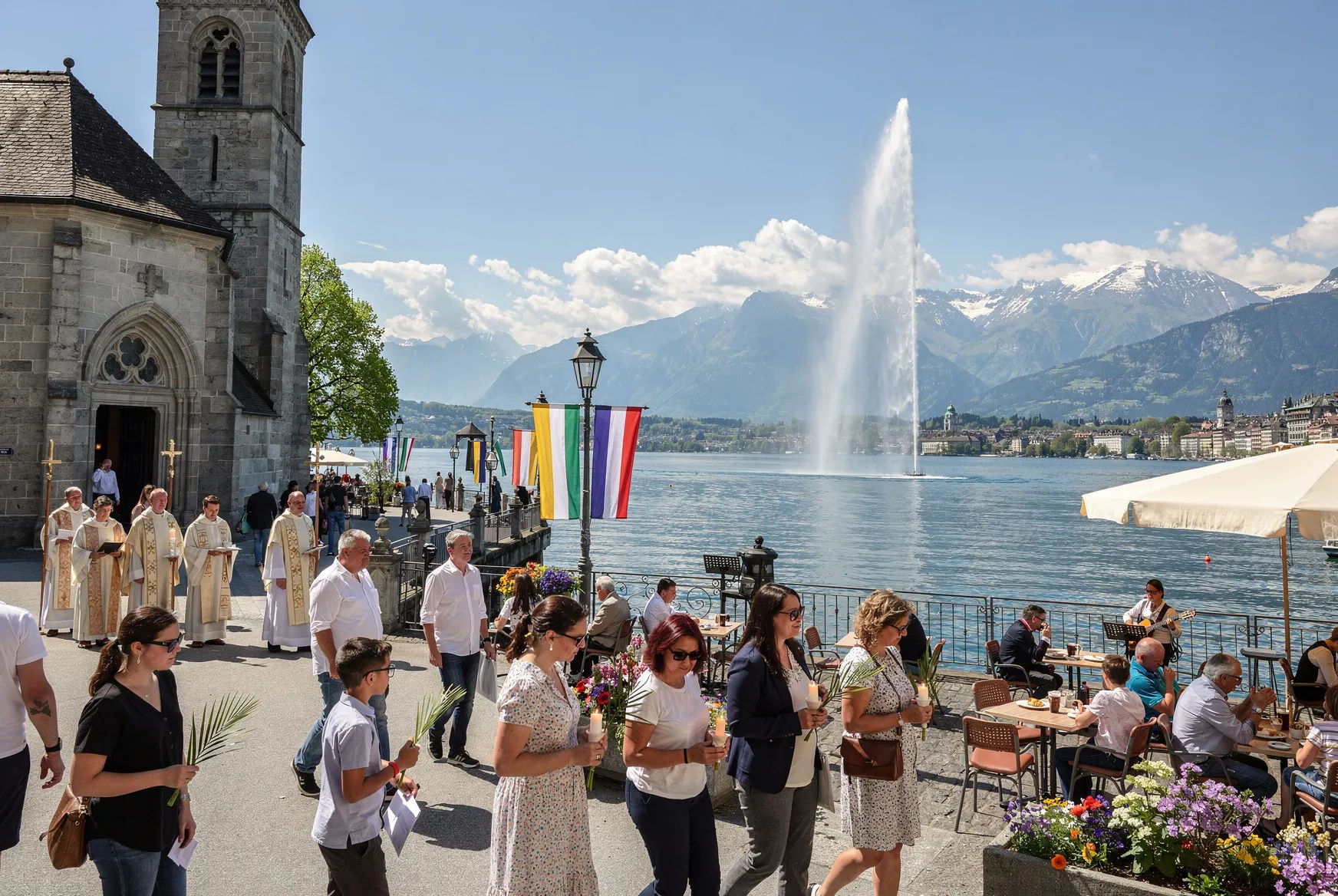
What makes Whit Monday particularly special in Geneva is the time of year. Late May in Geneva is the beginning of the outdoor season that the city lives for in the warmer months. The Jet d'Eau, the iconic 140-metre water fountain in Lake Geneva that has become the city's most recognised symbol, is operational from spring through early autumn and is visible from most of the lakefront and from much of the Old Town. On a clear May morning, the combination of the jet's white plume against the blue lake and the snow-capped Alps beyond is the visual image of Geneva at its most spectacular.
The Quais du Rhône and du Lac (the riverside and lakeside promenades) are at their most animated on public holidays when the working city takes to the water. The Bains des Pâquis, the popular public baths on the Right Bank lakefront, open their season in spring and are one of the most beloved social spaces in Geneva for both residents and visitors: a wooden jetty with a small sauna, café, and changing facilities that extends into the lake and turns the public holiday afternoon into a genuinely Genevan experience.
The Parc des Bastions, immediately below the Old Town and home to the Reformation Wall (Mur des Réformateurs), is a large urban park with giant chess pieces and shaded walks that is one of the most popular outdoor gathering places in the city. The Reformation Wall itself, an 100-metre-long bas-relief monument featuring the principal figures of the Protestant Reformation including Calvin, Farel, Beza, and Knox, is one of the most important historical monuments in the city and gives the park a significance beyond its role as an urban green space.
The Jardin Anglais on the Right Bank, home to the famous Horloge Fleurie (Flower Clock) planted with thousands of flowering plants that is replenished each season, is at its most colourful in late May, when the spring planting is fully established. The Flower Clock's giant clock mechanism and intricate seasonal planting have made it Geneva's most photographed landmark after the Jet d'Eau.
Exploring Geneva on Whit Monday: A City Built for Long Days Off
The Old Town: History in Every Alley
Geneva's Vieille Ville (Old Town) is the historic heart of the city, built on a hill above the Rhône and the lake with ramparts, medieval churches, and 18th-century bourgeois architecture all layered onto the Roman settlement that preceded them. On a public holiday, the Old Town takes on a different rhythm from the weekday rush: the Grand-Rue and the Place du Bourg-de-Four fill with people who have time to look rather than simply pass through.
The Cathédrale Saint-Pierre, where John Calvin preached from 1536 and which remains one of the finest Gothic churches in the French-speaking world, is open to visitors throughout the year. Climbing the north tower for the view over the city, the lake, and the mountains is one of the finest free experiences Geneva offers, available for a modest fee. The Archaeological Site under Saint-Pierre, accessible through the cathedral entrance, reveals Roman, early Christian, and medieval layers beneath the current building in one of the finest urban archaeology displays in Switzerland.
The Musée d'Art et d'Histoire (Museum of Art and History) on the Rue Charles-Galland, the largest museum in Switzerland by collection size, houses Egyptian antiquities, Flemish and Dutch paintings, Impressionist works, and an extraordinary collection of Swiss watchmaking history. Its reopening from renovation in 2028 means that in 2026 many of its collections are displayed at alternative venues; check the museum website for current access information.
The Maison Tavel, the oldest private house in Geneva, converted into a museum of the city's history, is located on the Rue du Puits-Saint-Pierre in the Old Town and provides an excellent introduction to the city's evolution from medieval commune to international capital.
The International District and the Palais des Nations
Geneva's identity as the headquarters of dozens of international organisations, from the United Nations European headquarters and the World Trade Organization to the International Committee of the Red Cross and the World Health Organization, gives the city a district that is unlike any other in Switzerland.
The Palais des Nations, the historic inter-war building that housed the League of Nations and now serves as the UN's second largest headquarters after New York, offers guided tours that are among the most interesting in Geneva. The Assembly Hall, the Council Chamber, and the Salle des Pas Perdus (the grand entrance lobby) are all accessible on the standard tour, which departs regularly from the Pregny Gate entrance. Visitors need to bring a passport or national ID document and should book in advance via the UN Geneva website.
The International Red Cross and Red Crescent Museum (Musée International de la Croix-Rouge et du Croissant-Rouge) on the Avenue de la Paix is one of Geneva's most powerful cultural institutions, and one of the most genuinely important museums in Switzerland. Its exhibitions on humanitarian law, the history of armed conflict, and the global reach of the ICRC are presented with a directness and emotional intelligence that makes it as moving as it is informative. The museum is open on public holidays (check icrcmuseum.org for confirmed holiday hours).
Day Trips: The Lake and the Mountains
The Lake Geneva region unfolds immediately from the city in both directions along the lake, and a public holiday in late May is an ideal time to take one of the CGN lake steamers (Compagnie Générale de Navigation) to destinations including Lausanne, Vevey, Montreux, and the Chillon Castle. The castle, arguably the finest medieval fortress in Switzerland, sits on a rocky promontory in the lake at the foot of the Alps near Villeneuve and is reachable in approximately 90 minutes by steamer from Geneva. It inspired Lord Byron's poem "The Prisoner of Chillon" and remains one of the most visited historic sites in the country.
The Salève mountain on the French side of the border, reachable by cable car from Étrembières just across the frontier and visible from virtually everywhere in Geneva, provides a panoramic platform above the city for those who want mountain air within an hour of the lakefront. A cable car journey, a walk on the ridge, and a lunch with views of the city and the Alps before descending is a satisfying Whit Monday structure.
The Lavaux wine terraces, a UNESCO World Heritage Site on the northern shore of Lake Geneva between Lausanne and Vevey, are at their most beautiful in late May when the vines are in full leaf. Walking the marked trails through the terraced vineyards, stopping at domaines for tastings of the local Chasselas white wine, is one of the great outdoor experiences of the Lake Geneva region and is accessible by train from Geneva in approximately 45 minutes.
Practical Information for Whit Monday 2026 in Geneva
Date: Monday 25 May 2026
Holiday status: Statutory national public holiday in the Canton of Geneva. Schools, government offices, banks, and most businesses closed.
Public transport: CFF (Swiss Federal Railways) trains, TMG city buses, and the TPG (Transports publics genevois) network all operate on public holiday timetables on Whit Monday, which are similar to Sunday schedules. Check sbb.ch and tpg.ch for confirmed timings.
Museums: Most of Geneva's major museums are open on public holidays with normal or slightly adjusted hours. Check individual institution websites for confirmation.
Weather in Geneva in late May: Average daytime temperatures of 18 to 22 degrees Celsius. Late May is typically warm, sunny, and dry, though brief afternoon thunderstorms are not uncommon given the city's position between mountain ranges. Light clothing with one layer for the evening and a small umbrella cover all scenarios.
Lake steamers: CGN lake steamers run full schedules on public holidays. Tickets and timetables at cgn.ch; advance booking recommended for popular routes on holiday Mondays.
The Palais des Nations: Guided tours require a passport or national ID. Book in advance at unog.ch.
Currency: Swiss franc (CHF). Credit cards are widely accepted in Geneva. Note that Geneva is one of the most expensive cities in the world; budgeting accordingly for accommodation, food, and activities is important.
Language: French is the official language of the Canton of Geneva. English is widely spoken in the international and tourist-facing sectors of the city. German and Italian are understood in international contexts.
A Monday That Invites You to Actually Be in Geneva
Whit Monday 2026 on 25 May in the Canton of Geneva is a day that rewards doing what Geneva does best: walking from the Old Town down to the lake, sitting on a terrace with the Jet d'Eau in view, taking a steamer to a lakeside village, climbing above the city on the Salève, or simply spending a long, unhurried morning in the archaeological rooms beneath the cathedral with the afternoon entirely unscheduled.
The holiday's Christian origins are part of the city's history, embedded in a calendar that has carried them through five centuries of Reformation, revolution, and global transformation into the thoroughly cosmopolitan present. But the day belongs to whoever is in Geneva on 25 May 2026, and the city is worth belonging to.
The lake is there. The mountains are visible from the lakefront. The Jet d'Eau is running. The Old Town's terraces are open. The steamer leaves from the Quai du Mont-Blanc. All of it is available to those who arrive in Geneva with time on their hands and the inclination to use it well.
Verified Information at a Glance
| Detail | Information |
|---|---|
| Holiday Name | Whit Monday / Lundi de Pentecôte / Pfingstmontag |
| Event Category | National Public Holiday (statutory) / Christian Feast Day |
| Date in 2026 | Monday 25 May 2026 |
| Canton | Geneva (and 22 other Swiss cantons; not observed in Neuchâtel, Solothurn, Valais, and Zug) |
| Holiday Status in Geneva | Statutory national public holiday; schools, government offices, banks, and most businesses closed |
| Theological Origin | The day after Pentecost Sunday (50 days after Easter); commemorates the descent of the Holy Spirit upon the Apostles as described in the Acts of the Apostles; date calculated as Easter 5 April 2026 + 50 days = Pentecost Sunday 24 May 2026; Whit Monday = 25 May 2026 |
| Key Attractions Open (verify with individual institutions) | Cathédrale Saint-Pierre (Old Town) with north tower climb and archaeological site |
| Public Transport | CFF trains and TPG city buses operate on Sunday/holiday timetable; check sbb.ch and tpg.ch |
| Weather on 25 May in Geneva | Average 18–22°C; warm and sunny; light clothing with one layer for evening; compact umbrella advisable |
| Currency | Swiss franc (CHF) |
| Official Language | French (canton of Geneva); English widely spoken |
| Geneva's Other Cantonal Public Holidays in 2026 | Good Friday: Friday 3 April 2026 |
| Easter Monday | Monday 6 April 2026 |
| Ascension Day | Thursday 14 May 2026 |
| Swiss National Day | Saturday 1 August 2026 |
| Genevan Fast (Jeûne Genevois) | Thursday 10 September 2026 |
| Christmas Day | Friday 25 December 2026 |
| Restoration of the Republic | Thursday 31 December 2026 |
| Tourism Information | geneve.com; myswitzerland.com |
More Events in Geneva


Event Has Passed - See You Next Time!
Event Details
Date
Location
Citywide, Geneva, Switzerland
Geneva, Switzerland
Price
Free Entry