
Event Has Passed - See You Next Time!
Event Details
Date
Time
7:30 PM - 9:30 PM
Location
KKL Luzern – Concert Hall (Konzertsaal), Europaplatz 1, 6005 Lucerne
Lucerne, Switzerland
Price
Not Available
About This Event
Festival Strings Lucerne: Elgar's Cello Concerto at KKL Luzern on June 10, 2026
A Wednesday evening in June. The doors of the KKL Luzern Concert Hall open onto the Europaplatz and the lake behind it, the water still catching the last of the evening light. Inside, the Festival Strings Lucerne are tuning. Anastasia Kobekina — the French-Russian cellist who has been described as a star of the young generation — is preparing to play one of the most personal and most emotionally direct works in all of orchestral music. And the programme they have built around her is extraordinary: Dame Ethel Smyth, Edward Elgar, Johannes Brahms — three composers, three countries, three very different relationships with music and with their own time.
The Festival Strings Lucerne Season Concert "Elgar's Cello Concerto" takes place on Wednesday, June 10, 2026 at 19:30 at the KKL Luzern Concert Hall, Europaplatz, Lucerne. Tickets available at kkl-luzern.ch.
The Festival Strings Lucerne: A Chamber Orchestra of World Standing
The Festival Strings Lucerne is one of Switzerland's most internationally active and most respected chamber orchestras — an ensemble that appears regularly in the great concert halls of Los Angeles, Hong Kong, Seoul, Berlin, Hamburg, Rome, Milan, and Istanbul, as well as the finest Swiss venues and summer festivals.
The orchestra is led by Daniel Dodds — concertmaster, conductor, and the artistic driving force who has shaped the Festival Strings Lucerne's programming across recent seasons into one of the most intelligent and adventurous in the Swiss chamber orchestra world. Dodds conducts from the violin position in the tradition of the great chamber orchestra leaders, maintaining the intimate, responsive connection between soloist, conductor, and ensemble that this kind of music-making demands.
The Festival Strings Lucerne hold a residency at the Hotel Schweizerhof Luzern — one of the most historic hotels in Lucerne, overlooking the lake and the old town — where the orchestra's soloists present chamber music concerts in intimate formations (trios to octets) throughout the season. The hotel residency gives the ensemble a specific presence in Lucerne's cultural life that goes beyond the formal concert season: informal, small-scale encounters with the musicians that are among the most rewarding experiences available to music-lovers in the city.
Their 2025/26 season has included the KKL's immersive Vivaldi Four Seasons concert (February 8), Inmo Yang playing Paganini (February 26), and the June 10 programme with Anastasia Kobekina — a season that reflects a consistent commitment to combining standard repertoire with more unusual programming choices.
Anastasia Kobekina: A Cellist of Exceptional Promise and Presence
Anastasia Kobekina is described by the KKL Luzern itself as "a star of the young generation" — and that description is not marketing language.
Born in Yekaterinburg, Russia and trained in Paris (where she studied at the Conservatoire National Supérieur de Musique), Kobekina has built an international profile with extraordinary speed, performing with the world's leading orchestras and at the major festivals. She is known for combining technical mastery with an expressive directness and a strong personal stage presence — a cellist who communicates through her body as much as through her bow arm, bringing a quality of physical commitment to performance that gives her playing an immediacy that pure technical refinement alone cannot produce.
For the Elgar Concerto specifically, those qualities are exactly right. The Elgar Cello Concerto requires a soloist who can carry the emotional weight of its introspection without sentimentality — who can play music that is genuinely sad, genuinely resigned, and genuinely beautiful all at once, and make those three qualities coexist in the room without letting any one of them overwhelm the others.
The Programme: Three Works, Three Voices
The June 10 programme is built with a care and intelligence that places it well above the standard "soloist plus orchestral filler" concert format. All three works belong together — not arbitrarily, but because each one speaks to the others in ways that become clearer as the evening progresses.
Dame Ethel Smyth: Symphony for Small Orchestra in D major
The opening work is by Dame Ethel Smyth (1858–1944) — one of the most significant and most persistently underappreciated composers of the late Romantic period.
Smyth studied in Leipzig against her father's wishes, composed operas, orchestral works, chamber music, and songs across a five-decade career, was a prominent figure in the women's suffrage movement (she composed the March of the Women for the Suffragettes), and received a DBE in 1922. She spent much of her career fighting against the systematic exclusion of women composers from the mainstream orchestral programming of her time — a fight that is still, a century later, not fully won.
The Symphony for Small Orchestra in D major is one of her orchestral works — crisp, technically accomplished, full of the melodic confidence and formal intelligence that characterise her best writing. Opening the programme with Smyth is both a musical choice (the D major symphony provides an excellent tonal and atmospheric platform for what follows) and a cultural one: it places a woman composer at the front of an evening that then goes on to celebrate two of the canonical male composers of the same period.
Edward Elgar: Cello Concerto in E minor, Op. 85
The Elgar Cello Concerto is the work around which the entire concert is built, and it deserves the weight that puts on it.
Composed in 1919 and premiered — to a disastrously underprepared performance — at the Queen's Hall in London, the Cello Concerto in E minor is the last major orchestral work Elgar completed. He lived until 1934, but wrote virtually nothing of importance after it. What he had to say in 1919, it seems, was complete — and what he said was a work of extraordinary, unadorned emotional honesty.
The concerto is in four movements and lasts approximately 30 minutes. It is not a virtuosic showpiece in any conventional sense — there is no dazzling display for its own sake, no fast passage work designed to impress an audience. What there is instead is a sustained meditation on memory, loss, and the kind of beauty that belongs to things that are passing or already past.
The opening bars — the cello alone, in a broad recitative — establish immediately that this is music of complete personal exposure. Elgar is not performing. He is not crafting a public gesture. He is speaking about something that cost him something to articulate, and every bar of the concerto carries that specific gravity.
The work was almost entirely neglected after its disastrous premiere and remained largely unknown until Jacqueline du Pré's legendary recording with the London Symphony Orchestra under John Barbirolli (recorded in 1965, at du Pré's age of 20) brought it to international attention. That recording — still considered by many to be the finest cello recording ever made — transformed the Elgar Concerto into one of the most beloved works in the cello repertoire.
For Anastasia Kobekina — a young French-Russian cellist playing a work that was defined in the popular imagination by the young English cellist du Pré — the programme carries an implicit generational dimension that gives the June 10 performance an extra layer of significance.
Johannes Brahms: Symphony No. 2 in D major, Op. 73
The concert closes with Brahms's Second Symphony — and the choice is perfect. After the introspective self-examination of the Elgar, the Brahms Second opens outward.
Composed in 1877 during a summer at Pörtschach on the Wörthersee in Carinthia, the Second Symphony is the warmest, most pastoral, and most openly joyful of Brahms's four symphonies. He described it himself as a work "so ingenuous and harmless and gentle" that it had practically written itself — and while that characteristic Brahmsian self-deprecation understates the achievement, there is a quality of spontaneous, uncomplicated pleasure in the Second Symphony that makes it one of the most immediately accessible of his orchestral works.
The Fourth Movement — one of the great orchestral finales in the repertoire, building from a gentle opening to a blazing D major conclusion — is, after the sustained emotional gravity of the Elgar, one of the most cathartic endings possible for a concert programme.
The KKL Luzern: Where the Music Is Right
The KKL Luzern (Kultur- und Kongresszentrum Luzern) at Europaplatz 1, 6003 Luzern is one of the finest concert halls in the world, and the right venue for this programme in every sense.
Jean Nouvel's building — opened in 1998, its extraordinary roof cantilevering over Lake Lucerne — achieves a quality of natural acoustic resonance in its Concert Hall that serves chamber orchestral music with particular clarity. The warm, direct sound of the Festival Strings Lucerne in the KKL Hall is an experience that rewards the journey to Lucerne from anywhere in central Europe.
Getting there:
- By train: Lucerne Hauptbahnhof (main train station) is a five-minute walk from the KKL along the lake promenade — direct trains from Zurich (50 min), Basel (70 min), Bern (90 min)
- On foot: The KKL is at Europaplatz 1, immediately east of the station on the waterfront
- By tram/bus: Multiple city bus and tram lines stop at the main station, adjacent to the KKL
- By car: Parking available at the Europaplatz car park directly beside the venue — arriving by train is simpler and recommended
Lucerne on a June Evening: The City at Its Most Beautiful
June in Lucerne is the city at full summer confidence. Lake Lucerne is deep blue and clear, the Pilatus and Rigi summits are accessible and vivid, the outdoor restaurant terraces that line the waterfront and the old town are full and alive, and the long June evenings give you time to explore the city before a 19:30 concert start.
Before the Concert: An Afternoon in Lucerne
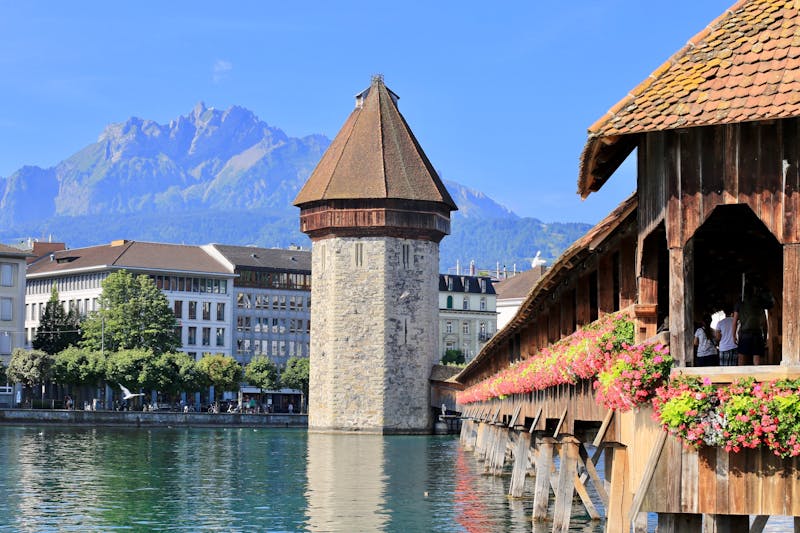
- The Kapellbrücke: Five minutes on foot from the KKL — walk across the 14th-century covered wooden bridge with its 17th-century painted panels above the river, the water tower rising from the middle, and the old town on one side and the modern city on the other
- The KKL lakeside walk: The promenade from the main station to the KKL past the lakeside gardens is one of Lucerne's great walks — the Pilatus visible to the south, the Rigi to the east, the lake reflecting everything
- The Altstadt: The old town with its painted facades, market squares, and the Museggmauer fortification towers is 10 minutes from the KKL — an afternoon walk through medieval streets that have barely changed in 500 years
A Wednesday Evening Worth Building a Trip Around
The Festival Strings Lucerne season concert "Elgar's Cello Concerto" on June 10, 2026 at 19:30 at KKL Luzern Concert Hall brings together one of Switzerland's finest chamber orchestras, one of the young generation's most distinctive cellists, and a programme of extraordinary range and emotional depth, in one of the world's great concert halls on a June evening in one of Europe's most beautiful cities.
Tickets at kkl-luzern.ch — book early, as the Festival Strings Lucerne's season concerts at KKL consistently sell out.
Verified Information at a Glance
EventInformationEventFestival Strings Lucerne Season Concert — "Anastasia Kobekina: Elgar's Cello Concerto"CategoryChamber Orchestra / Classical Music Concert / Season ConcertDateWednesday, June 10, 2026Time19:30VenueKKL Luzern, Concert HallAddressEuropaplatz 1, 6003 Luzern, SwitzerlandArtists Festival Strings Lucerne (chamber orchestra)
Daniel Dodds (conductor / violin)
Anastasia Kobekina (cello soloist) Programme Dame Ethel Smyth: Symphony for Small Orchestra in D major
Edward Elgar: Cello Concerto in E minor, Op. 85
Johannes Brahms: Symphony No. 2 in D major, Op. 73 Ticket PlatformKKL Luzern box office — kkl-luzern.chOrganiserFestival Strings LucerneAbout the OrchestraFestival Strings Lucerne is a Lucerne-based internationally touring chamber orchestra, led by Daniel Dodds; residency at Hotel Schweizerhof Luzern; regular performers at KKL Luzern and internationallyAbout the SoloistAnastasia Kobekina — French-Russian cellist, trained at the Conservatoire National Supérieur de Musique, Paris; described by KKL as "a star of the young generation"Other 2025/26 Festival Strings Lucerne KKL datesFeb 8 (Vivaldi Four Seasons), Feb 26 (Inmo Yang / Paganini), Apr 27 (Reise nach Paris: Piemontesi)Getting there5 min walk from Lucerne HB (main station); direct trains from Zurich (50 min), Basel (70 min), Bern (90 min)
Event Has Passed - See You Next Time!
Event Details
Date
Time
7:30 PM - 9:30 PM
Location
KKL Luzern – Concert Hall (Konzertsaal), Europaplatz 1, 6005 Lucerne
Lucerne, Switzerland
Price
Not Available