Event Has Passed - See You Next Time!
Event Details
Date
to
Time
11:00 AM
Location
Wiener Stadthalle (live shows), Rathausplatz / Eurovision Village (free, May 10–17), Prater Dome / EuroClub (nightly) – Vienna
Vienna, Austria
Price
from €0 to €120
About This Event
Eurovision Song Contest 2026 Vienna: Everything You Need to Know About the 70th Edition
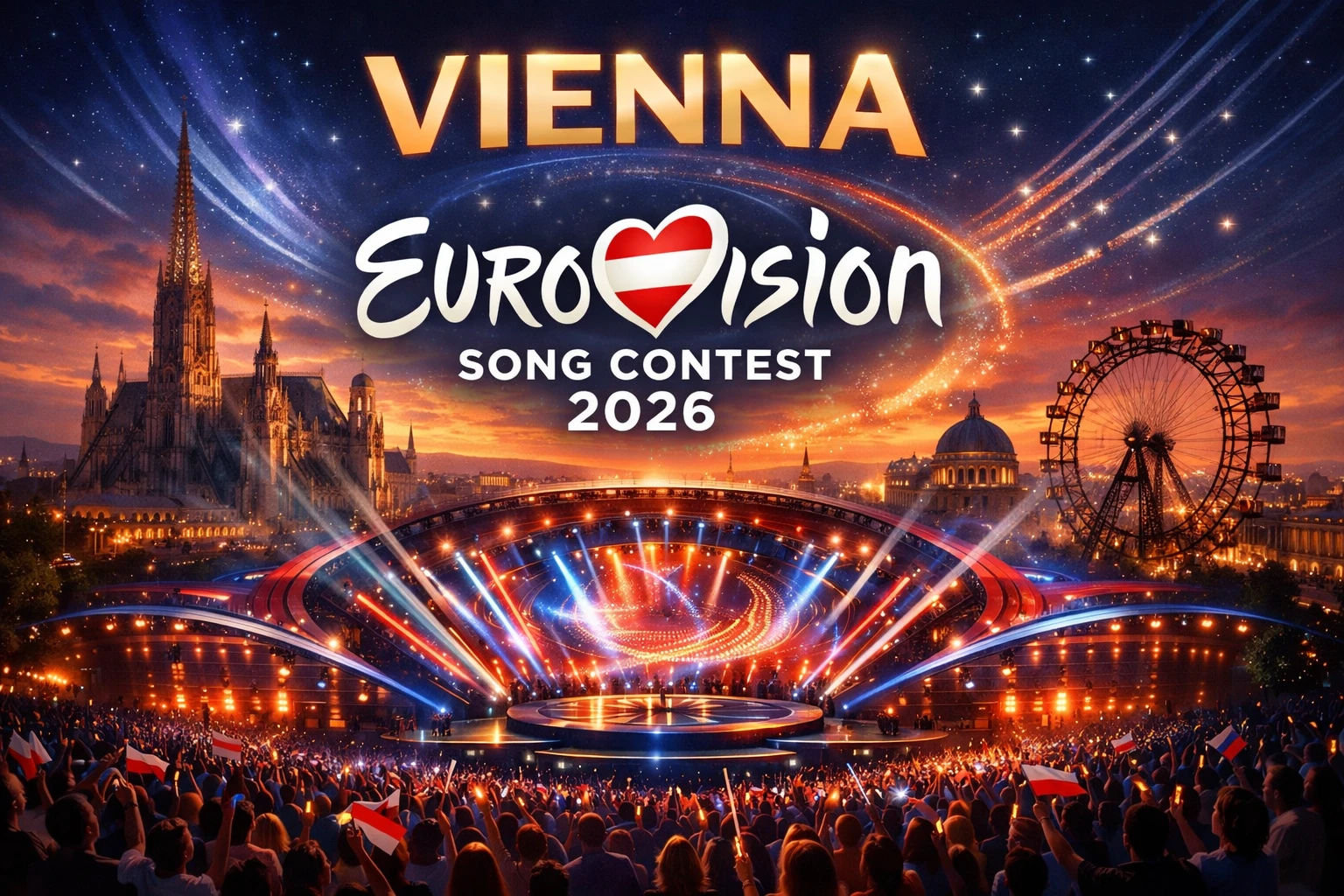
Vienna is ready. For the third time in the city's history, Europe's biggest, loudest, most joyfully excessive music competition is coming to the Austrian capital. The 70th Eurovision Song Contest takes place at the Wiener Stadthalle from Tuesday May 12 to Saturday May 16, 2026 — a week that will see more glitter per square metre than any other event in the European cultural calendar.
The story starts in Basel, May 2025, when Austrian singer JJ won the 2025 contest with "Wasted Love" — a haunting, operatic pop song that earned Austria its third Eurovision victory and the right to host the 70th edition on home soil.
Semi-Final 1: Tuesday May 12, 2026, 21:00 CEST. Semi-Final 2: Thursday May 14, 2026, 21:00 CEST. Grand Final: Saturday May 16, 2026, 21:00 CEST. Eurovision Village (free, Rathausplatz): May 10–17. Turquoise Carpet Opening: May 10 at the Burgtheater and Vienna City Hall.
How Vienna Won the Right to Host: JJ and "Wasted Love"
Austria's path to hosting Eurovision 2026 runs through one of the most striking performances in recent contest history.
JJ — the Austrian countertenor and pop artist whose stage name belies a genuinely extraordinary vocal range that moves between classical countertenor register and contemporary pop phrasing — won the 2025 Eurovision Song Contest in Basel with "Wasted Love." The song, built on an ascending operatic structure that resolves into a contemporary pop chorus, earned top jury and televote scores that gave Austria a clear victory.
It was Austria's third Eurovision win in the contest's 70-year history:
- 1966: Udo Jürgens, "Merci, Chérie" — the win that made Jürgens one of the most celebrated entertainers in German-language music history
- 2014: Conchita Wurst, "Rise Like a Phoenix" — one of the most discussed Eurovision victories in modern times; Conchita's performance in Copenhagen became a global cultural moment and an iconic statement of identity and acceptance; the 2015 Vienna edition hosted in the aftermath of that win set a benchmark for Eurovision hospitality that the city now has to match
- 2025: JJ, "Wasted Love" — the win that brings Eurovision back to Vienna for the 70th anniversary
Austria is one of only a small group of countries to have hosted Eurovision three times — all three occasions in Vienna, all three at the Wiener Stadthalle or predecessor Vienna venues.
The Venue: Wiener Stadthalle in Vienna's 15th District
The Wiener Stadthalle — Roland-Rainer-Platz 1, 1150 Vienna — is Austria's largest indoor arena and one of the most technically sophisticated event venues in Central Europe. With a capacity of 16,152 seats configured for the Eurovision stage format, it hosted the 2015 contest successfully and the EBU's decision to return to the same venue for 2026 reflects the building's proven capability for the contest's specific technical requirements.
The Stadthalle was designed by Austrian architect Roland Rainer and opened in 1958 — a mid-century modernist building that sits in the Rudolfsheim-Fünfhaus district (15th district), approximately 3 kilometres from the Vienna city centre.
Getting to the Wiener Stadthalle:
- U6 U-Bahn to Burggasse-Stadthalle station — the most direct connection; U6 runs the full length of the western and southern Vienna suburbs and connects at Längenfeldgasse with U4 (for the city centre/Karlsplatz) and at Gumpendorfer Straße with U3
- Tram line 6 and bus lines 12A, 14A — surface connections from multiple city centre points
- From Wien Hauptbahnhof: U1 to Karlsplatz, then U4 to Längenfeldgasse, then U6 two stops to Burggasse-Stadthalle — approximately 20 minutes total
The Full Eurovision Week Schedule: May 10–17, 2026
Eurovision is never just a Saturday night. The full week transforms Vienna into a city within a city — a festival-inside-a-festival where the official shows at the Stadthalle are surrounded by days of free public events, parties, rehearsals, and the specific chaotic energy of 40+ national delegations occupying the same city simultaneously.
Sunday May 10 — Opening Ceremony and Turquoise Carpet
The Turquoise Carpet — Eurovision's equivalent of a red carpet, the signature colour chosen for the Vienna 2026 edition — takes place at the Burgtheater (the imperial court theatre on the Ringstraße, one of the most significant German-language theatres in the world), with contestants and their delegations presented before accredited press and fans before the procession moves to the Vienna City Hall (Wiener Rathaus) for the official opening ceremony.
Burgtheater address: Dr.-Karl-Lueger-Ring 2, 1010 Vienna
Vienna City Hall address: Friedrich-Schmidt-Platz 1, 1010 Vienna
This is the moment when Vienna gets its first sight of the year's contestants in person — a public event that draws thousands of fans to the Ringstraße area for the procession.
Tuesday May 12 — Semi-Final 1, 21:00 CEST
The first live show at the Wiener Stadthalle. Countries confirmed for Semi-Final 1 include: Finland, Georgia, Portugal, Belgium, Estonia, Lithuania, Montenegro, San Marino, and Serbia.
Each semi-final qualifies approximately 10 countries for the Grand Final; the top qualifiers from each semi-final join the six automatic Grand Final qualifiers — Austria (as host), plus the "Big Five": United Kingdom, France, Germany, Spain, and Italy.
Thursday May 14 — Semi-Final 2, 21:00 CEST
The second live show. Countries confirmed for Semi-Final 2 include: Armenia, Azerbaijan, Czech Republic, Luxembourg, Romania, Albania, Cyprus, Denmark, Malta, Norway, and Ukraine.
Saturday May 16 — Grand Final, 21:00 CEST
The 70th Eurovision Song Contest Grand Final — the show that will be watched by an estimated 160 million viewers worldwide across the EBU's member broadcaster network and via the Eurovision YouTube stream.
Presented by Victoria Swarovski (Austrian television presenter and singer, known from "Let's Dance" and previous ORF presenting roles) and Michael Ostrowski (Austrian actor and comedian), the Grand Final runs approximately three hours including the songs from all qualified countries, the iconic voting sequence, and the winner's reprise.
Eurovision Village: Free, Open-Air, Rathausplatz, May 10–17
The Eurovision Village at Rathausplatz — the square in front of Vienna's neo-Gothic City Hall — is the free, public face of Eurovision 2026.
From May 10 to May 17, Rathausplatz hosts:
Live public screenings of all three TV shows (Semi-Final 1, Semi-Final 2, Grand Final) — the Vienna tradition of outdoor public screenings at Rathausplatz, established during the summer Film Festival and adapted for Eurovision, gives anyone who does not have a Stadthalle ticket the full broadcast experience in an outdoor concert atmosphere
Performances by contest participants — many competing artists perform at the Eurovision Village during the week; for fans without show tickets, the Village is often where the most spontaneous and personally accessible encounters with the artists happen
Local and international artists — additional programming beyond the contest participants; the Village functions as a week-long outdoor festival in its own right
Admission: Free. No tickets required.
EuroClub: The Official Party Venue
EuroClub — the official after-party and private performance venue for Eurovision — runs from May 11 to May 16 at the Praterdome, Vienna's large club venue in the Prater area of the 2nd district.
EuroClub access requires official accreditation — it is primarily for delegations, accredited press, and industry — but participating fans with specific ticket packages can also attend some events. The Praterdome's location in the Prater, approximately 3 kilometres from the city centre and directly accessible by U2 (station: Messe-Prater or Krieau), makes it logistically well-placed for the late-night schedule that EuroClub always follows.
Tickets: The Reality in April 2026
Stadthalle show tickets were sold exclusively via eurovision.com in two main sales rounds:
Round 1: January 13, 2026 — for fans who pre-registered by the December 18, 2025 deadline, who received a unique personal access code via email on January 11, 2026
Round 2 (last remaining tickets): March 26, 2026, 15:00 CET — final allocation for registered fans with a personal access code
The practical reality as of April 2026: Official ticket inventory through eurovision.com is effectively exhausted. The March 26 final sale was the last allocation. Resale platforms exist but carry the standard risks of the secondary market; fans looking to attend in person should check eurovision.com for any late releases and approach secondary market options with caution.
The Eurovision Village at Rathausplatz and the public screenings remain fully free and accessible without tickets — and for many visitors to Vienna during Eurovision week, the combination of the Village atmosphere, the city-wide fan events, and watching the Grand Final on the big outdoor screen at Rathausplatz constitutes an entirely complete Eurovision experience.
Vienna as an Eurovision City: What the 2015 Edition Proved
Vienna hosted Eurovision in 2015 following Conchita Wurst's iconic 2014 Vienna — and the evaluation of that edition by the EBU confirmed the city's specific strengths as an Eurovision host:
Hotel infrastructure: Vienna has approximately 140,000 hotel beds — one of the highest capacities of any European capital; the city absorbed the 2015 Eurovision audience without the capacity crises that smaller host cities sometimes experience
Transport: The Vienna public transport network (Wiener Linien) operates a 24-hour service on weekends including during major events; the U-Bahn and tram network covers all relevant Eurovision locations with reliable frequency
Airport: Vienna International Airport (VIE) is one of Central Europe's busiest airports — with direct connections to every European capital and to major intercontinental hubs; the CAT (City Airport Train) runs to Wien Mitte (Landstraße) in 16 minutes
Fan culture: Vienna's combination of imperial architecture, café culture, and the specific Viennese quality of taking everything seriously while treating nothing with undue reverence makes it one of the most naturally welcoming cities for the Eurovision audience — diverse, camp, politically engaged, and passionately international.
Vienna in Eurovision Week: The City Beyond the Stadthalle
The week of May 10–17 puts Vienna under a specific kind of international spotlight — one that the city's cultural institutions, restaurants, bars, and public spaces all respond to.
Neighbourhoods to stay in and explore:
1st district (Innere Stadt) — the historic centre; walking distance from the Turquoise Carpet venues (Burgtheater, Rathaus); the Graben, Kohlmarkt, and Kärntner Straße pedestrian zones fill with Eurovision-adjacent activity during the week
7th district (Neubau/Spittelberg) — the design and creative neighbourhood adjacent to the MuseumsQuartier; full of bars, restaurants, and boutiques; a favourite with the Eurovision fan demographic
2nd district (Leopoldstadt) — includes the Prater, home to EuroClub at the Praterdome, and the Augarten; undergoing significant urban development and increasingly popular with visitors; the Naschmarkt on the U4 line (station: Kettenbrückengasse) is a 15-minute journey from the Praterdome
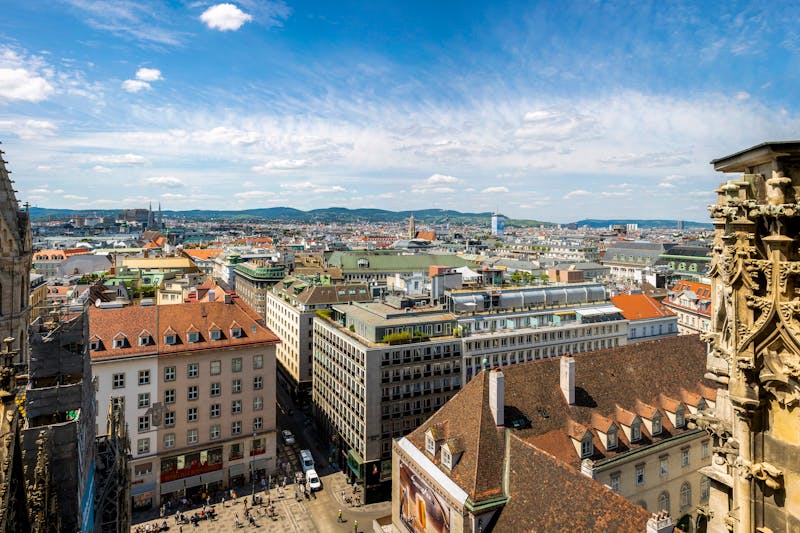
Rathausplatz — the centre of Eurovision's public life for the full week; the surrounding Josefstadt (8th district) and the Ringstraße institutions (Kunsthistorisches Museum, Naturhistorisches Museum, Burgtheater) are all walkable from the Village
The 70th Anniversary: A Contest That Has Defined Decades
Eurovision 2026 is the 70th edition — a number that reflects the contest's genuine longevity as the world's longest-running international televised music competition.
The contest was created by the EBU in 1956 as part of the post-war project of European cultural and broadcasting cooperation — a format in which member national broadcasters each submitted a song, broadcast the competition live, and voted for each other's entries.
The first contest took place in Lugano, Switzerland in May 1956 with 7 participating countries. The 2026 edition features approximately 37 participating countries and will be watched by an estimated 160 million viewers — one of the largest single-event television audiences in the world in any year.
The 70 years in between have produced the musical careers of ABBA (1974 winners representing Sweden), Celine Dion (1988 winner representing Switzerland), and Julio Iglesias (1970 Spanish entrant before his international career), and generated some of the most debated, celebrated, and remembered performances in the history of European popular music.
Vienna in May: One of Europe's Best Travel Moments
May in Vienna is the city at its most comfortable and most alive: mild temperatures typically ranging from 14°C to 22°C, the parks in full leaf, the Ringstraße at its most beautiful, and the outdoor café culture that makes Vienna one of the most leisured and pleasant cities in Europe operating at full capacity.
Eurovision week adds the specific energy of an international fan community that has been waiting a year for this: flags at hotel windows, costumes on the U-Bahn, multilingual conversations on the Graben, and the Rathausplatz Village turning Vienna's most ceremonial public square into Europe's most colourful outdoor party.
The city is ready. The Stadthalle is dressed. The Turquoise Carpet is unrolled. Thirty-seven countries. One winner. Saturday May 16 at 21:00 CEST.
Verified Information at a Glance
| Detail | Information |
|---|---|
| Event | Eurovision Song Contest 2026 — 70th Edition |
| Category | International Music Television Competition / Live Entertainment Event |
| Host city | Vienna, Austria |
| Host broadcaster | ORF (Österreichischer Rundfunk) |
| Organiser | European Broadcasting Union (EBU) |
| TV Show dates and times (all 21 | 00 CEST): |
| Semi-Final 1 | Tuesday, May 12, 2026 |
| Semi-Final 2 | Thursday, May 14, 2026 |
| Grand Final | Saturday, May 16, 2026 |
| Venue | Wiener Stadthalle |
| Venue address | Roland-Rainer-Platz 1, 1150 Vienna, Austria |
| Venue capacity | 16,152 seats |
| TV Presenters | Victoria Swarovski and Michael Ostrowski |
| Austria's win | JJ, "Wasted Love," Eurovision 2025, Basel — Austria's 3rd victory |
| Previous Vienna hosting | 1967 (after Udo Jürgens 1966 win); 2015 (after Conchita Wurst 2014 win) |
| Eurovision Village (FREE) | May 10–17, 2026, Rathausplatz, Vienna |
| Opening Ceremony / Turquoise Carpet | Sunday May 10, 2026 — Burgtheater (Dr.-Karl-Lueger-Ring 2) then Vienna City Hall (Friedrich-Schmidt-Platz 1) |
| EuroClub | May 11–16, 2026 — Praterdome, Vienna (2nd district) — accreditation required |
| Semi-Final 1 countries (confirmed) | Finland, Georgia, Portugal, Belgium, Estonia, Lithuania, Montenegro, San Marino, Serbia |
| Semi-Final 2 countries (confirmed) | Armenia, Azerbaijan, Czech Republic, Luxembourg, Romania, Albania, Cyprus, Denmark, Malta, Norway, Ukraine |
| Automatic Grand Final qualifiers | Austria (host), UK, France, Germany, Spain, Italy |
| Worldwide viewership | ~160 million |
| Tickets | eurovision.com (official; last sale March 26, 2026 — effectively sold out) |
| Eurovision Village | Free, no tickets required |
| Venue transport | U6 to Burggasse-Stadthalle |
| Airport | Vienna International Airport (VIE) — CAT to Wien Mitte 16 min |
| Official Eurovision website | eurovision.com |
| Wien.info Eurovision page | wien.info/en/now-on/eurovision-song-contest/esc-2026-wien |
Event Has Passed - See You Next Time!
Event Details
Date
to
Time
11:00 AM
Location
Wiener Stadthalle (live shows), Rathausplatz / Eurovision Village (free, May 10–17), Prater Dome / EuroClub (nightly) – Vienna
Vienna, Austria
Price
from €0 to €120