
Event Has Passed - See You Next Time!
Event Details
Date
Time
7:30 PM - 10:00 PM
Location
Heldenplatz, Burggasse 7 (in front of Neue Burg / Hofburg), 1010 Vienna
Vienna, Austria
Price
Free Entry
About This Event
Fest der Freude 2026: Vienna's Most Moving Free Concert Returns to Heldenplatz on May 8
Not every free concert is the same. Some are free because nobody would pay for them. And then there is the Fest der Freude — the Festival of Joy — a free outdoor concert on Vienna's Heldenplatz that has been drawing tens of thousands of Viennese and international visitors every year since 2013, not because of clever marketing, but because of what it means and what it sounds like.
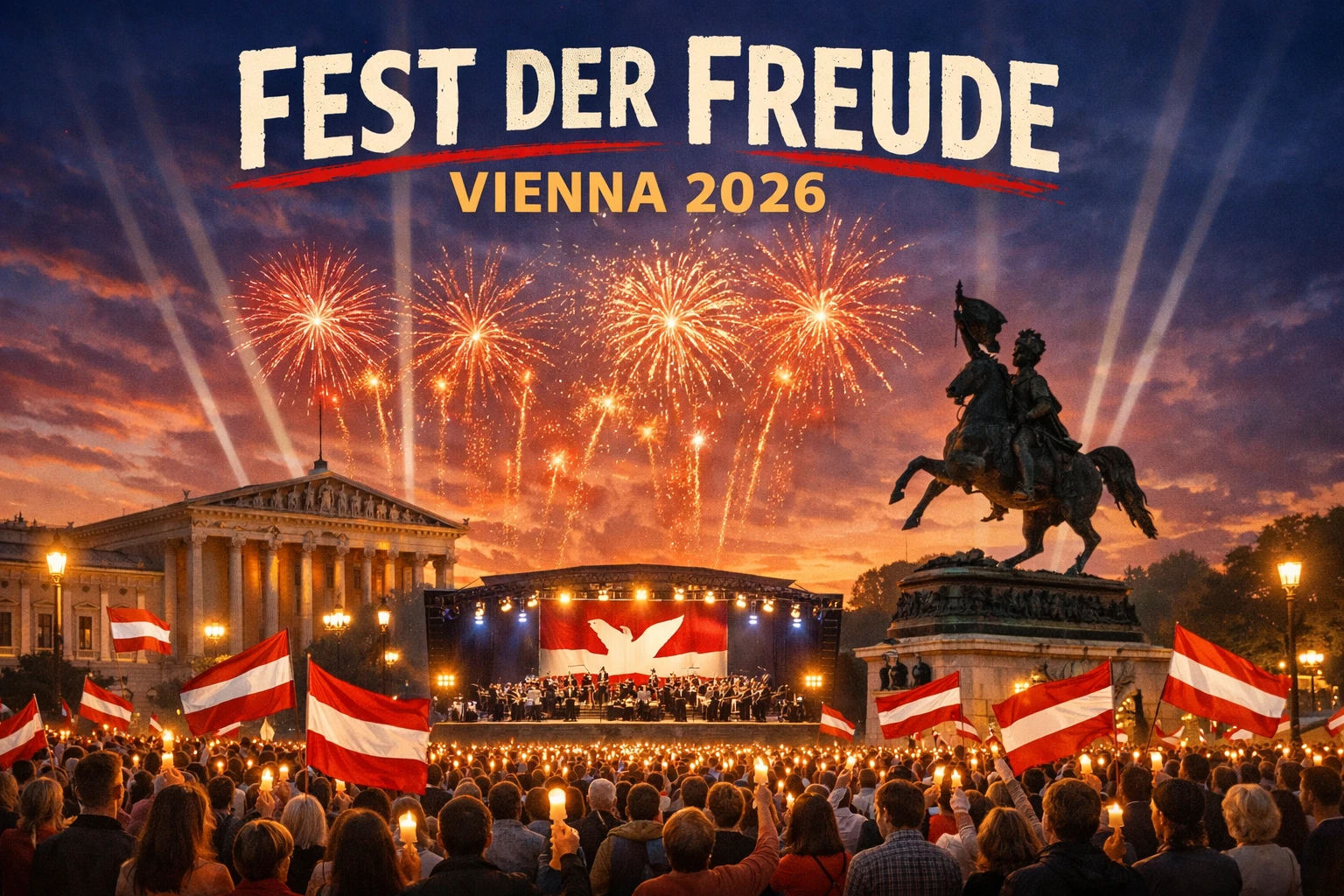
On Friday, May 8, 2026 at 19:30, the Wiener Symphoniker (Vienna Symphony Orchestra) takes the outdoor stage at the Heldenplatz under conductor Ingo Metzmacher to mark the 81st anniversary of the unconditional surrender of the German Wehrmacht — the end of the Second World War in Europe, and the end of Nazi rule over Austria. Federal President Alexander Van der Bellen will address the audience. Contemporary witness Lucy Waldstein will speak. Soprano Eleanor Lyons and Austrian singer Magda will perform alongside the full orchestra. And the evening will end, as it always does, with Ludwig van Beethoven's "Ode to Joy."
Free admission. No ticket required. Heldenplatz, Vienna, May 8 at 19:30.
The 8th of May: What the Fest der Freude Commemorates
May 8, 1945 was the day the German army surrendered unconditionally to the Allied forces — the event that ended the Second World War in Europe after nearly six years of conflict and brought to a close twelve years of Nazi rule across Germany, Austria, and occupied Europe.
For Austria, the meaning of May 8 is specific and layered. Austria was formally incorporated into the German Reich through the Anschluss of March 12–13, 1938 — an annexation that was welcomed by a significant portion of the Austrian population even as it stripped the country of its sovereignty and made it a full participant in the Nazi apparatus of war and genocide.
The Heldenplatz is the physical location at which these two moments of Austrian 20th-century history are most directly visible. On March 15, 1938, more than 200,000 people gathered on the same square to hear Adolf Hitler formally announce the Anschluss from the balcony of the Neue Burg — the imperial palace wing that borders the square's eastern side. The scale of the crowd's approval on that day remains one of the most discussed and most uncomfortable facts in Austrian historical memory.
The choice of Heldenplatz for the Fest der Freude is therefore not coincidental. It is a deliberate act of historical reckoning — using the specific place where Austria's complicity in Nazism was most visibly displayed to mark the liberation from that same complicity, transforming the square from a site of historical shame into a site of annual commemoration and cultural celebration.
The festival's name — "Festival of Joy" — captures both dimensions: the genuine joy of liberation from a regime of violence and terror, and the complex, sorrow-infused joy of remembrance that comes with marking the survival of the people who lived through it and mourning those who did not.
The Organiser: Mauthausen Committee Austria
The Mauthausen Committee Austria (Mauthausen Komitee Österreich, MKÖ) — the civil society organisation dedicated to the commemoration of the victims of the Mauthausen concentration camp and the broader Nazi persecution — has organised the Fest der Freude since its first edition in 2013.
Mauthausen was a Category III concentration camp located approximately 20 kilometres east of Linz in Upper Austria — the harshest category in the Nazi camp classification system, designated for "incorrigible" political prisoners. Between 1938 and 1945, approximately 190,000 prisoners were held at Mauthausen and its sub-camps; at least 90,000 of them died — through forced labour in the granite quarry, starvation, medical experiments, and direct killing. Mauthausen is therefore not simply a name but a specific place of documented, quantified horror that the MKÖ exists to ensure is never forgotten.
MKÖ Chairman Willi Mernyi gives the opening welcome speech at every edition of the Fest der Freude and will do so again in 2026.
The 2026 edition is the 14th Fest der Freude since the event's founding in 2013 — by now a firmly established fixture in the Viennese cultural calendar and one of the most attended free classical music concerts in Austria every year.
The 2026 Theme: Perpetrators of National Socialism
Each year, the Fest der Freude is dedicated to a specific theme that focuses the speeches, readings, and programme on a particular aspect of the Nazi period and its legacy.
For 2026, the theme is "Perpetrators of National Socialism" ("Täterinnen und Täter im Nationalsozialismus") — a deliberate choice to focus the anniversary commemoration not only on the victims and survivors of the Nazi regime but on the people who carried out its violence.
The theme reflects a significant shift in how Austrian — and more broadly European — historical memory has engaged with the Nazi period over the past three decades: away from a model that identified the Nazi regime as an external force imposed on otherwise innocent populations and toward a more honest accounting of the millions of ordinary Germans and Austrians who participated actively in the bureaucratic, military, and social machinery of mass murder.
Presenter Katharina Stemberger will read a text specifically related to the 2026 theme. Contemporary witness Lucy Waldstein will offer her personal testimony. Federal President Alexander Van der Bellen will address the audience in his role as the highest representative of the Austrian Republic.
The 2026 Music Programme: An Exceptional Programme
The Wiener Symphoniker (Vienna Symphony Orchestra) have been the musical partner of the Fest der Freude since the very first edition in 2013 — an institutional commitment from one of the world's great orchestras to what is not a conventional commercial concert engagement but a civic and commemorative one.
The 2026 programme, under conductor Ingo Metzmacher with soprano Eleanor Lyons and Austrian singer Magda, is one of the most carefully curated in the event's history — a selection of works whose composers are all connected to the themes of exile, persecution, resistance, and survival in the Nazi era:
Franz Schreker — "Phantastische Ouvertüre" für großes Orchester op. 15 (11 minutes)
Schreker (1878–1934) was one of the most celebrated Austrian composers of the early 20th century — a Jewish composer whose works were banned by the Nazis in 1933; he died of a stroke in 1934 following a period of professional persecution and public humiliation at the hands of Nazi-aligned music critics. Programming Schreker at the Fest der Freude is an act of specific historical restoration.
Bohuslav Martinů — "Památník Lidicím" ("Gedenken an Lidice"), Trauermusik für Orchester H. 296 (8 minutes)
Martinů composed this memorial work in 1943 in response to the Nazi massacre of the Czech village of Lidice — where on June 10, 1942, the SS murdered all 173 male residents, deported the women to Ravensbrück concentration camp, and killed most of the children. The village was then razed to the ground. Martinů's memorial is one of the most direct and devastatingly simple musical responses to a specific Nazi atrocity in the entire 20th-century repertoire.
Paul Abraham — "Toujours l'amour" from the operetta "Ball im Savoy" (5 minutes)
Abraham (1892–1960) was a Hungarian-Jewish composer whose operettas were wildly popular in Berlin and Vienna in the early 1930s; he fled Nazi Germany in 1933, eventually making his way to the United States, and never fully recovered professionally or personally. Performing his music at the Fest der Freude is a reclamation of an artist whose work the Nazis silenced.
Magda — "Wandrisse – Pflaster" (arr. Eirik Berge) (6 minutes)
Magda is a contemporary Austrian singer whose presence at the concert bridges the historical perspective of the programme with a living voice — her two pieces ("Wandrisse – Pflaster" and "Brich mich") are both orchestrally arranged for this performance.
Fritz Kreisler — "Liebesleid" für Violine und Orchester from "Alt-Wiener Tanzweisen" (4 minutes)
Kreisler (1875–1962) is one of the most beloved figures in Viennese musical history — a Jewish-Austrian violinist and composer who was born in Vienna, served in the Austrian army in both World Wars, and spent the Nazi years in the United States. "Liebesleid" (Love's Sorrow) is one of his most enduringly popular miniatures — a piece of Viennese musical identity performed in the city where it was written.
Richard Strauss — two songs: "Malven" (arr. Wolfgang Rihm, soprano and orchestra, 3 minutes) and "Lied der Frauen" from Six Songs op. 68 (7 minutes)
Kurt Weill — Symphony No. 2, 3rd movement Allegro vivace – Presto (8 minutes)
Weill (1900–1950) — Jewish-German composer of "The Threepenny Opera" and "Rise and Fall of the City of Mahagonny" — fled Germany in 1933, eventually settling in New York. His Symphony No. 2 was written in exile in 1933–34, the year he left Europe for the last time.
Ludwig van Beethoven — Symphony No. 9 in D minor op. 125, 4th movement: Finale "Ode to Joy" (concluding piece)
The Ninth Symphony's final movement — written by Beethoven while resident in Vienna and since adopted as the official anthem of the European Union — closes every Fest der Freude as a statement about the values that the commemoration upholds: joy, brotherhood, and the belief in human dignity that Nazism systematically attacked.
The Guided Tour Before the Concert
Before the 2026 Fest der Freude, the Mauthausen Committee Austria offers a dedicated guided walking tour of the Heldenplatz area — a two-hour tour covering:
- The history of May 8 and its meaning for Austria
- The story of the Heldenplatz itself — including the 1938 Anschluss speech
- The history of Austria's liberation from National Socialism
- The context of the Fest der Freude as a commemorative event
Tour details:
- Duration: 2 hours
- Maximum participants: 25 per group
- Meeting point: Äußeres Burgtor, left firebowl (fire bowl), Heldenplatz, 1010 Vienna
- Timing: Before the Fest der Freude on May 8, 2026
- Registration: Via festderfreude.at
The tour is specifically designed for visitors who want historical context before the concert — and for residents and tourists who want to understand why the Heldenplatz matters beyond its dramatic architectural presence.
Practical Information for May 8, 2026
Date: Friday, May 8, 2026
Time: 19:30 (7:30 PM)
Venue: Heldenplatz, 1010 Vienna, Austria
Admission: Completely free. No ticket, no registration, no pre-booking required.
What to bring: Comfortable shoes and warm layers — May evenings in Vienna can be cool, particularly on an open square with no wind protection; a blanket for sitting on the ground if available; water; the concert typically lasts approximately 90 minutes
Getting to Heldenplatz:
Heldenplatz is one of the most centrally located public spaces in Vienna — adjacent to the Hofburg Imperial Palace, at the junction of the Ringstraße and the Burggarten:
- U-Bahn U3 to Volkstheater station — approximately 5 minutes' walk across the Ring
- U-Bahn U2 to Museumsquartier — approximately 8 minutes' walk
- Tram line 1 or 2 (Ringstraße trams) — stop at Burgring/Kunsthistorisches Museum — 2 minutes' walk to the square
- On foot from Stephansdom: approximately 12 minutes west along the Ringstraße
Public transport after the concert: Wiener Linien operates frequent late-night tram and night bus services on May 8; the U-Bahn runs until approximately midnight, with night buses (N lines) covering the full network thereafter.
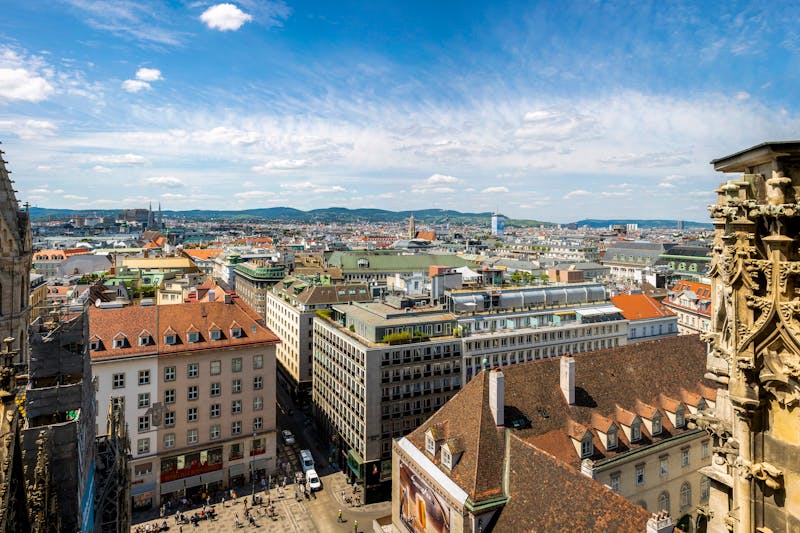
Heldenplatz and the Vienna You'll See Around It
Heldenplatz — literally "Heroes' Square" — is bordered on three sides by some of the most significant buildings in Vienna:
The Neue Burg (New Castle Wing) — the early 20th-century addition to the Hofburg that closes the square's eastern end; home to several Kunsthistorisches Museum collections including the arms and armour collection and the ancient musical instruments collection; the balcony from which Hitler spoke in 1938 is architecturally part of this building
The Burgtor (Outer Castle Gate) — the neoclassical triumphal arch at the Ringstraße end of the square, built between 1821 and 1824, now functioning as Austria's primary War Memorial (Heldendenkmal)
The Kunsthistorisches Museum and Naturhistorisches Museum — the twin museums facing each other across the Maria-Theresien-Platz, immediately adjacent to the Heldenplatz; together they constitute one of the great museum complexes in the world
The Burgtheater — approximately 10 minutes' walk along the Ringstraße to the north; Vienna's imperial court theatre
Café Central, Café Landtmann — the historic Viennese coffeehouses within a 10-minute walk of Heldenplatz; the ideal pre-concert location for visitors arriving in the area before 19:30
May 8 context in Vienna: May 8 is a public holiday in Austria — the shops are closed, the streets are quieter than a normal Friday, and the city takes on the specific quality of a commemorative day that is also genuinely a day off. The combination of the Fest der Freude and the public holiday atmosphere makes arriving in Vienna on May 8 and spending the full day in the 1st district — museums, coffeehouses, a walk through the Burggarten and Volksgarten, and then the concert on the square at 19:30 — one of the more memorable ways to experience the city.
Fourteen Years of Joy on the Most Charged Square in Vienna
Since 2013, the Mauthausen Committee Austria has gathered tens of thousands of people on the Heldenplatz every May 8 for the Fest der Freude — a free concert that is simultaneously a commemoration of the dead, a celebration of the living, a performance by one of the world's great orchestras, and an act of civic courage by a city that has not always found it easy to look directly at its own history.
The 2026 edition — the 14th Fest der Freude, the 81st anniversary of the end of WWII in Europe, themed on "Perpetrators of National Socialism," conducted by Ingo Metzmacher, featuring works by exiled and persecuted composers, and ending with Beethoven's Ode to Joy on the square where the Anschluss was announced — is the most fully realised expression of what this event has always been trying to do.
Friday, May 8. 19:30. Heldenplatz, Vienna. Free. No ticket needed.
Verified Information at a Glance
| Detail | Information |
|---|---|
| Event | Fest der Freude 2026 (Festival of Joy) — 14th Edition |
| Category | Free Outdoor Commemorative Classical Music Concert / Liberation Day Commemoration |
| Date | Friday, May 8, 2026 |
| Time | 19:30 (7:30 PM) |
| Venue | Heldenplatz, 1010 Vienna, Austria |
| Admission | Free — no ticket, no registration, no pre-booking required |
| Occasion | 81st anniversary of the unconditional surrender of the German Wehrmacht and the end of WWII in Europe |
| 2026 Theme | "Perpetrators of National Socialism" |
| Organiser | Mauthausen Committee Austria (MKÖ) |
| Orchestra | Wiener Symphoniker (Vienna Symphony Orchestra) |
| Conductor | Ingo Metzmacher |
| Soprano | Eleanor Lyons |
| Singer/Guest artist | Magda |
| Presenter | Katharina Stemberger |
| Speakers | Willi Mernyi (MKÖ Chairman); Federal President Alexander Van der Bellen |
| Contemporary witness | Lucy Waldstein |
| 2026 confirmed programme | — |
| Schreker | Phantastische Ouvertüre op. 15 (11 min) |
| Martinů | Památník Lidicím H. 296 (8 min) |
| Paul Abraham | "Toujours l'amour" from Ball im Savoy (5 min) |
| Magda | "Wandrisse – Pflaster" (arr. Berge) (6 min) |
| Kreisler | Liebesleid (4 min) |
| R. Strauss | Malven (arr. Rihm) (3 min) |
| R. Strauss | Lied der Frauen op. 68 (7 min) |
| Weill | Symphony No. 2, 3rd movement (8 min) |
| Magda | "Brich mich" (arr. Berge) (3 min) |
| Beethoven | Symphony No. 9, 4th movement "Ode to Joy" (finale) |
| Guided tour (before concert) | "Tour Festival of Joy" — 2 hours, max 25 participants, meeting point: Äußeres Burgtor left firebowl, Heldenplatz; register at festderfreude.at |
| Transport | Tram 1/2 (Burgring/KHM stop); U3 to Volkstheater (~5 min walk); U2 to MuseumsQuartier (~8 min walk) |
| Official website | festderfreude.at |
| Wiener Symphoniker event page | wienersymphoniker.at |
| Wien.info page | wien.info |
Event Has Passed - See You Next Time!
Event Details
Date
Time
7:30 PM - 10:00 PM
Location
Heldenplatz, Burggasse 7 (in front of Neue Burg / Hofburg), 1010 Vienna
Vienna, Austria
Price
Free Entry