
Event Has Passed - See You Next Time!
Event Details
Date
Time
8:45 PM
Location
Schlosspark (Palace Park), Schönbrunn Palace, 1130 Vienna (UNESCO World Heritage; U4: Schönbrunn or Hietzing)
Vienna, Austria
Price
Free Entry
About This Event
Sommernachtskonzert Schönbrunn 2026: A Free Evening with the Vienna Philharmonic in a UNESCO World Heritage Park
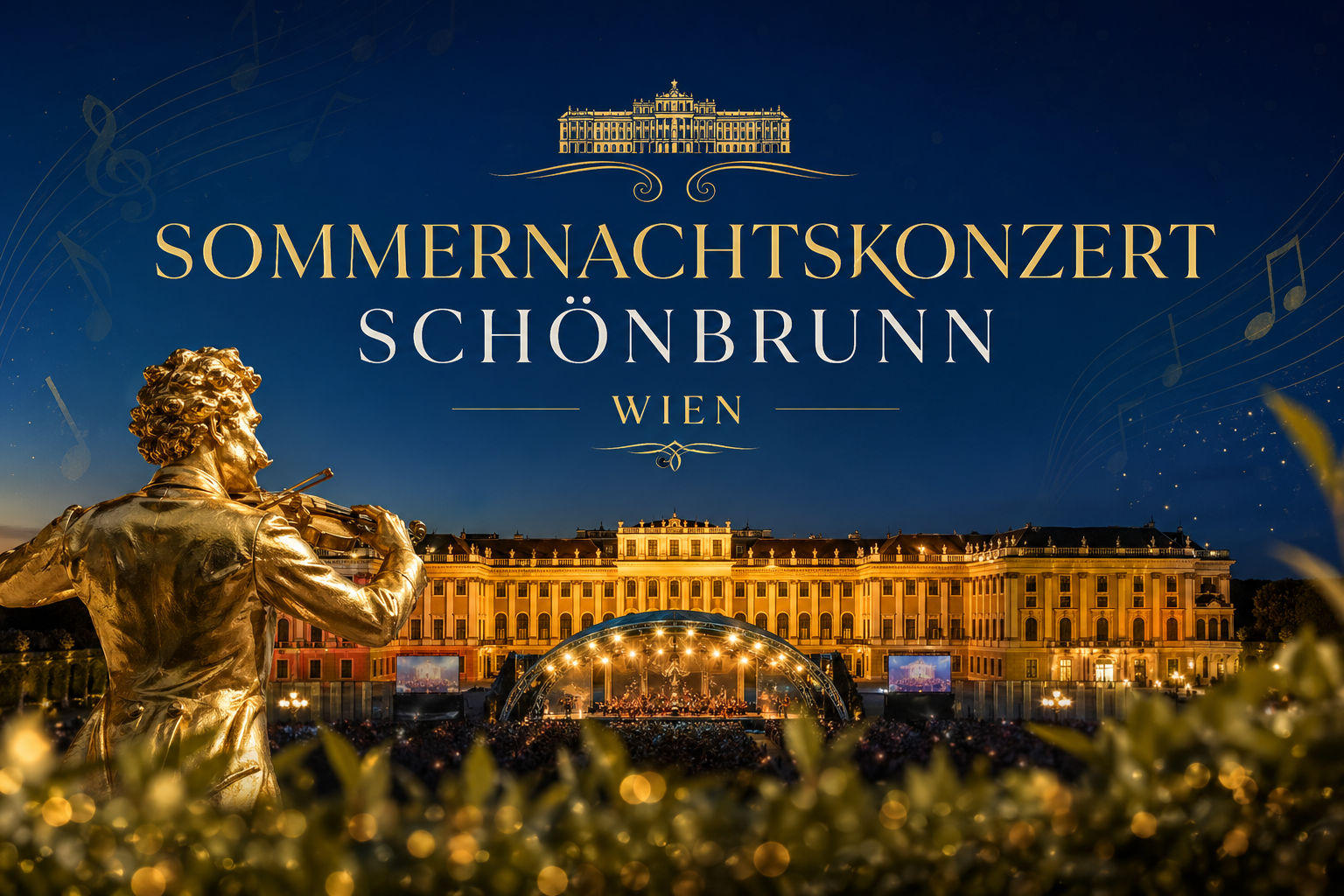
Some concerts require a ticket, a seat allocation, and three weeks of planning. The Sommernachtskonzert Schönbrunn requires none of those things. You turn up at the gates of the Schönbrunn Palace Park on the evening of Friday June 19, 2026, walk into the baroque gardens as the sun goes down over the Gloriette, find a patch of grass in front of the stage, and listen to one of the finest orchestras in the world play a summer programme under the open sky — in front of a UNESCO World Heritage imperial palace — for free.
The 23rd Sommernachtskonzert Schönbrunn takes place on Friday June 19, 2026, with the concert beginning at 20:45 and park gates opening from 17:00. Entry to the standing area is free and requires no ticket. Around 60,000 people attend every year, making this one of the largest and most attended classical music events in the world. The concert is broadcast live by 3sat and streamed internationally via Medici.TV — but nothing compares to being in the park on the evening.
Full information and registration for the barrier-free seating area at wienerphilharmoniker.at.
The Story Behind the Sommernachtskonzert: Free Classical Music Since 2004
The Sommernachtskonzert Schönbrunn was inaugurated in 2004 — a decision by the Vienna Philharmonic to give a free, open-air summer concert in the grounds of Schönbrunn Palace, bringing classical music to an audience of tens of thousands who could experience the Vienna Philharmonic live without the formalities or the prices of a concert hall.
The concept was immediately successful and the event has grown steadily. By 2026, the 23rd edition consistently draws approximately 60,000 visitors to the Schlosspark on a June Friday evening — a combination of Vienna residents, Austrian visitors from across the country, and international tourists who plan their Vienna trip specifically around the concert date. The event is broadcast on 3sat (the joint German-Austrian-Swiss public broadcaster) the following evening and livestreamed globally through Medici.TV, reaching an international audience that multiplies the on-site attendance many times over.
Each edition features a different conductor and soloist. The 2025 concert was conducted by Tugan Sokhiev with Polish tenor Piotr Beczała as soloist. Previous conductors have included Gustavo Dudamel (2022), Franz Welser-Möst, Valery Gergiev, and other internationally celebrated figures. The programme is drawn fresh each year from across the classical and Romantic repertoire, typically combining well-loved symphonic works with operatic highlights and at least one showpiece that reflects the open-air summer setting.
The conductor and soloist for 2026 will be announced at wienerphilharmoniker.at as the date approaches.
The Vienna Philharmonic: The Orchestra Playing in Your Garden
The Wiener Philharmoniker (Vienna Philharmonic Orchestra) is, by virtually any measure, one of the two or three finest orchestras in the world. Founded in 1842, the orchestra has maintained a continuous performing tradition for 184 years — a lineage that connects today's players directly to the premieres of works by Brahms, Bruckner, Mahler, and Richard Strauss.
The orchestra is self-governing — unlike most major orchestras, it is administered by its own members rather than an external board — and all of its members are also members of the Vienna State Opera Orchestra, which gives it a unique relationship with the operatic repertoire that is audible in the way it plays symphonic music: with a vocal quality, a warmth in the strings, and a sensitivity to melody that are the direct products of nightly opera performances in one of the world's greatest opera houses.
The Vienna Philharmonic's New Year's Concert (Neujahrskonzert) is, alongside the Sommernachtskonzert, the most watched classical music broadcast in the world — and the summer concert shares the New Year's Concert's fundamental character: accessible, celebratory, and performed with a warmth that goes beyond technical perfection into genuine musical joy.
For the 60,000 people who gather in the Schlosspark every June, the Sommernachtskonzert is not a compromise version of the Vienna Philharmonic — it is the real orchestra, the same players who perform at the Musikverein and the State Opera and Carnegie Hall, playing at full scale and full quality in an extraordinary outdoor setting.
Schönbrunn Palace and Park: The Stage for the Concert
Understanding the Sommernachtskonzert requires understanding Schönbrunn Palace — because the palace and its park are not merely a backdrop for the concert but its central reason for being.
Schloss Schönbrunn is the former summer imperial residence of the Habsburg dynasty — the imperial family that ruled the Austro-Hungarian Empire and shaped European history for over six centuries. Construction of the current Baroque palace began in the late 17th century under Emperor Leopold I and was developed and expanded through the 18th century under Empress Maria Theresa, whose long reign (1740–1780) saw Schönbrunn reach its current form. The palace has 1,441 rooms and was the primary summer residence of the Habsburg court from the reign of Maria Theresa onward. Emperor Franz Joseph I was born at Schönbrunn in 1830 and died there in 1916. The young Mozart performed for Empress Maria Theresa at Schönbrunn in 1762.
In 1996, both Schönbrunn Palace and its park were inscribed on the UNESCO World Heritage List — a recognition not just of the palace's architectural significance but of the park's extraordinary preservation of Baroque garden design at imperial scale.
The park where the concert takes place:
- The Schlosspark (Palace Park): 1.2 square kilometres of formal Baroque gardens stretching from the palace toward the Gloriette on the hill above; the orchestra stage is positioned in the park area directly before the palace, with the Gloriette on its hill providing the backdrop behind
- The Gloriette: A Neo-Classical triumphal arch on the crest of the hill above the palace, built in 1775 by Johann Ferdinand Hetzendorf von Hohenberg; lit at night during the concert; one of the most dramatic architectural silhouettes in Vienna
- The Neptune Fountain: An enormous Baroque fountain at the foot of the hill below the Gloriette; one of the focal points of the park and visible from the concert area
- The Great Parterre: The formal garden area between the palace and the fountains where the audience spreads out on the grass during the concert
- The Palm House (Palmenhaus): One of the largest glass greenhouses in Europe, visible in the park; houses tropical plants including specimens that have been growing at Schönbrunn for over 100 years
Practical Information for the Evening: How to Make the Most of June 19
The Sommernachtskonzert draws 60,000 people to a park that is accessible from multiple gates — and the logistics of attending comfortably reward some advance thought.
Gates and entry:
- Entry to the park for the concert area is through the Hietzinger Tor and the Meidlinger Tor (Hietzinger Gate and Meidlinger Gate)
- Gates open from 17:00 — arrive early to secure a good position on the grass
- Important: If the event grounds reach capacity, the Wiener Philharmoniker has confirmed that entrance to the entire Palace Park will be barred — late arrivals may not be admitted; arriving before 19:00 is strongly recommended for a comfortable viewing position
Barrier-free seating:
- Persons with a valid certificate of disability can register from May 2026 via the official Vienna Philharmonic website (wienerphilharmoniker.at) for access to the dedicated barrier-free seating area
- This is the only form of pre-registration available; all other attendance is walk-up, first-come
Getting to Schönbrunn by public transport:
- U4 — Schönbrunn stop: The most direct connection; the U4 runs from Wien Mitte (interchange with the Airport train) through the city centre and stops directly at the Schönbrunn palace area; approximately 10 minutes from Karlsplatz
- U4 — Hietzing stop: The next stop after Schönbrunn on the U4; closer to the Hietzinger Tor gate entrance
- Increased U4 frequency after the concert: The Wiener Linien typically increases service frequency on the U4 after the concert ends to handle the 60,000-person departure
- Address: Schönbrunner Schlossstraße 47, 1130 Vienna
What to bring: A blanket or portable seat for the grass; a light layer for after the concert (Vienna evenings in June cool noticeably after dark); water and snacks (bring your own as food vendors inside the park area sell out quickly); a charged phone for photos of the Gloriette at night — it is worth documenting
Weather contingency: The concert takes place outdoors and is subject to weather; official decisions about rain or severe weather are communicated through wienerphilharmoniker.at and the official social media channels; a light waterproof layer is worth packing
Vienna in Mid-June: The Context of the Concert
June 19, 2026 places the Sommernachtskonzert at the midpoint of Vienna's pre-summer cultural peak — the weeks between the Pfingstfest (Whitsun) holidays and the start of July when the city is warm, green, and operating at full cultural intensity.
Vienna in the days around the Sommernachtskonzert:
- Schönbrunn Palace itself: Open for tours daily; the State Apartments, the Imperial Tour, and the Grand Tour are available; the Schönbrunn Palace Concerts at the Orangerie (scheduled concert June 14 among others) offer a ticketed indoor version of Viennese classical music inside the palace buildings — a complement to the free outdoor concert
- Naschmarkt: Vienna's open-air food market on the Linke Wienzeile; a Saturday morning June 20 visit to the market, combined with the livestream broadcast of the previous evening's concert on 3sat that same night, makes for a perfect Vienna cultural weekend
- Kunsthistorisches Museum: One of the world's great art museums; the Habsburg imperial art collections assembled over six centuries; the large display of paintings by Bruegel, Vermeer, Velázquez, and Raphael is simply unmissable and is 20 minutes by U4 from Schönbrunn
- Belvedere Palace: Vienna's other great imperial palace and garden complex, housing Klimt's The Kiss and one of the finest collections of Austrian art in the world; a short tram ride from the city centre
- Vienna State Opera: The opera season runs through late June; if the Sommernachtskonzert date coincides with an opera performance at the Staatsoper, it is possible to plan an extraordinary single day combining an opera evening and the summer concert morning
Practical Guide to Sommernachtskonzert Schönbrunn 2026
Event: Sommernachtskonzert Schönbrunn 2026 (Summer Night Concert Schönbrunn)
Category: Free Open-Air Classical Concert
Edition: 23rd (inaugural concert 2004)
Date: Friday June 19, 2026
Concert start: 20:45 (8:45 PM) — begins at nightfall; exact time may vary slightly based on sunset
Gates open: From 17:00
Venue: Schlosspark Schönbrunn (Schönbrunn Palace Park), 1130 Vienna, Austria
Address: Schönbrunner Schlossstraße 47, 1130 Wien
Admission: Free; no ticket required for standing area
Barrier-free seating: Registration opens May 2026 via wienerphilharmoniker.at (valid disability certificate required)
Entry gates: Hietzinger Tor and Meidlinger Tor
Capacity warning: Park will be closed to new entrants if capacity reached — arrive early
Annual attendance: ~60,000 on-site
Orchestra: Wiener Philharmoniker (Vienna Philharmonic Orchestra)
Conductor and soloist 2026: To be announced at wienerphilharmoniker.at
Programme: To be announced; classical and Romantic orchestral programme with soloist
TV broadcast: 3sat — June 20, 2026, 20:15
Livestream: Medici.TV — worldwide (for countries not covered by 3sat broadcast)
Getting there:
- U4 — Schönbrunn stop or Hietzing stop (closest to Hietzinger Tor)
- From Wien Mitte/Landstraße (Airport connection): U4 direct, approximately 15 minutes
- From Karlsplatz: U4, approximately 10 minutes
- Increased U4 service after the concert
Nearest airport: Vienna International Airport (VIE) — approximately 35–40 minutes by CAT or S-Bahn to Wien Mitte, then U4 to Schönbrunn
June 19 weather in Vienna: Typically 22–27°C at 17:00; 16–20°C at 21:00; bring a light layer for after dark; occasional evening showers possible in June
Official website: wienerphilharmoniker.at/en/summernightconcert
June 19, 2026: The Grass, the Gloriette, and 60,000 People Listening to the Vienna Philharmonic
The Sommernachtskonzert works because its ingredients are individually extraordinary and together they become something that cannot be replicated anywhere else on Earth. An orchestra with 184 years of unbroken tradition. A Baroque palace declared a World Heritage Site in 1996. A park where the Empress Maria Theresa watched fireworks in the 18th century. A June evening in Vienna. All of it free, all of it open, and all of it available to anyone who arrives at the Hietzinger Tor by 19:00 on a Friday evening in June.
Friday June 19, 2026. Gates open 17:00. Concert begins 20:45. Schlosspark Schönbrunn, 1130 Vienna. Free admission. No ticket. Entry via Hietzinger Tor and Meidlinger Tor. Arrive early — the park closes to new visitors when it reaches capacity. The Vienna Philharmonic. The Gloriette lit at night. 60,000 people on the grass. This is what Vienna in summer looks like at its absolute best.
Verified Information at a Glance
| Detail | Information |
|---|---|
| Event | Sommernachtskonzert Schönbrunn 2026 (Summer Night Concert Schönbrunn) |
| Category | Free Open-Air Classical Concert |
| Edition | 23rd (inaugural 2004) |
| Date | Friday June 19, 2026 |
| Concert start | 20:45 (8:45 PM); gates open from 17:00 |
| Venue | Schlosspark Schönbrunn (Schönbrunn Palace Park), 1130 Vienna |
| Address | Schönbrunner Schlossstraße 47, 1130 Wien |
| Entry gates | Hietzinger Tor and Meidlinger Tor |
| Admission | Free; no ticket required for standing area |
| Barrier-free seating | Register from May 2026 at wienerphilharmoniker.at (disability certificate required) |
| Capacity warning | Park entry barred if grounds reach capacity; arrive early |
| Annual on-site attendance | ~60,000 |
| Orchestra | Wiener Philharmoniker (Vienna Philharmonic Orchestra) |
| Conductor and soloist 2026 | To be announced |
| TV broadcast | 3sat — June 20, 2026, 20:15 |
| Livestream | Medici.TV worldwide |
| UNESCO World Heritage Site | Yes — Schönbrunn Palace and Park inscribed 1996 |
| Transport | U4 — Schönbrunn or Hietzing stop; increased frequency after concert |
| Nearest airport | Vienna International Airport (VIE) — ~35–40 min by CAT/S-Bahn + U4 |
| June 19 weather | 22–27°C at 17:00; 16–20°C at 21:00; light layer and rain backup recommended |
| Official website | wienerphilharmoniker.at/en/summernightconcert |
Event Has Passed - See You Next Time!
Event Details
Date
Time
8:45 PM
Location
Schlosspark (Palace Park), Schönbrunn Palace, 1130 Vienna (UNESCO World Heritage; U4: Schönbrunn or Hietzing)
Vienna, Austria
Price
Free Entry