

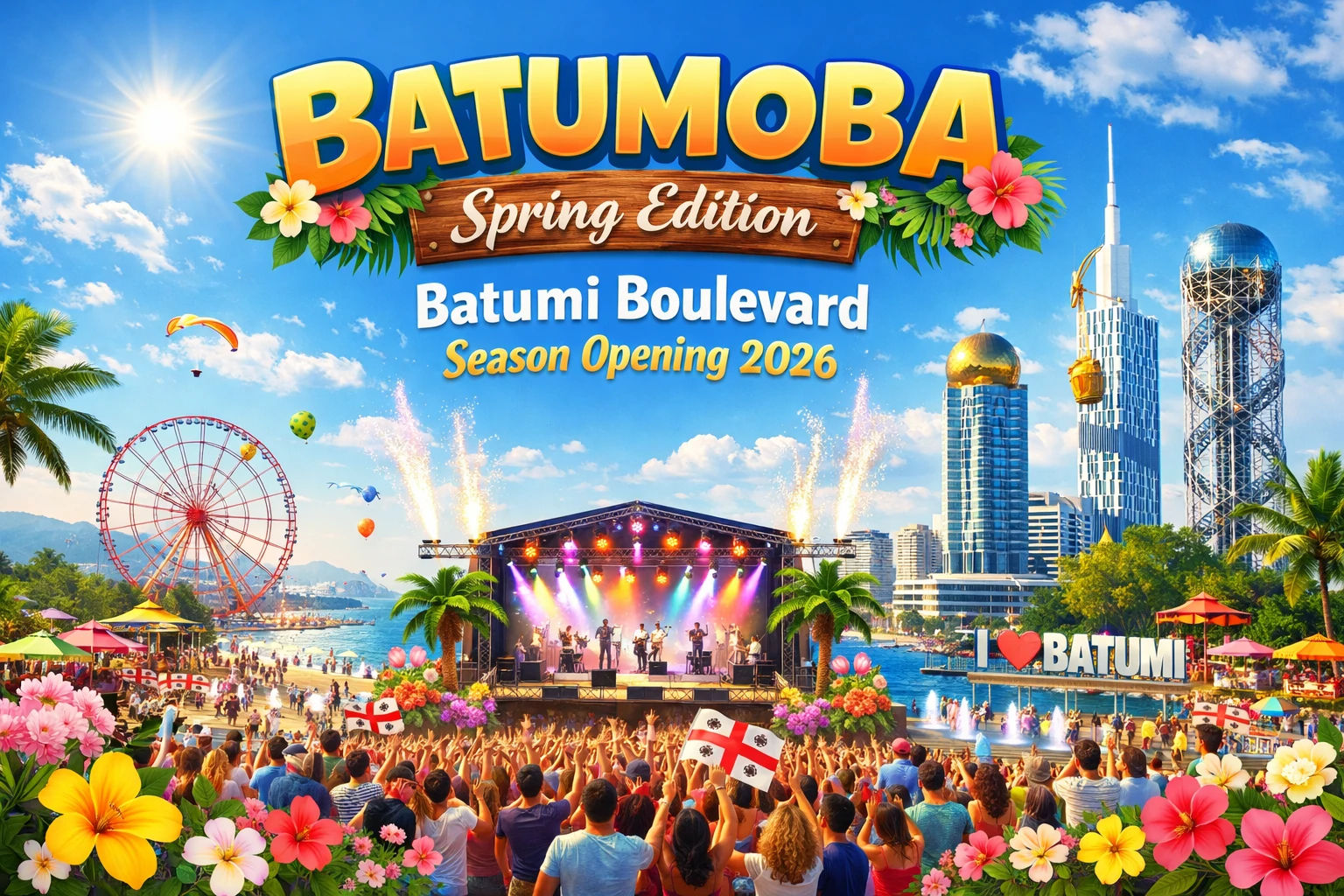
Event Has Passed - See You Next Time!
Event Details
Date
to
Location
Old Batumi Boulevard (Seaside Promenade), Batumi
Batumi, Georgia
Price
Free Entry
About This Event
Batumoba 2026 and the Batumi Boulevard Spring Season Opening: Georgia's Most Joyful City Festival
There is a moment every spring in Batumi when you can feel the entire city shift gears. The Black Sea warms a little. The seven kilometres of the Boulevard promenade fill with a different kind of energy. The cafes push their chairs further toward the water. And then, on Tuesday 28 April 2026, the city celebrates Batumoba, the annual festival marking the anniversary of Batumi being granted official city status back in 1888, and the day the boulevard season is joyfully declared open for another year.
Batumoba is not just a local public celebration. It is a two-day festival of culture, folklore, jazz, food, folk dance, theatre, sports, and civic pride that fills the Old Boulevard and the surrounding streets of central Batumi with music and people from morning until well past midnight. Entry is completely free. The setting is one of the most beautiful urban promenades in the South Caucasus. And the spirit of the occasion, warm, generous, and genuinely community-owned, reflects something important about the character of this city that no amount of new hotel towers and casino lights can change.
For visitors arriving in Batumi in late April 2026, Batumoba is the single best introduction to what this city actually is when it is at home and celebrating itself. This guide covers everything you need to know.
The Story Behind Batumoba: Why April 28 Matters
From a Letter to an Official City
Batumi's festival roots are pleasingly specific. In 1885, ninety residents of Batumi addressed the head of the Civil Division of the Caucasus with a request: they wanted their settlement formally elevated to city status. They made their case, they waited, and on April 28, 1888, their wish was granted. Batumi became an official city of the Russian Empire on that date, and in doing so acquired the administrative recognition that reflected the growing commercial and strategic importance it had built through its position on the Black Sea coast.
Batumi has a 2,500-year history, but this day gained special significance in 1885, when 90 residents of the city wrote to the head of the Civil Division of the Caucasus, requesting that Batumi be granted city status. Three years later, this request was granted, and Batumi was officially declared a city.
The festival began as "Batumkalakoba" and was initially celebrated in May, then in September, before finally settling permanently on April 28 to honour the precise date of the city's formal designation. That anchoring of the celebration to a specific historical moment gives Batumoba a rootedness that many city festivals lack. This is not an invented marketing event. It is a community marking a genuinely significant milestone in its own history, year after year, with the same generosity and enthusiasm.
In 2026, Tuesday 28 April marks 138 years since Batumi was granted city status. The main festival runs from noon on 28 April through to 02:00 on 29 April, giving attendees a full 14-hour celebration across the Old Boulevard and the surrounding streets.
Batumoba as the Boulevard Season Opening
One of the most important symbolic dimensions of Batumoba is its role as the unofficial opening of the Batumi Boulevard's summer season. There is no better time to experience Batumi Boulevard, a seaside promenade that was laid out in 1884 by Prussian gardeners. Its seven kilometres of walking paths and dedicated bicycle lanes feature outdoor cafes, quirky modern sculptures, and a Japanese garden that bursts with cherry blossoms.
By late April, the subtropical climate has produced the lush green fullness that makes the Boulevard one of the most beautiful urban promenades in the region. The cherry blossoms of the Japanese garden have typically peaked and are fading, giving way to the deeper greens of the bamboo grove and the mature tree canopy that lines the main promenade. The outdoor cafes are moving into their full spring-summer operations. The cycling lanes are full. The dancing fountains are running. And on Batumoba weekend, all of this living, breathing infrastructure is overlaid with the specific electricity of a city celebrating itself.
The Batumoba 2026 Programme: What to Expect Across Two Days
Batumoba 2026 runs from Tuesday 28 April from 12:00 noon until Wednesday 29 April at 02:00. The main venue for all events is Batumi Boulevard, specifically the Old Boulevard area near the Summer Theater and the boulevard colonnades. All events are free to attend.
Daytime: The Market, Exhibitions, and Family Activities
From noon on 28 April, the Old Boulevard fills with the Batumoba market, one of the most enjoyable outdoor markets in the Georgian event calendar. Based on the established programme format from recent editions, the market includes the following:
Exhibition and sale of handicrafts: Local and regional artisans display and sell traditional Georgian crafts, including hand-embroidered textiles, cloisonné enamel jewellery (minankari), woodcarvings, ceramics, and leather goods. This is one of the best opportunities of the year to acquire genuinely made-by-hand Georgian work directly from the people who made it.
Gastronomic corner: Food stalls serving Adjarian specialties including the iconic boat-shaped Adjarian Khachapuri with egg and butter, churchkhela (walnut-and-grape-juice sweets), freshly prepared Georgian dishes, and local wines. The Adjara region produces its own distinctive grape varieties, including Chkhaveri, used to produce a unique semi-sweet rosé, and Kedis Tsolikauri, a white variety vinified in the traditional qvevri clay vessel method.
Botanical Garden exhibition: The Batumi Botanical Garden, one of the finest in the Caucasus with nine phyto-geographic zones across 111 hectares, typically brings a display of its collections to the Batumoba market, making it accessible to those who cannot make the journey to the garden itself.
Maritime Academy exhibition: Reflecting Batumi's identity as a port city and maritime hub, the Maritime Academy exhibition provides context for the Black Sea's role in the city's commercial history.
Museum and Art Academy displays: Local cultural institutions use Batumoba to engage with the city's broader public, bringing exhibitions, demonstrations, and interactive elements to the Boulevard.
Children's corner: A dedicated area for younger visitors, with activities, games, and entertainment that keeps children engaged throughout the long afternoon.
Sports events: Sports contests and activities along the Boulevard provide another layer of community participation, typically including demonstrations by local clubs and teams in martial arts, gymnastics, and other disciplines.
Afternoon: Theatre, Jazz, and Folk Dance
Following the 2025 programme as a guide, the afternoon cultural schedule includes:
13:00 (approximate) – Performance by the Batumi Jazz Big Band. Jazz has a particular place in Batumi's cultural identity: the city hosts the International Black Sea Jazz Festival annually and has nurtured a jazz scene that is genuinely impressive for a city of its size. The Jazz Big Band's Batumoba performance is always one of the most anticipated elements of the afternoon programme.
Mid-afternoon – Performance by the Batumi State Professional Theater of Puppets and Teen Spectators, directed at family audiences and typically staged near the Summer Theater area of the Boulevard.
Late afternoon – Performances by folk ensembles and choral groups, including the Women's Academic Chamber Choir and various folk vocal ensembles from the Batumi Culture Center.
Early evening – Georgian Folklore Concert featuring the Enver Khabadze Georgian National Dance State Academic Ensemble "Batumi," the city's most celebrated folk dance ensemble. Their performances, with the athleticism of the male dancers and the extraordinary grace of the female dancers, are among the finest examples of Georgian folk dance anywhere in the country.
Evening: The Gala Concert
The culminating event of Batumoba is the grand gala concert, which begins at 21:00 on April 28 and continues until the early hours. Past editions have featured major Georgian solo performers, including names such as Jemal Gogitidze, Anri Guchmanidze, Morris Meladze, Salome Mirianashvili, Merab Dolidze, and many others from Georgia's premier solo singer roster. The 2026 gala programme will be confirmed by the Adjara government and the Batumi municipality in the weeks leading up to the festival, and is typically announced via the batumievents.com platform and the official Visit Batumi social media channels.
One of the most cherished Batumoba traditions is the awarding of Honorary Batumi Residents (Honorary Batumelebi), which takes place during the festival, honouring individuals whose contributions to the city's cultural, scientific, or civic life deserve formal recognition.
Batumi Boulevard: The Stage That Makes Batumoba Special
To understand why Batumoba works as a festival, you need to understand the Boulevard itself. The concept of a seaside park in Batumi was first proposed in 1881 by the governor of the Batumi district. Since then, various professionals have contributed to its development, transforming the boulevard into one of Batumi's most beautiful features. The Boulevard was laid out by Prussian gardeners in 1884 and has been refined, expanded, and planted across more than 140 years of continuous care.
Today, numerous must-see attractions can be found along the boulevard. You'll come across monuments dedicated to Jason Gordeziani and Mikheil Dalphons, the key figures behind the boulevard's creation. You can also explore Batumi colonnades, the summer theater, dancing fountains, Batumi lighthouse, Alphabet Tower, "Ali and Nino" sculpture, and many other captivating sights.
The Summer Theater, located along the Old Boulevard and used for Batumoba's main concert stage, is one of the most atmospheric outdoor performance venues in the city. Its semicircular form and open-air design allow audiences to experience concerts with the Black Sea audible and visible behind the performers, a combination that makes even a fairly ordinary folk performance feel genuinely special.
The Alphabet Tower, Batumi's most iconic contemporary landmark at 130 metres tall with all 33 letters of the Georgian alphabet spiralling up its double-helix structure, is visible from virtually every point on the Boulevard and serves as a visual anchor for the Batumoba celebrations. Its rotating restaurant and panorama bar offer an extraordinary vantage point for seeing the full extent of the festival spread along the promenade below.
The Ali and Nino kinetic sculpture, depicting the slowly merging and separating figures of the great Caucasian love story's protagonists, continues its daily cycle through the Batumoba crowds, a piece of public art that has become as much a part of the Boulevard's identity as the palm trees and the sea itself.
The dancing fountains, installed at multiple points along the Boulevard, are particularly spectacular at night during Batumoba, when the combination of coloured lights, choreographed water movements, and the general festive energy of the crowd creates an atmosphere that is difficult to describe to anyone who has not been in it.
The Food and Drink of Batumoba: Adjarian Cuisine at Its Most Accessible
No Batumoba is complete without engaging with the food culture of Adjara, and the gastronomic corner of the festival market provides the most concentrated and accessible entry point into that culture that the city offers at any time of year.
Adjarian Khachapuri: The Essential Beginning
No Adjarian food experience is complete without Adjarian Khachapuri, the boat-shaped bread filled with gooey melted sulguni cheese, topped with a raw egg and a generous knob of butter. The technique for eating it correctly, breaking open the egg into the cheese, mixing everything together with the bread sides, then tearing off pieces of bread to dip, is something that vendors will cheerfully demonstrate to first-timers. It is one of the most comforting and genuinely delicious things you can eat on a cool April evening by the Black Sea.
Georgian Wine and the Adjarian Varieties
Adjara has its own grape varieties and its own winemaking traditions, partly distinct from those of the larger Kakheti region that dominates most Georgian wine production. The Chkhaveri grape produces a light, semi-sweet rosé that is particular to the Adjara and Guria regions. Kedis Tsolikauri produces a white wine with a pleasant acidity and herbal character. Both are worth seeking out at the Batumoba gastronomic market.
Georgia's overall winemaking tradition is 8,000 years old, the oldest continuous winemaking culture in the world, and the qvevri method of fermenting and ageing wine in large clay vessels buried underground produces amber wines with a character entirely unlike anything produced in the rest of the world. The Batumoba gastronomic corner is an excellent place to encounter this tradition at its most approachable.
Churchkhela, Chakapuli, and Spring Specialties
Churchkhela, the traditional Georgian sweet made by repeatedly dipping strings of walnuts into thickened grape juice and drying them into a sausage shape, hangs in colourful curtains at the market stalls and makes both an excellent snack and a transportable souvenir.
Chakapuli, a fragrant spring lamb stew made with green plums, tarragon, and white wine that is one of the defining dishes of the Georgian spring season, may appear at the gastronomic corner if the timing aligns with the traditional Easter-season preparation. Spring in Adjara is also the season for fresh greens, herbs, and the first strawberries of the year, all of which appear at the market alongside the more substantial traditional dishes.
Beyond Batumoba: Exploring Batumi in Late April
The Batumoba weekend gives visitors the perfect anchor for a longer stay in Batumi, and the city in late April rewards extended exploration generously.
The Batumi Botanical Garden
North along the coast, the Batumi Botanical Garden is a veritable Eden, with nine climatic zones and flora from all four corners. Covering 111 hectares on the hillside north of the city, the garden was established in 1912 and contains plants from East Asia, the Himalayas, Australia, New Zealand, North America, Mexico, South America, the Mediterranean, and the Transcaucasian subtropics. In late April, the garden is at its most lush, with spring flowering across multiple zones and views of the Black Sea visible through the canopy from the lookout points along the marked trails. The garden is accessible by minibus from central Batumi and deserves a full morning.
The Batumi Old Town
The Old Town, with its ornate 19th-century facades, wrought-iron balconies, and the Piazza Square modelled on Italian precedents, is a ten-minute walk from the Boulevard's main festival area. The concentration of architectural styles, from Ottoman residential vernacular to Russian Imperial civic buildings to early 20th-century European commercial facades, tells the story of a port city that has been at the intersection of empires for centuries. The mosque, the synagogue, the Armenian Gregorian church, and the Cathedral of the Mother of God all stand within walking distance of each other in the city centre.
Gonio-Apsaros Fortress
Located 15 kilometres south of Batumi, the Gonio fortress is a Roman-era coastal fortification with Byzantine and Ottoman layers that dates back to the 1st century AD. It is believed by the Georgian Orthodox Church to contain the tomb of the Apostle Matthias. The site is accessible by city bus from Batumi and makes an excellent afternoon excursion from the city on the days around Batumoba.
The Argo Cable Car
The Argo cable car connects the central city to a hilltop viewpoint and restaurant approximately 260 metres above Batumi, providing one of the finest panoramic views of the bay, the Boulevard, and the mountains behind the city. In late April, the hillside vegetation is fully green and the contrast between the subtropical city below and the forested mountain ridge above is particularly dramatic.
Practical Travel Guide: Visiting Batumi for Batumoba 2026
Festival dates: Tuesday 28 April 2026, 12:00 noon to Wednesday 29 April 2026, 02:00
Main venue: Old Batumi Boulevard, near the Summer Theater and Boulevard colonnades; Memed Abashidze Avenue; Europe Square
Admission: All Batumoba events are completely free of charge
Getting to Batumi: Batumi International Airport (BUS) operates direct connections from Istanbul, Warsaw, Vienna, Riga, Kyiv, Tel Aviv, and several other European cities. From Tbilisi, the daytime express train takes approximately four hours. The overnight sleeper service takes approximately five and a half hours. Marshrutka minibuses connect the two cities in five to six hours at lower cost. Late April is increasingly popular with domestic Georgian tourists and international visitors, so booking transport in advance is advisable.
Getting around Batumi: The historic centre, Old Town, Boulevard, and most hotels are within comfortable walking distance of each other. City buses serve the wider urban area. Taxis are inexpensive by European standards and universally available. Bicycle hire is available along the Boulevard and is an excellent way to cover the promenade's full seven kilometres on a spring day.
Accommodation: Late April is the beginning of Batumi's spring tourist season. Hotel demand picks up significantly around the Batumoba weekend, so booking four to six weeks in advance is recommended. The Boulevard area has the highest concentration of accommodation at all price points, including the Sheraton, Hilton, and Radisson Blu at the higher end and a wide range of mid-range guesthouses and boutique hotels in and around the Old Town.
Weather: Late April in Batumi is typically warm and subtropical, with average daytime temperatures of 16 to 20 degrees Celsius. Light summer clothing is appropriate for the day, with a thin layer for the evening. Brief spring showers are possible, so a compact waterproof jacket is worth packing. The sea is cool but beginning to warm.
Currency: Georgian Lari (GEL). ATMs are widely available throughout central Batumi. Most hotels and restaurants accept cards. Market vendors at Batumoba prefer cash.
Language: Georgian is the official language. Russian is widely understood by older residents. English is spoken at most hotels and by younger Batumians in the tourism sector.
What is open on April 28: Although Batumoba is a city holiday, it is not a national public holiday, so government offices, schools, and businesses operate normally. All tourist attractions, museums, and the Boulevard's facilities are open as usual.
Upcoming related events: Georgia's Independence Day (Gamarjobis Dge) falls on 26 May 2026, just under a month after Batumoba. Victory Day (May 9) and Andriaoba (May 12) also fall within the same spring window, making late April through late May an extraordinarily rich period to base a longer Georgia trip around Batumi.
A City That Knows How to Welcome Spring
Batumoba sees the resort city transform into a colourful celebration of tradition and folklore, with jazz concerts, a handicraft and gastronomic market, and other events.
That description is accurate as far as it goes, but it does not quite capture what Batumoba actually feels like from the inside. It feels like a city that has been waiting all winter for exactly this, the long April evenings, the warm air coming off the Black Sea, the Alphabet Tower lit against the dark sky, the Jazz Big Band somewhere along the Boulevard and the sound of folk dance music from a stage beyond the colonnades. It feels like something that belongs entirely to Batumi and that Batumi is genuinely delighted to share.
Batumi hosts six international music festivals annually, and Batumoba is the one that anchors everything else, the festival that marks the moment the city turns its full attention outward to the water and the season ahead.
Come to Batumi on 28 April 2026. Walk the Boulevard from noon. Try the Adjarian Khachapuri at the gastronomic corner while the Jazz Big Band plays. Stay for the Enver Khabadze Ensemble in the early evening. Be on the Boulevard at 21:00 when the gala concert starts and the city is lit and warm and entirely alive. This is exactly where you should be.
Verified Information at a Glance
| Detail | Information |
|---|---|
| Event Name | Batumoba 2026 (Day of Batumi / Spring Festival) |
| Secondary Description | Batumi Boulevard Spring Season Opening |
| Event Category | City Festival / Cultural Festival / Annual Civic Celebration |
| Date | Tuesday 28 April 2026 (main festival day) |
| Festival Run | Tuesday 28 April 2026 from 12:00 noon until Wednesday 29 April 2026 at 02:00 |
| Historical Basis | Commemorates April 28, 1888, the date Batumi was officially granted city status by the head of the Civil Division of the Caucasus |
| Edition | 138th anniversary of Batumi's city designation (2026) |
| Main Venue | Old Batumi Boulevard, near the Summer Theater and Boulevard colonnades; additional events on Memed Abashidze Avenue and Europe Square |
| Admission | All events completely free of charge |
| Confirmed Programme Elements (based on established annual format) | 12:00 – Market opens: exhibition and sale of handicrafts, Botanical Garden display, Maritime Academy exhibition, gastronomic corner, children's corner, museum and art academy |
| ~13 | 00 – Batumi Jazz Big Band performance |
| ~14 | 00–17:00 – Women's Academic Chamber Choir, folk ensembles, choral groups |
| ~19 | 30 – Enver Khabadze Georgian National Dance State Academic Ensemble "Batumi" and folk vocal groups |
| 21 | 00 – Grand Gala Concert (performers to be confirmed by Adjara government closer to date) |
| Continues until 02 | 00 on 29 April |
| 2026 Specific Programme | To be confirmed at batumievents.com and official Adjara government channels |
| Getting to Batumi | Batumi International Airport (BUS); train from Tbilisi approx. 4 hours (daytime); marshrutka 5–6 hours |
| Average Temperature on April 28 | 16–20°C; subtropical spring; light layers recommended |
| Currency | Georgian Lari (GEL) |
| Official Festival Platform | batumievents.com |
| Tourism Website | visitbatumi.com |
| Note | Batumoba is a city holiday but not a national public holiday; businesses and government offices operate normally on this date |
Event Has Passed - See You Next Time!
Event Details
Date
to
Location
Old Batumi Boulevard (Seaside Promenade), Batumi
Batumi, Georgia
Price
Free Entry