
Event Has Passed - See You Next Time!
Event Details
Date
Location
Plaza de Armas, Calle del Medio, San Cristóbal & neighborhoods citywide, Cusco
Cusco, Peru
Price
Free Entry
About This Event
Cruz Velacuy: The Festival of the Holy Cross
Cruz Velacuy, the Festival of the Holy Cross, fills Cusco's traditional neighborhoods with devotion, music, color, and communal fire on the night of May 2 and the main day of May 3, 2026. It is one of the city's most deeply rooted and spiritually layered celebrations of the year. Unlike the grand state ceremonies of Inti Raymi or Corpus Christi, Cruz Velacuy is an intensely community-driven festival: it unfolds not in Cusco's Plaza de Armas but in the hillside neighborhoods, small chapels, and family courtyards where Andean and Catholic traditions have been woven together for centuries.
Cruz Velacuy 2026 Cusco: The Main Day Explained
May 3 is the central date of Cruz Velacuy, confirmed across all major Cusco festival calendars for 2026. CuscoPeru.com lists it explicitly as "May 3: Cruz Velacuy or Vigil of the Cross, Location: Traditional neighborhoods of Cusco," describing it as "one of the most heartfelt religious festivities in Cusco's traditional neighborhoods."
The name "Cruz Velacuy" comes from Quechua and Spanish together: cruz (cross in Spanish) and velacuy (derived from the Quechua verb velar, to keep vigil). The full name means "vigil of the cross," which captures the spiritual core of the event: communities staying awake through the night in prayer, music, and offering to honor crosses that are believed to protect each neighborhood, hill, and sacred space.
The History Behind Cruz Velacuy in Cusco
The historical roots of Cruz Velacuy stretch back centuries, drawing from both Old World and New World spiritual traditions. Apus Peru traces the event to the Roman Emperor Constantine, who, according to Christian tradition, saw a cross in the sky before winning a decisive battle and subsequently converted to Christianity. When Spanish colonizers arrived in the Andes, they brought May 3 as the Feast of the Invention (Finding) of the Holy Cross, which merged with Andean practices of honoring the apus, the sacred mountains that Quechua communities have venerated as protectors since long before the conquest.
By the 18th century, colonial documents were already recording processions and community gatherings linked to the crosses around Cusco. During the 20th century, the rise of Peru's indigenous cultural movement revalued and amplified these syncretic expressions, cementing Cruz Velacuy as a symbol of Andean identity rather than purely Catholic observance. Today it is recognized as one of the most authentic living examples of Andean-Christian syncretism, and Cusco celebrates it with a depth that few other Peruvian cities match.
What Happens on May 2 (The Vigil) and May 3 (The Main Day)
The Vigil: May 2, 2026
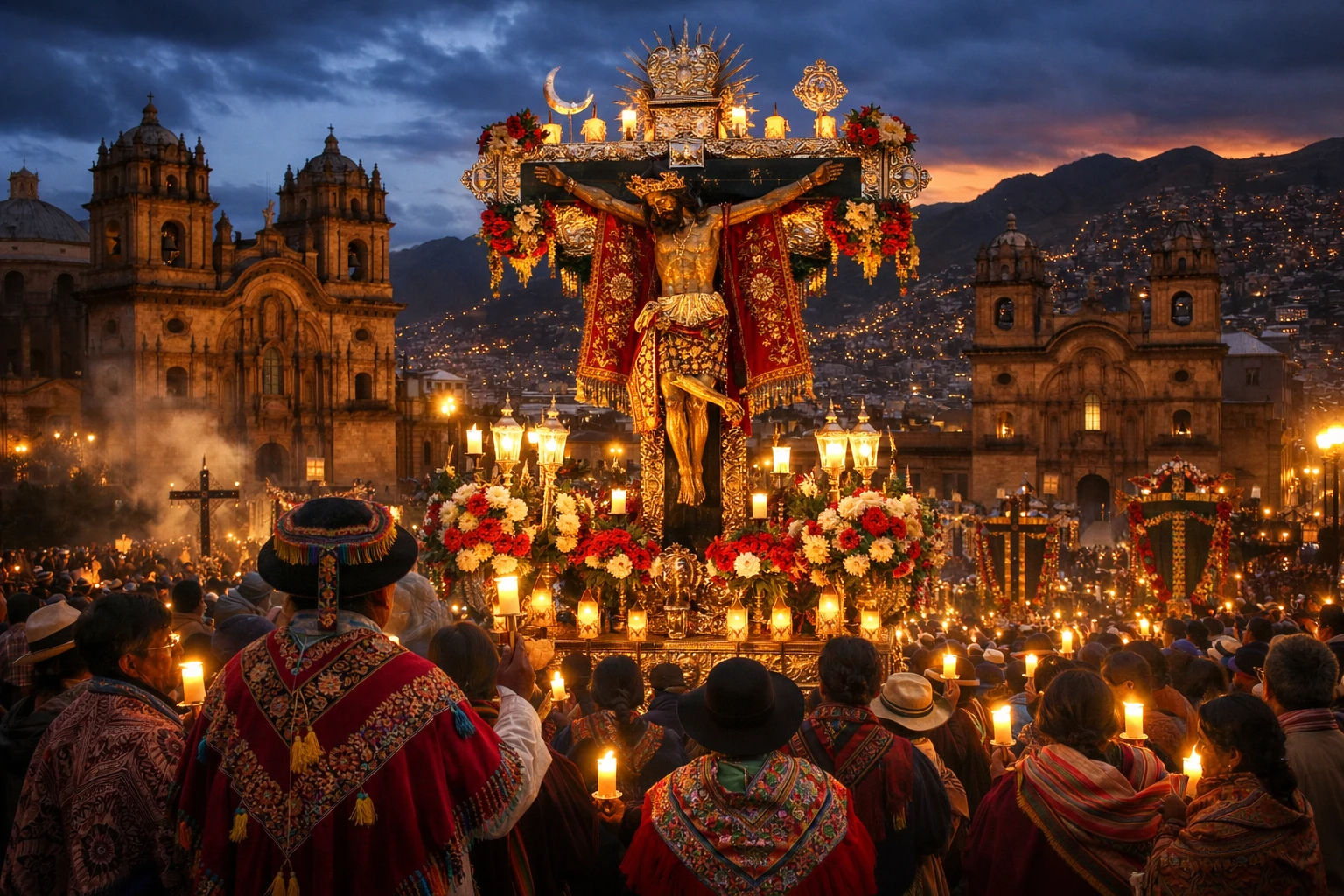
The celebration begins the evening of May 2, known as the Bajada de la Cruz (Descent of the Cross), when crosses are physically brought down from hilltops, peaks, and roadside shrines. These crosses have spent the year on the heights, guarding each community, and their descent is a communal act of welcome and thanksgiving.
The Velación de la Cruz (vigil of the cross) begins on May 2 evening. The carguyoq (or mayordomo carguyoq), a community member who has volunteered or been chosen to sponsor and organize the celebration, opens their home to neighbors. An altar is decorated specifically for the vigil, adorned with flowers, ribbons, textiles, candles, and offerings of fruit and sweets.
Throughout the night, the community gathers for prayers and hymns, traditional food and chicha, and the appointment of the next year's carguyoq, ensuring the cycle continues. An earth offering known as despacho, a ritual gratitude ceremony for Pachamama (Mother Earth), is performed with coca leaves, seeds, and symbolic items. Musicians play huaynos and sacred music through the night.
The Main Day: May 3, 2026
May 3 is the most intense day of Cruz Velacuy, drawing the largest number of faithful and visitors across the city. The sequence of events follows a clear and emotionally powerful arc:
- Central Mass: Devotees carry the cross in procession to the nearest church for a central mass in its honor, accompanied by local bands.
- Procession: After mass, the cross is carried back, often up to a hilltop summit, as a symbolic bridge between earth and sky, accompanied by the faithful, musicians, and comparsa (folk dance troupes).
- Communal Feast at the Carguyoq's Home: The cross is placed on an altar built especially for veneration, and the community gathers for pachamanca, chiriuchu (cold spiced guinea pig), roast suckling pig, and chicha.
- Traditional Dances: Comparsas in elaborate traditional dress animate the streets and courtyards with rhythmic movement passed down through generations.
- Fireworks: The celebration closes with fireworks, especially visible from the hillside neighborhoods around Cusco's historic center.
- Live Music, Bullfights, and Horse Races: In some plazas and surrounding villages, these activities round out the day's events.
Where in Cusco Cruz Velacuy Unfolds
Cruz Velacuy is deliberately local: it does not happen in a single central location but across Cusco's traditional neighborhoods and surrounding communities. Salkantay Trekking details some of the most important celebration points:
- San Blas: The artisan neighborhood on the hillside above the historic center is one of the most vibrant Cruz Velacuy settings, where narrow cobblestone streets fill with music and lanterns.
- Santa Ana: One of Cusco's oldest districts, known for its communal energy during Cruz Velacuy.
- Santiago District: Renowned for traditional music and vibrant comparsas during the May 3 festivities.
- Hilltop Shrines and Surrounding Villages: Crosses on peaks outside the city are key sites; many visitors follow the procession up into the mountains for a genuinely moving experience.
Part of what makes Cruz Velacuy so rewarding to witness is precisely this decentralized nature. There is no single ticket, no main stage. You follow the sound of the music, the smoke of the despacho, and the lantern-lit processions up cobblestone streets.
Cruz Velacuy and Andean Syncretism: A Living Tradition
What strikes visitors most about Cruz Velacuy is how naturally the Catholic and Andean elements live together rather than in tension. The cross is honored as a Christian symbol of sacrifice and salvation, but it is also dressed in Andean textiles, fed offerings to Pachamama, and treated as a living protective presence connected to the apus.
Salkantay Trekking describes this as "a seamless fusion of Christianity and Andean cosmology": the vigil, the despacho, the procession, and the feast are not separate elements grafted together but a genuinely unified ritual that communities have been practicing for generations. For travelers who come to Cusco looking for more than ruins and trekking, Cruz Velacuy offers one of the most authentic encounters available with living Andean culture.
Practical Tips for Visitors Attending Cruz Velacuy 2026 in Cusco
To experience Cruz Velacuy fully and respectfully:
- Go to the neighborhoods, not the main plaza: The heart of Cruz Velacuy is in San Blas, Santa Ana, and Santiago, not the Plaza de Armas.
- Start on the evening of May 2: The Bajada de la Cruz and first vigil activities begin after dark, and arriving early gives you time to find the carguyoq's home or a chapel with an active celebration.
- Ask local guesthouses or guides: Because celebrations are community-organized, locals always know which neighborhoods have the most active events each year.
- Eat the traditional food: Stalls and families offer chiriuchu (the quintessential Cusco festival dish of cold guinea pig, corn, cheese, and dried meat), chicha de jora, and pachamanca. Trying the food is an act of participation, not just tourism.
- Dress in layers and wear good shoes: May nights in Cusco drop to around 3–7°C, and if you follow processions up hillside streets or toward peaks, you will want warm clothes and stable footwear.
- Be a respectful observer: These are genuine community rituals. Bring a camera but ask before photographing individuals; observe the despacho and vigil from a respectful distance unless invited closer.
- Acclimatize first: Cusco sits at 3,400 meters (11,150 feet). Arriving a day or two before May 3 lets your body adjust so you can actually enjoy an all-night vigil if you choose to.
Why Cruz Velacuy is One of Cusco's Most Authentic Festivals
Cusco's festival calendar is packed with spectacular events, but Cruz Velacuy occupies a special place because it belongs entirely to the communities. There is no tourism infrastructure around it, no grandstand tickets, no light show. There is a cross coming down the mountain, a family opening their door, chicha being poured, a band playing huayno at two in the morning, and everyone welcome who comes with genuine curiosity and respect.
If you are in Cusco in early May 2026, let May 2 and 3 be the nights you step away from the guidebook circuit and into the living city. Follow the music uphill through San Blas, find a vigil in progress, and sit with the cross, the candles, and the mountain air that has shaped this tradition for centuries.
Verified Information at glance
| Detail | Information |
|---|---|
| Event name | Cruz Velacuy (Festival of the Holy Cross / Fiesta de la Cruz) |
| Event category | Traditional religious and cultural festival (Andean-Catholic syncretic) |
| Main day confirmed | Sunday, May 3, 2026 |
| Vigil / eve activities | Saturday, May 2, 2026 (Bajada de la Cruz, Velación de la Cruz) |
| Location | Traditional neighborhoods of Cusco (San Blas, Santa Ana, Santiago, hillside shrines) and surrounding communities |
| Format | Community-organized, no central venue; celebrations in chapels, homes, plazas, and hilltops across the city |
| Entry / ticket pricing | Free and open to all; no admission fee; community-hosted |
| Key activities | Cross descent (Bajada de la Cruz), cross vigil (Velación), earth offering (Despacho), central mass, procession, communal feast, traditional dances (comparsas), live music (huaynos, sacred music), fireworks |
| Traditional foods | Chiriuchu, pachamanca, chicha de jora, roast suckling pig |
| Organizing structure | Each neighborhood's carguyoq (sponsored community member) organizes local celebration; no central government or institutional organizer |
Event Has Passed - See You Next Time!
Event Details
Date
Location
Plaza de Armas, Calle del Medio, San Cristóbal & neighborhoods citywide, Cusco
Cusco, Peru
Price
Free Entry