
Event Has Passed - See You Next Time!
Event Details
Date
to
Location
Cusco Cathedral & Plaza de Armas, Historic Centre, Cusco
Cusco, Peru
Price
Free Entry
About This Event
Corpus Christi in Cusco 2026: The Most Spectacular Catholic Festival in South America
In a city where every major celebration manages to be simultaneously Catholic and Andean, colonial and indigenous, Spanish and Quechua, Corpus Christi stands as perhaps the most perfect expression of what Cusco is. The festival that brings the 15 patron saints and virgins of Cusco's parishes into the Plaza de Armas in one of the most visually extraordinary processions in the world takes place on Thursday June 4, 2026 — the main day of a celebration that begins the evening before and extends through an eight-day period to the Octava on Thursday June 11.
Cusco's Corpus Christi is described by historians as the oldest continuous festival in the Americas — a celebration whose origins lie in the earliest decades of the Spanish colonial presence in the city, and which incorporated elements of the Inca solar festival tradition from its very beginning in a syncretic fusion that has only deepened across five centuries.
Admission is free. The Plaza de Armas belongs to everyone, and on Corpus Christi it belongs most of all to the thousands of Cusqueños and visitors who fill it from morning through evening to witness the passage of the saints.
The History: Five Centuries of Devotion and Cultural Fusion
Corpus Christi — the Feast of the Body and Blood of Christ — is a Catholic liturgical feast celebrated on the Thursday following Trinity Sunday, sixty days after Easter Sunday. In the broader Catholic calendar, it is observed worldwide as a day of eucharistic processions in which the consecrated Host is carried through the streets to affirm the Catholic doctrine of the Real Presence of Christ in the Eucharist.
In Cusco, the festival arrived with the Spanish colonisers in the 16th century and was immediately shaped by the specific dynamics of the Inca city into which it was transplanted. The Plaza de Armas — the Inca Huacaypata, the central ceremonial plaza of the Tawantinsuyu where the great Inca festivals had been held — was the natural location for the colonial procession, and the decision to hold it there was deliberate: the Spanish authorities and the Catholic Church used the festival as an opportunity to demonstrate the supremacy of the new religion over the Inca traditions that the same square had once served.
What actually happened was more interesting than that. The Andean communities of Cusco, under the direction of their confraternities (religious brotherhoods, or cofradías — community organisations that took responsibility for the care and veneration of specific saints), developed the Corpus Christi celebrations into something that expressed their own cultural identity as fully as it expressed Catholic devotion. The elaborate silverwork and textile decoration of the saints' platforms, the specific dances and music associated with each parish, the culinary traditions that made Chiriuchu the essential dish of the festival — all of these are Andean contributions to a Catholic form, creating the syncretic celebration that continues in 2026.
Some historians have noted a deeper structural connection: the gathering of the 15 patron saints in the Cathedral of Cusco mirrors the Inca tradition of bringing the mummies of deceased Sapa Incas to the Huacaypata for the great festivals of Tawantinsuyu — the departed rulers feasting symbolically with their community. Whether or not the colonial founders consciously structured Corpus Christi to echo this practice, the parallels are striking, and they help explain why the celebration took root so completely in Cusco's cultural life.
The 2026 Programme: Three Key Dates
Wednesday June 3 — La Entrada (The Entry of the Saints)
The evening before the main day, June 3, is known as La Entrada — the arrival of the saints at the Cathedral.
Throughout the afternoon and evening of June 3, the 15 patron saints and virgins are carried from their home churches across Cusco in procession through the city's streets to the Cathedral of Cusco on the Plaza de Armas. Each image travels with its parish's confraternity, accompanied by brass bands, folk dancers, fireworks, and the crowds of faithful and neighbours who line the route.
The atmosphere of the Entrada is one of the most intimate and authentically communal events of the Cusco calendar — each procession is a neighbourhood event as much as a city-wide one, and the streets of San Blas (the artisan quarter), San Cristóbal, San Sebastián, San Jerónimo, and the other parishes fill with their local communities accompanying their saint on the journey to the Cathedral. By the time the last images arrive in the plaza that evening, the Cathedral holds all 15 saints gathered together — an assembly that will not be broken until the Octava on June 11.
Fireworks fill the sky above the plaza during the Entrada, and the combination of rockets, brass bands, incense, and the lights of the Cathedral at night creates an atmosphere that requires no theatrical direction — the city does it naturally, having done it for nearly five centuries.
Thursday June 4 — The Main Day: Mass and Grand Procession
June 4, 2026 is the heart of Corpus Christi — a day that begins with Mass and builds over the course of the morning and afternoon into the largest and most visually extraordinary public procession in South America.
Morning Mass is celebrated at the Cathedral of Cusco, led by the Archbishop, beginning in the early hours and drawing the most devout community members and religious figures from across the region. The Mass precedes the procession and provides the theological and devotional context for what follows.
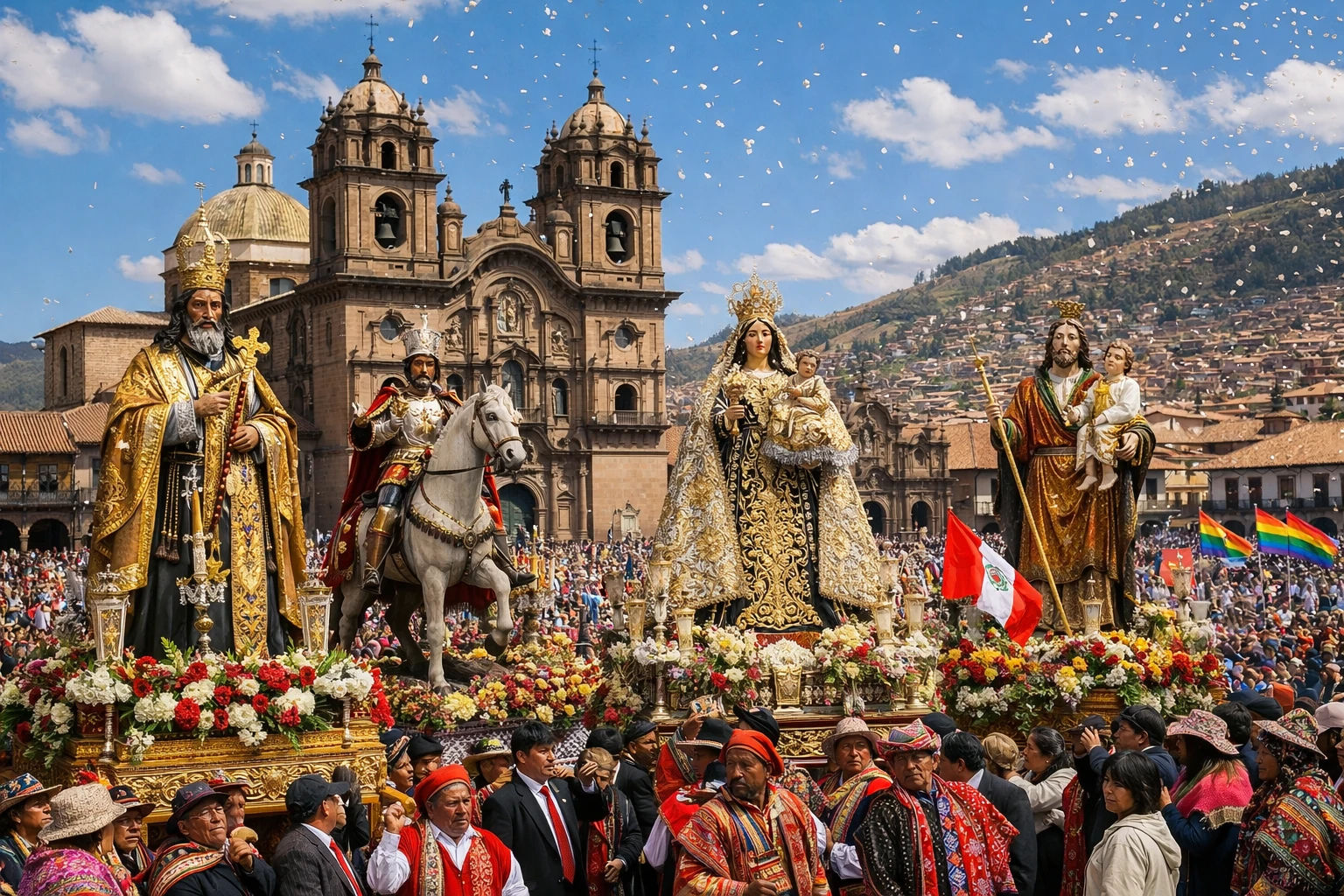
The Grand Procession begins at approximately 11:00 AM. The 15 images of saints and virgins leave the Cathedral one by one in a precisely established hierarchical order and are carried in procession around the Plaza de Armas — the full circuit of the square, with each image passing in front of the official reviewing stand and the Cathedral facade before completing the circuit and returning inside.
The 15 patron saints and virgins of Corpus Christi Cusco:
- Santa Ana (parish of Santa Ana)
- San Cristóbal (parish of San Cristóbal — the neighbourhood on the Sacsayhuamán hillside)
- San Sebastián (parish of San Sebastián — one of the oldest parishes, south of central Cusco)
- San Blas (parish of San Blas — the artisan quarter above the Plaza de Armas)
- San Jerónimo (parish of San Jerónimo — outer district of Cusco)
- Santiago (St James, patron of Spain; parish of Santiago)
- San Antonio (parish of San Antonio)
- Santa Bárbara (confraternity of Santa Bárbara)
- San Pedro and San Pablo (the twin apostles; Cathedral parish)
- Virgen de la Almudena (patron of the Hospital de los Naturales — specifically associated with the indigenous population of Cusco during the colonial period)
- Virgen de Belén (parish of Belén)
- Virgen de la Natividad de Almudena (second Almudena image)
- Virgen Purificada de San Pedro (parish of San Pedro)
- Virgen de la Asunción (parish of Santiago)
Each image is carried on an elaborately decorated platform (anda) — a wooden litter covered in silver, gold, fresh flowers, candles, and embroidered textiles, borne on the shoulders of the male members of its parish confraternity. The silverwork on the most prestigious platforms represents centuries of accumulated devotional donation: individual pieces worth thousands of dollars contributed by generations of Cusqueño families, creating a collective display of communal wealth and faith.
Each image is accompanied by:
- The parish's brass band (several musicians playing the specific march associated with each saint)
- Religious confraternity members in ceremonial dress
- Folkloric dance groups performing the traditional dances associated with the parish and its community
- Fireworks discharged at moments of particular devotional intensity — the arrival in front of the Cathedral, the departure from the square — creating a continuous percussion of rockets that underscores the emotional atmosphere
The procession of all 15 images around the Plaza de Armas takes four to five hours in total — each image completing its circuit individually, with enough time between each departure to allow the previous one to complete its route. The last images do not complete their circuit until well into the afternoon.
The Blessed Sacrament (Host) — the consecrated Eucharist in its monstrance — is carried in the procession as the theological centerpiece of the festival, preceded and followed by the saints. This is the doctrinal heart of Corpus Christi: the visible demonstration that the Body of Christ, present in the Eucharist, is being honored by the city's entire religious community.
Chiriuchu season: The main day of Corpus Christi is inseparable from the traditional cold platter of Cusco:
- Cuy (roasted guinea pig)
- Gallina (chicken)
- Cecina (dried beef or pork)
- Moraya (freeze-dried potato — chuño blanco, the white variety)
- Choclo (large-kernel corn)
- Morcilla (blood sausage)
- Tortilla de maíz (corn flatbread)
- Queso (cheese)
- Caviar de río / cushuro (a blue-green algae from Andean rivers, treated as a delicacy — the "Andean caviar")
- Cancha (toasted corn)
Vendors line the streets around the Plaza de Armas from the early morning of June 4, selling Chiriuchu from large ceramic pots — the same tradition of feeding the community during the festival that dates to the colonial period. Trying Chiriuchu for the first time on Corpus Christi Day is one of the most distinctly Cusqueño cultural experiences available to visitors.
Thursday June 11 — La Octava (The Return of the Saints)
Eight days after the main celebration, Thursday June 11, is La Octava — the day when the 15 saints and virgins leave the Cathedral and return to their home parishes.
The Octava procession follows the same structure as the Entrada and main procession — each image departing the Cathedral individually, accompanied by its confraternity and band — but in reverse, dispersing back across the city rather than gathering at the center.
The Octava is described by many regular Corpus Christi participants as an emotionally distinct experience from the main day — the community is saying farewell to the saints for another year, and the atmosphere carries that awareness throughout. The processional route of each image through its own neighbourhood has an intimate, locally specific quality that the main Plaza de Armas ceremony, with its massive crowds, cannot replicate.
The Octava procession typically runs from early afternoon (~2:00 PM) until approximately 7:00 PM.
Q'eswachaka Bridge Renewal: The Inca Engineering Festival Nearby
The Q'eswachaka Bridge Renewal takes place in the same June period — the annual reconstruction of the last remaining suspension bridge of the Inca road network, woven entirely from mountain grass fibres (qoya ichu), spanning the Apurimac River canyon at Huinchiri in the Canas province of the Cusco region.
The reconstruction takes four days and involves the collaborative weaving effort of four surrounding communities — each bringing its pre-cut grass cables to the canyon edge and working in relay to replace the entire bridge. The completed bridge is approximately 28 metres long, constructed using the same techniques documented by the Spanish in the 16th century. The ceremony and festival around the reconstruction includes traditional dances, music, and offerings to Pachamama.
The Q'eswachaka Bridge Renewal takes place approximately June 8–11, 2026 — overlapping with the final days of the Corpus Christi period, making the two events combinable for visitors with the flexibility to travel to Canas province (approximately 3–4 hours from Cusco).
Practical Information for Visiting Cusco During Corpus Christi 2026
Admission: All public events — Entrada (June 3), main procession (June 4), Octava (June 11) — are completely free.
Viewing positions for the June 4 procession:
- The arcaded portales surrounding the Plaza de Armas provide elevated positions above street level and protection from sun
- Cathedral steps and La Compañía de Jesús church facade areas on the north side
- Restaurant terraces above the plaza — typically charged seating during the procession; reserve ahead of time for the best terrace positions
- The procession route passes through the full circuit of the plaza, so every perimeter position offers good views of at least several images passing
- Arrive at least 90 minutes before 11:00 AM on June 4 for the best positions; the plaza fills completely by mid-morning
Photography: Corpus Christi is one of the most photographically rewarding days in the Cusco calendar. The combination of elaborate silverwork platforms, traditional costumes, brass bands, flower decorations, and the backdrop of the Cathedral facade creates compositions of extraordinary richness. For the best images: position yourself in the shade of the arcades with the images passing in afternoon light, or use the elevation of the Cathedral steps for a broader compositional view.
June weather in Cusco: Dry season; virtually no rain; sunny days (18–20°C); cold nights (1–5°C). The June 4 procession takes place in full sunshine — bring sun protection, a hat, and light layers for the afternoon.
Altitude: Cusco at 3,400 metres (11,152 feet). Acclimatise for at least 2 days before attending the festival, and avoid alcohol for the first 48 hours after arrival. Coca tea (available everywhere) is the standard Andean acclimatisation aid.
Getting to Cusco: Alejandro Velasco Astete Airport (CUZ); domestic flights from Lima (~1.5 hours); Lima is the main international gateway for flights from North America, Europe, and Australasia.
Accommodation in June: June is high season in Cusco. Book at least 3–4 months in advance. The week around June 4 (Corpus Christi) and June 21–24 (Andean New Year, Vigilia, Inti Raymi) are the two most-booked periods of the month.
A Celebration That Belongs to the Whole City
Corpus Christi in Cusco is not a tourist spectacle that happens to be open to visitors. It is a community celebration of extraordinary depth and beauty that happens to be free and publicly accessible. The confraternities that carry the saints, the families that have donated the silverwork to their parish's platform across generations, the musicians who have played the same march for the same saint since childhood — all of these participants are carrying something that they believe is worth carrying, in both the literal and the deeper sense.
Thursday June 4, 2026. Cathedral and Plaza de Armas, Cusco. La Entrada on Wednesday June 3. La Octava on Thursday June 11. Free admission. 15 saints and virgins, 500 years of devotion, and Chiriuchu vendors lining every street. Corpus Christi in Cusco is one of the genuinely unmissable days in South American cultural life.
Verified Information at a Glance
| Detail | Information |
|---|---|
| Event | Corpus Christi in Cusco 2026 |
| Category | Catholic Religious Festival / Cultural Syncretic Celebration / Public Procession |
| Main day | Thursday June 4, 2026 |
| La Entrada (Entry of Saints) | Wednesday June 3, 2026 — saints carried to Cathedral from home parishes; evening |
| Saints' residence at Cathedral | June 4–11, 2026 (8 days) |
| La Octava (Return of Saints) | Thursday June 11, 2026; procession ~2:00–7:00 PM |
| Main procession start time | ~11:00 AM on June 4; duration: 4–5 hours |
| Primary venue | Cathedral of Cusco and Plaza de Armas (Plaza Mayor), Cusco |
| City | Cusco (Qosqo), Peru |
| Admission | FREE — all public procession and ceremony events |
| The 15 patron saints and virgins | Santa Ana, San Cristóbal, San Sebastián, San Blas, San Jerónimo, Santiago, San Antonio, Santa Bárbara, San Pedro, San Pablo, Virgen de la Almudena, Virgen de Belén, Virgen de la Natividad, Virgen Purificada de San Pedro, Virgen de la Asunción |
| Traditional food | Chiriuchu — cold platter of cuy, chicken, dried meat, freeze-dried potato, corn, blood sausage, corn flatbread, cushuro (river algae), cheese, toasted corn; vendors throughout Plaza de Armas area on June 4 |
| Historical status | Described as the oldest continuous festival in the Americas |
| June Cusco weather | Dry season; 18–20°C days; 1–5°C nights; no rain; sunny |
| Altitude | 3,400 metres (11,152 feet) |
| Nearby concurrent event | Q'eswachaka Bridge Renewal (~June 8–11); Inca grass-rope suspension bridge reconstruction in Canas province (~3–4 hrs from Cusco) |
| Getting to Cusco | Alejandro Velasco Astete Airport (CUZ); Lima–Cusco ~1.5 hrs by air; Lima main international hub |
| Accommodation | Book 3–4 months in advance for June 4 week; June is peak season |
| UNESCO | Cusco Historic Centre — UNESCO World Heritage Site (1983) |
| June Jubilee Month context | Corpus Christi on June 4 opens the Cusco Jubilee Month events leading to Inti Raymi on June 24 |
Event Has Passed - See You Next Time!
Event Details
Date
to
Location
Cusco Cathedral & Plaza de Armas, Historic Centre, Cusco
Cusco, Peru
Price
Free Entry