
.webp)
Event Has Passed - See You Next Time!
Event Details
Date
to
Location
Bab Makina, Dar Batha Museum, and venues across Fes, Morocco
Fes, Morocco
Price
Free Entry
About This Event
Fes Festival of World Sacred Music 2026 (29th Edition): Four Days of Spiritual Music in Morocco's Oldest City
There is a festival that takes place inside the walls of the world's largest car-free medieval city, on a stage framed by royal palace walls, under a sky that has been witness to 1,200 years of human civilisation. The Fes Festival of World Sacred Music 2026 — the 29th edition of the event that Esprit de Fes Foundation describes as the world's first festival dedicated entirely to sacred music — runs from Thursday June 4 to Sunday June 7, 2026, in Fes, Morocco, under the theme "Fez and its Maalems: Guardians of Craft and Heritage."
This year's theme is a tribute to the master craftsmen of Fes — the Maalems, the artisans of the city's legendary tanneries, zellige tile workshops, metalwork foundries, woodcarving ateliers, and weaving traditions — whose skills represent a living continuity with the medieval Andalusian civilization that built Fes el-Bali twelve centuries ago. The festival frames these artisanal masters as the guardians of something as sacred as any religious tradition: the physical, human knowledge of how to make things by hand in the way they were always made.
The World's First Sacred Music Festival: Origins and Legacy
The Fes Festival of World Sacred Music was founded in 1994 — a year that, in retrospect, seems perfectly chosen for a festival whose declared purpose was to use the universal language of music as a vehicle for dialogue between cultures, religions, and civilisations. The early 1990s, following the end of the Cold War, saw both a surge of optimism about cross-cultural connection and an early warning of the identity-based conflicts that would define the following decades.
The festival's founders chose Fes for reasons that go beyond convenience. Fes is simultaneously a city of extraordinary Islamic spiritual heritage (home to the Qarawiyyin Mosque and University, founded in 859 AD and widely considered the oldest continuously operating university in the world), a city shaped by Andalusian refugees fleeing the Reconquista with their music, architecture, and knowledge, a city with a significant Jewish heritage in the historic Mellah quarter, and a city whose artisanal traditions are among the most sophisticated and continuously practised in the Arab world.
There is no more appropriate city in the world for a festival whose mission is spiritual dialogue through music. Fes has been practising exactly that kind of dialogue for over a thousand years.
The festival holds the High Patronage of His Majesty King Mohammed VI of Morocco — a formal recognition that places it at the highest level of Moroccan cultural life.
By the 2025 edition (the 28th, held May 16–24 under the theme "Renaissances"), the festival was bringing together approximately 200 artists from 15 countries — representing a geographic and musical range spanning Sufi mysticism, Gregorian chant, Jewish liturgical music, Hindu devotional traditions, West African spiritual music, indigenous sacred chanting, and contemporary sacred crossover.
The 2026 Theme: Fez and Its Maalems
The decision to dedicate the 29th edition to "Fez and its Maalems: Guardians of Craft and Heritage" places the spotlight on something that the festival has always honoured implicitly but now makes explicit: the sacred dimension of craft knowledge.
The Maalem (plural: Maalems) is a master craftsman in Moroccan tradition — a figure who has reached the highest level of their discipline after years of apprenticeship under a previous Maalem. The title carries both professional and spiritual meaning: a Maalem is not simply skilled but is the keeper of a living tradition, responsible for transmitting it to the next generation with fidelity.
Fes's Maalems represent the full spectrum of the city's famous artisanal heritage:
- Zellige — the intricate geometric ceramic tile-making tradition, producing the star-and-polygon patterns that cover Morocco's finest religious and civic buildings
- Tannery work — the Chouara Tanneries of Fes el-Bali, where leather has been processed using the same vat-dyeing methods for over a thousand years, are the most visited and most photographed craft site in Morocco
- Wood carving and zouak — the carved cedar wood screens, panels, and minbar decoration of Fes's mosques and madrasas
- Metalwork (dinanderie) — copper and brass hammering in the Seffarine Square area, producing the trays, lanterns, and decorative objects of Moroccan interiors
- Weaving and textile — the silk and wool weaving traditions of the Fes medina
By asking the question of what it means to be the guardian of a craft tradition in the same breath as asking what it means to be the guardian of a sacred music tradition, the 2026 festival places artistic transmission itself at the center of its inquiry — arguing that how knowledge is passed from one generation to the next is as spiritually significant as the content of that knowledge.
The Main Stage: Bab Makina and the Royal Palace Walls
The principal concert venue of the Fes Festival of World Sacred Music is Bab Makina — the grand outdoor esplanade in front of the walls of the Royal Palace of Fes in the historic medina.
Bab Makina is not a purpose-built concert venue. It is a historic public space enclosed on one side by the ornate monumental gate of the Royal Palace — a facade of carved plaster, zellige tile, and iron detail that provides a backdrop of extraordinary visual complexity and historical resonance — and on the other sides by the walls and structures of the medieval medina. When the stage is set and the evening audience fills the esplanade under the open Moroccan sky, the effect is unlike any other concert setting in the world.
Performers on the Bab Makina stage over the festival's history have included artists from virtually every religious and spiritual musical tradition: Qawwali masters from Pakistan (in the lineage of the late Nusrat Fateh Ali Khan), Sufi brotherhoods from Morocco and West Africa, Jewish Sephardic vocal ensembles, Georgian polyphonic choirs, Buddhist ceremonial music from Tibet and Japan, Gnawa masters from southern Morocco, Gregorian chant ensembles, West African griot traditions, and sacred music from India's Carnatic and Hindustani traditions.
The festival's programming philosophy consistently refuses simple genre categories: what unites the performers is not stylistic similarity but the shared conviction that music can be a path toward the sacred, however that is understood within each tradition.
Free Evenings: Nights of Sufi Music and Gnawa Across the Medina
One of the Fes Festival's most beloved elements is that it does not restrict itself to the ticketed main stage. Every evening during the June 4–7 festival period, free concerts of Sufi music, Gnawa traditions, and sacred music from the Moroccan repertoire take place in smaller venues across Fes el-Bali — in squares, courtyards, mosques, and cultural spaces that together turn the entire medina into a distributed festival site.
Gnawa music — the trance-ceremonial tradition brought to Morocco by sub-Saharan African communities over the centuries, combining percussion, the sintir (a long-necked bass lute), and qraqeb (metal castanets) in all-night healing ceremonies — is central to the free evening programming. The music has been described as "the blues of Morocco" — rhythmically driving, spiritually intense, and capable of inducing the specific altered state that its practitioners intend. Encountering Gnawa music in the lantern-lit squares of the Fes medina at midnight during the sacred music festival is one of those experiences that cannot be planned or manufactured — it has to be found.
These free events are where the festival integrates fully with the living city — where Fes residents and international visitors share the same courtyard, sitting on the same stone steps, listening to music that belongs to the city and its tradition as much as to the formal festival programme.
Fes el-Bali: The Festival's Living Context
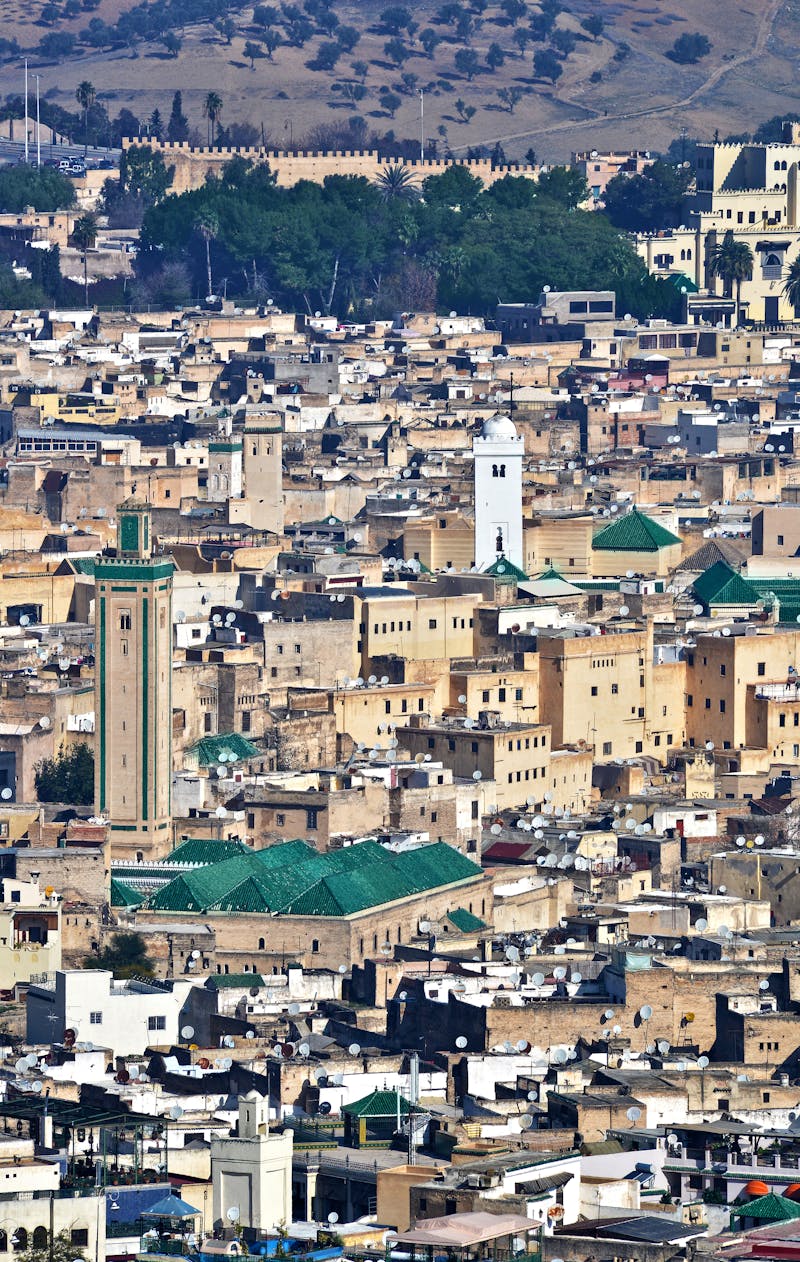
Fes el-Bali (Old Fes) — the UNESCO World Heritage-listed medina within which the festival takes place — is the largest car-free urban area in the world: a labyrinthine city of approximately 9,000 streets and alleys, some barely wide enough for two people to pass each other, whose urban structure has remained essentially unchanged since the medieval period.
The medina contains:
- Qarawiyyin Mosque and University (859 AD) — the world's oldest continuously operating university, whose founding in the 9th century established Fes as the intellectual capital of the medieval Islamic world
- Medersa Bou Inania — the most exquisitely decorated Marinid-era theological college in Morocco, with carved stucco, zellige tile, and cedar wood panels representing the finest medieval Islamic artisanal achievement
- Medersa al-Attarine — adjacent to the Qarawiyyin, equally ornate, its upper terrace offering views over the mosque's minaret
- Chouara Tanneries — the ancient leather-dyeing complex visible from several terraces around the medina, its circular vats filled with natural dyes of turmeric, poppy, indigo, and mint; an industrial landscape whose visual and olfactory intensity is immediately unforgettable
- Seffarine Square — the metalwork square where coppersmith Maalems have worked since the medieval period, the sound of hammering filling the adjacent lanes
- Mellah (Jewish Quarter) — the historic Jewish neighbourhood of Fes, with its distinctive architecture and the Aben Danan Synagogue, reminding visitors of the city's multi-faith history
The Fes medina is not a preserved monument. It is a living city where people are born, grow up, work, and die within the same walls that housed their ancestors for a thousand years. Walking through it during the Festival of Sacred Music, when additional musicians and performers bring their specific traditions into the already-layered acoustic environment of the medina, is an experience that genuinely has no equivalent anywhere else in the world.
Practical Information for Visiting the 2026 Festival
Festival dates: Thursday June 4 to Sunday June 7, 2026
Main venue: Bab Makina, Fes el-Bali (Royal Palace square), Fes, Morocco
Ticket availability: Official tickets for the Bab Makina evening concerts are sold through the fesfestival.com official website and at the festival box office in Fes. The free evening Sufi and Gnawa concerts across the medina require no ticket.
The festival's free programme: Every evening, free sacred music events take place across Fes el-Bali — these require no advance booking and are found by simply being in the medina after dark.
Getting to Fes:
- By air: Fes-Saïss Airport (FEZ) is the international gateway; direct flights from Paris, London (Ryanair), Amsterdam, Brussels, Madrid, and other European cities; flying time from London approximately 3 hours; from Paris approximately 2.5 hours
- By train: The ONCF Moroccan rail network connects Fes to Casablanca (approximately 3.5–4 hours), Rabat (~3 hours), and Marrakech (via Casablanca, ~7 hours). Casablanca Mohammed V Airport (CMN) is the main international hub for intercontinental flights.
- By bus: CTM and Supratours run reliable intercity bus services connecting Fes to all major Moroccan cities
Accommodation in Fes: The traditional choice is a riad — a restored medina townhouse with interior courtyard — available at a wide range of price points, from budget guesthouses to luxury properties. Staying inside Fes el-Bali during the festival means the evening concerts are within walking distance of your room and the free medina events are outside your door. Book at least 2–3 months in advance for festival week.
June weather in Fes: June in Fes is warm to hot — daytime temperatures typically range from 28–36°C (82–97°F). Evenings cool to 18–22°C for the outdoor concerts — comfortable for open-air performances with a light layer after midnight. The city is dry in June; sun protection is essential during daytime exploration.
Currency: Moroccan dirham (MAD). As of April 2026, approximately 10.5 MAD = $1 USD. ATMs are available throughout Fes. Credit cards accepted at hotels and some restaurants but cash is preferred for medina shops and food stalls.
Language: Arabic (Darija dialect) and French are the practical languages of daily life in Fes. English is widely understood in hotels and tourist contexts. Spanish is sometimes heard near the northern Morocco areas.
A Festival That Earns Its Reputation Every Year
The Fes Festival of World Sacred Music has been arguing for 29 editions that music is the most effective form of cross-cultural dialogue available to human beings — and that the specific music made in devotion to whatever is considered sacred in each tradition carries a particular kind of emotional and spiritual authority that political or academic dialogue cannot match.
June 4–7, 2026 in Fes. Bab Makina under the night sky. The oldest city in Morocco, the oldest university in the world, and the newest programme of sacred music from across the globe. The 29th edition of a festival that has been uniting voices since 1994. Free Gnawa and Sufi evenings across Fes el-Bali every night. Tickets at fesfestival.com. No other festival on earth sounds quite like this.
Verified Information at a Glance
| Detail | Information |
|---|---|
| Event | Fes Festival of World Sacred Music 2026 — 29th Edition |
| Category | Sacred Music / World Music / Intercultural Dialogue Festival |
| Dates | Thursday June 4 to Sunday June 7, 2026 |
| 2026 theme | "Fez and its Maalems: Guardians of Craft and Heritage" (French: "Fès et les Mâalemines, Gardiens du Geste et du Patrimoine") |
| Primary venue | Bab Makina (Royal Palace Square), Fes el-Bali, Fes, Morocco |
| Additional venues | El Ashabine Square, Sgha Square, Bab Guissa, medina courtyard spaces throughout Fes el-Bali |
| City | Fes (Fez), Morocco |
| Organiser | Esprit de Fes Foundation (Fondation Esprit de Fès) |
| High Patronage | HM King Mohammed VI of Morocco |
| Festival founded | 1994 (32 years history; 29th edition in 2026) |
| Free programme | Nightly Sufi music, Gnawa concerts, and sacred music events across Fes el-Bali — no tickets required |
| Ticketed events | Bab Makina evening concerts — tickets via fesfestival.com |
| 2025 edition scale | ~200 artists from ~15 countries |
| Nearest airport | Fes-Saïss Airport (FEZ) — direct flights from London, Paris, Amsterdam, Brussels, Madrid |
| June weather in Fes | 28–36°C days; 18–22°C evenings; dry; sunny |
| Accommodation | Riads in Fes el-Bali (traditional medina townhouses) recommended; book 2–3 months ahead |
| Official website | fesfestival.com |
| UNESCO | Fes el-Bali (medina) — UNESCO World Heritage Site |
| Key Fes landmarks | Qarawiyyin Mosque and University (859 AD, world's oldest university); Medersa Bou Inania; Chouara Tanneries; Seffarine Square; Mellah (Jewish Quarter); Bab Guissa |
Event Has Passed - See You Next Time!
Event Details
Date
to
Location
Bab Makina, Dar Batha Museum, and venues across Fes, Morocco
Fes, Morocco
Price
Free Entry