
Event Has Passed - See You Next Time!
Event Details
Date
to
Location
Bab Boujloud Square, Fes, Morocco
Fes, Morocco
Price
Free Entry
About This Event
Fez Cultural Programme at Bab Boujloud Square 2026: Every Weekend, Morocco's Blue Gate Comes Alive
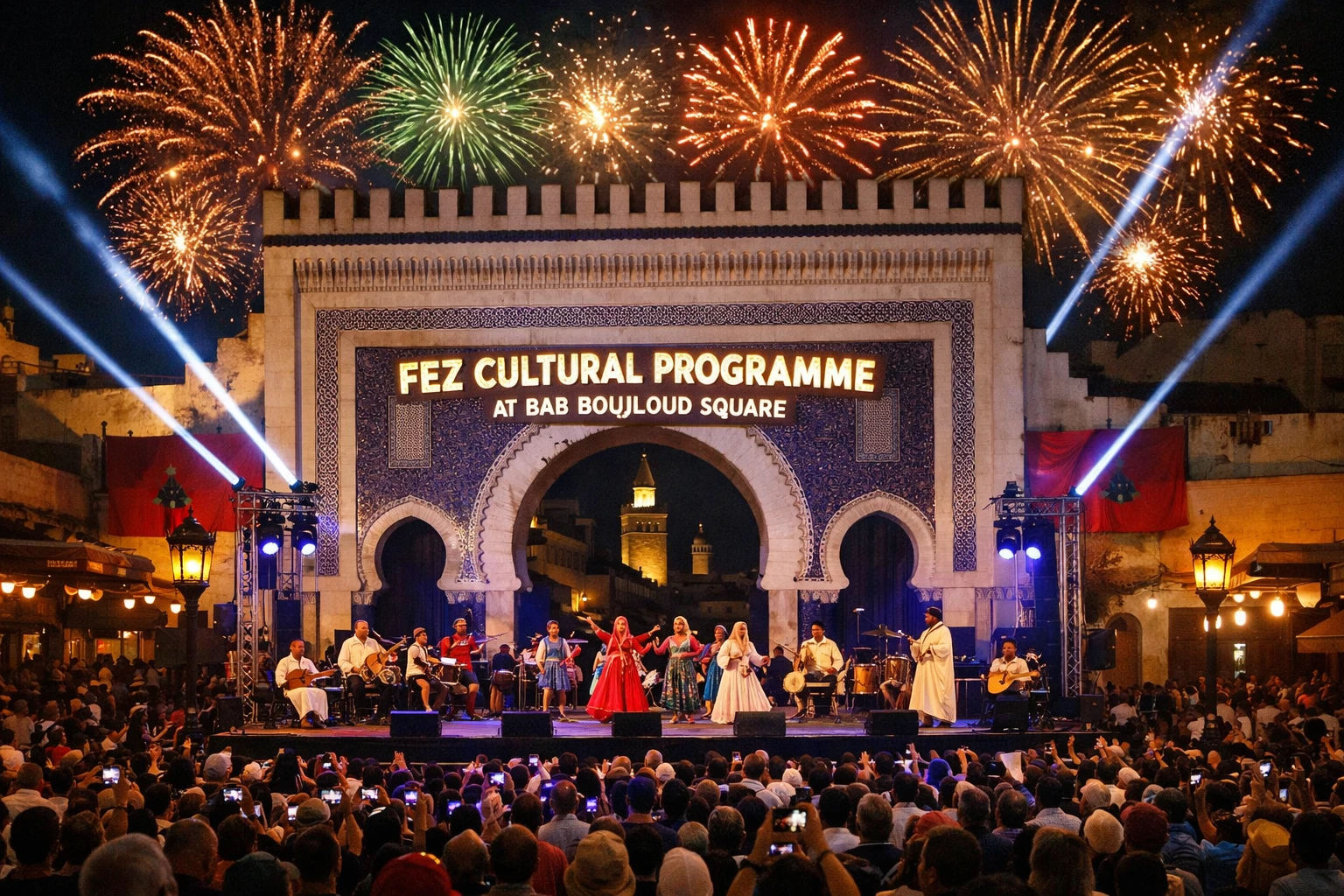
There is a gate in Fez that stops every visitor in their tracks. Bab Boujloud — the Blue Gate — has been the defining visual symbol of Fes el-Bali for over a century: its exterior face covered in cobalt blue zellige tiles, its interior glowing in Islamic green, its three horseshoe arches framing the labyrinthine entry into the world's largest medieval medina. In 2026, the square that spreads before it has become something new: a free, weekly cultural performance space, alive every Friday, Saturday, and Sunday from 5:00 PM, bringing together storytelling, live music, theatrical performance, and street parades in one of the most historically layered public spaces in the Arab world.
The Fez Cultural Programme at Bab Boujloud Square launched on Thursday March 26, 2026, organised by the Commune of Fez in partnership with the Fes-Sais Association and under the supervision of the Wilaya of the Fes-Meknes Region. It is a year-round commitment to making the city's living heritage visible to everyone who passes through its most famous gateway. And it costs nothing to watch.
The Blue Gate: Morocco's Most Iconic Threshold
Bab Boujloud was constructed in 1913, during the early years of the French Protectorate, as the principal ceremonial entrance to Fes el-Bali from the west. Its position at the junction of the medina's main commercial arteries — the Talaa Kebira and Talaa Sghira, the "Big Slope" and "Small Slope" that descend from the gate into the heart of the old city — made it the natural threshold between the ancient and the modern, the medina and the world beyond it.
The gate's tilework carries deliberate symbolic meaning. The cobalt blue exterior pays tribute to Fez's centuries-old ceramics tradition — the specific shade of blue that is recognised worldwide as "Fez blue" comes from the cobalt oxide used by the city's pottery Maalems, and the choice to clad the gate's exterior in this colour was an assertion of civic identity. The green interior tiles represent Islam — the colour of the Prophet and of Moroccan Islamic practice — and greet visitors as they pass into the sacred space of the medina.
The square in front of the gate has a history that precedes the 1913 structure by many centuries. The name Boujloud derives from Abu Al Junud — "father of the troops" in Arabic — because the space was historically used as a parade ground and military staging post. It was also a caravan staging ground, where merchants arriving from the long desert and mountain routes paused before entering the city. The square was later also known as Baghdadi Square, named after Pasha Mohammad Ben Bouchta El Baghdadi, the first administrator of Fez under the French Protectorate in 1912.
Today, Bab Boujloud and its square serve as the most natural gathering point in Fes el-Bali — the place where the medina's internal world meets the city outside it, where first-time visitors orient themselves, where locals converge, and where the social life of the medina overflows into open space. The 2026 cultural programme formalises and enriches what has always happened here organically.
What the Weekly Programme Offers
The Bab Boujloud Cultural Programme is not a single recurring event but a rotating repertoire of performance types, each drawing on a different strand of Fez's extraordinarily deep artistic heritage.
Storytelling Sessions (Halqa)
Traditional Moroccan storytelling — the Halqa — is one of the oldest performing arts of North Africa and the Arab world. The Halqa is a circle performance: a single storyteller standing in an open space, drawing a crowd that gathers and tightens around them as the narrative unfolds. The stories traditionally draw from the great cycles of Arabic oral literature — tales from the Thousand and One Nights, heroic histories of the Islamic world, local legends of Fez, the lives of saints and scholars — delivered with the full performative art of voice, gesture, and audience engagement that the tradition demands.
The Halqa tradition is in active preservation across Morocco, and seeing it performed at Bab Boujloud — in the square that was for centuries a literal waystation for the travellers whose stories fed into the oral tradition — is one of the most contextually resonant cultural experiences available in the country.
Theatrical Performances
Street theatre in the Bab Boujloud programme draws on Andalusian, Amazigh (Berber), and contemporary Moroccan theatrical traditions, presenting short-form theatrical pieces in the open square.
The Andalusian heritage of Fez is specific and significant. When Muslim and Jewish communities were expelled from Spain during the Reconquista — with the final expulsions occurring in the late 15th century — many settled in Fez, bringing with them the sophisticated artistic and intellectual culture of Al-Andalus: its music, its poetry, its architectural vocabulary, its culinary traditions, and its theatrical forms. The Bab Boujloud theatrical programme includes performances in this Andalusian tradition, staging material that has been in Fez's cultural repertoire for over 500 years.
The Amazigh theatrical tradition represents the Berber indigenous cultural heritage of Morocco's pre-Arab population — a tradition that has experienced significant revival in recent decades as Morocco formally recognised Tamazight (the Amazigh language) as a co-official language alongside Arabic in 2011.
Live Musical Performances
The musical programme at Bab Boujloud spans several of Fez's most celebrated traditions:
Andalusian classical music (Al-Ala): The musical tradition brought from Al-Andalus and developed in Fez over 500 years into one of the most sophisticated classical forms in the Arab world. Al-Ala is performed by ensembles of stringed instruments (oud, rabab, lute), woodwinds, and voice in formal suites (nawbat) that can last several hours. Its relationship to the Spanish and Portuguese flamenco tradition is not coincidental — both derive from the same Moorish-Andalusian musical roots. Fez is the primary custodian of the Moroccan Al-Ala tradition.
Sufi music and Malhun: The mystical musical expressions of Morocco's Sufi brotherhoods (turuq) — including the Tijaniyya, whose founding zawiya is in the Fez medina — range from meditative vocal chanting to ecstatic percussion-driven ceremonies. The Malhun is a specifically Moroccan form of sung poetry in Moroccan Arabic dialect, performed with classical instruments and voice, whose roots are in the Andalusian tradition.
Gnawa influence: While the Gnawa trance music tradition has its most concentrated expression in Marrakech and the south, its presence in Fez reflects the city's historical role as a crossroads of sub-Saharan African, Berber, Andalusian, and Arab cultural streams.
Street Parades
The street parade component brings the performance out of the fixed square space and into the surrounding lanes of the medina — processions of musicians, costumed performers, and traditional artisans that animate Bab Boujloud's adjacent streets.
These parades draw on the Moroccan tradition of the fantasia (tbourida) and the urban festival procession, bringing the kind of street-level theatrical energy that characterises Fez's major religious festivals — Mawlid an-Nabi (Prophet's birthday), Eid processions, and the saints' festivals of the various zawiyas — into the regular cultural calendar.
Why This Initiative Matters for Fez in 2026
The Bab Boujloud Cultural Programme is not simply a leisure offering. It is part of a deliberate, coordinated strategy to reposition Fez as a year-round cultural destination rather than a city known primarily for its participation in peak-season international festivals.
Several converging factors make 2026 a particularly significant year for this ambition:
The 2030 FIFA World Cup: Morocco is co-hosting the 2030 FIFA World Cup alongside Spain and Portugal, with matches scheduled at venues including Fez's stadium. The tournament has accelerated investment in Moroccan tourism infrastructure and the cultural programming that turns a sporting event host city into a destination worth visiting before and after the matches. The Bab Boujloud programme is explicitly part of this preparation — building the cultural infrastructure and visitor experience quality that will be needed when the international spotlight turns toward Morocco.
New direct air routes: Fez-Saïss Airport (FEZ) has seen significant expansion of direct connections from European cities in recent years, with Ryanair, easyJet, and other carriers adding routes from the UK, France, the Netherlands, Belgium, and Spain. Increased air connectivity means more first-time visitors to Fez who need engaging, accessible cultural experiences on arrival.
Bloomberg Philanthropies recognition: Fez recently received a $1 million Bloomberg Philanthropies award as part of a global city challenge, recognising its ambitions for sustainable cultural tourism and urban heritage management. The Bab Boujloud programme is part of the strategy that earned this recognition.
Complementing the World Sacred Music Festival: The June 4–7, 2026 edition of the Fes Festival of World Sacred Music will bring international audiences to the city in significant numbers — but concentrating cultural programming exclusively around that four-day window has limits. The Bab Boujloud weekly programme ensures that visitors arriving in any week of 2026 find a rich cultural offering waiting for them, regardless of whether they coincide with the international festival.
The Medina Context: What Surrounds Bab Boujloud
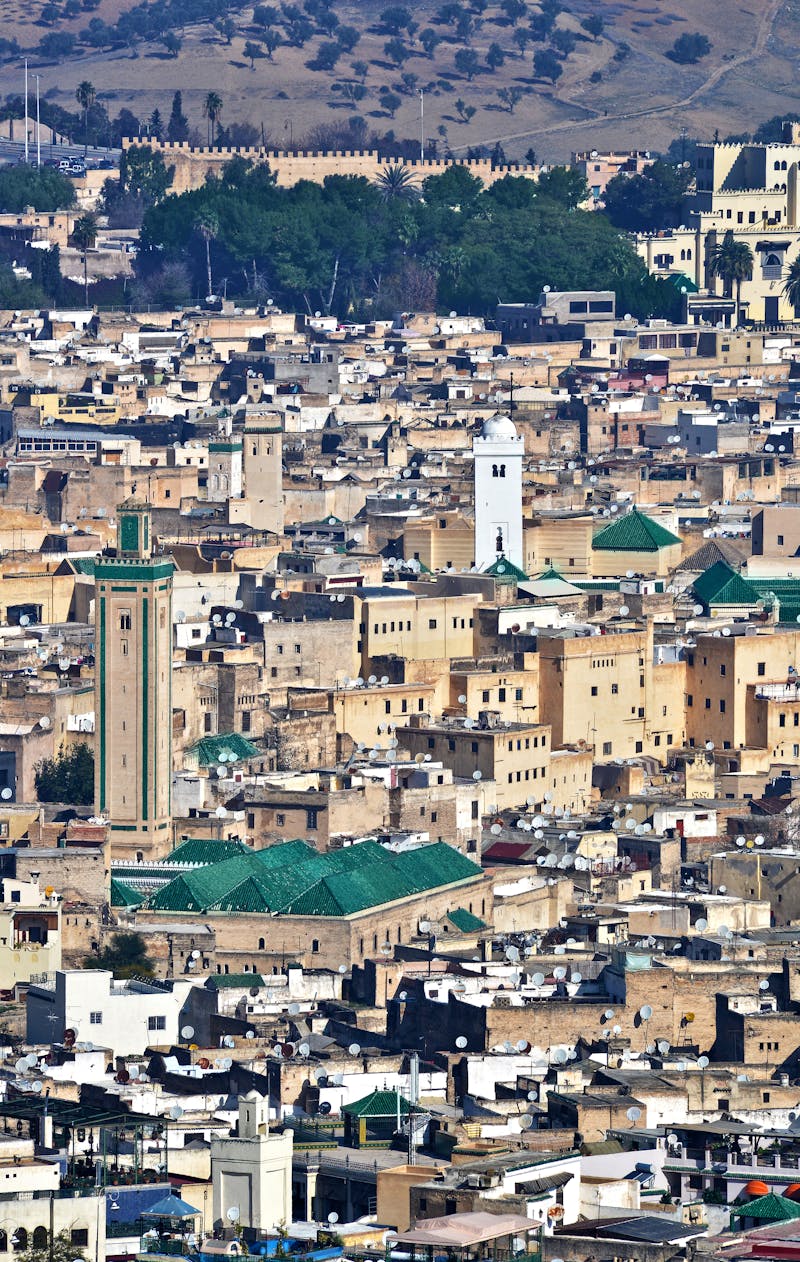
The cultural programme at Bab Boujloud Square takes place at the western entrance to Fes el-Bali — the UNESCO World Heritage-listed medina that is the largest car-free urban space in the world, with approximately 9,000 streets and alleys spreading through a medieval layout that has remained essentially unchanged for centuries.
The square's immediate surroundings include some of the medina's most significant cultural sites:
- Medersa Bou Inania — one hundred metres inside the main gate; the most ornately decorated Marinid theological college in Morocco, with carved stucco, zellige tile, and cedar wood panels of extraordinary quality; open to non-Muslim visitors
- Talaa Kebira — the main commercial artery of the medina, beginning directly inside Bab Boujloud and running past spice souks, ceramic shops, textile stalls, and the workshops of craftsmen to the heart of the old city
- Rcif Square and the Qarawiyyin — 10–15 minutes' walk inside the gate; the complex around the great mosque-university (founded 859 AD) and the Medersa al-Attarine, one of the most beautiful architectural ensembles in Morocco
- Seffarine Square — the coppersmith quarter where Maalem metalworkers hammer brass and copper to the same rhythms that have filled this corner of the medina for a thousand years
- Chouara Tanneries — accessible by foot through several routes from Bab Boujloud; the ancient leather vats whose natural dye colours are best viewed from the terraces of surrounding shops
Practical Guide: Attending the Bab Boujloud Cultural Programme
Schedule: Every Friday, Saturday, and Sunday; performances begin at 5:00 PM
Admission: Completely free
Programme start: Launched March 26, 2026; ongoing throughout 2026
Location: Bab Boujloud Square (Place Boujloud), western entrance to Fes el-Bali, Fes, Morocco
What to expect:
- Performances rotate across storytelling, theatrical shows, musical concerts, and street parades throughout the weekend programme
- The square fills from around 5:00 PM with both local families and visitors; the atmosphere is welcoming and informal
- Performances are typically in Moroccan Arabic (Darija) and sometimes Tamazight; the visual and musical elements are accessible regardless of language
- Performances typically last 60–90 minutes per session
Getting to Bab Boujloud:
- The square is the main western entry point to Fes el-Bali and is well signposted from all directions in the city
- Taxis from the Ville Nouvelle (New City / modern Fez) or Fez-Jdid (Middle Fez) to Bab Boujloud take approximately 10–15 minutes; fare around 20–30 MAD
- From the Fes train station, a petit taxi to Bab Boujloud costs approximately 25–40 MAD; taxi ranks are directly outside the station
What to combine:
- An afternoon of medina exploration arriving via Bab Boujloud, continuing to the Bou Inania Medersa, Talaa Kebira souk, Seffarine Square, and the tanneries — then returning to the square for the 5:00 PM performance
- Friday attendance followed by Saturday and Sunday allows visitors to experience different performance formats across the rotating programme
- Visiting Bab Boujloud in June coordinates with the World Sacred Music Festival (June 4–7, 2026) — the same weekend performances continue alongside the festival, giving visitors the richest possible concentration of cultural experiences
June weather in Fez: Warm to hot (28–36°C in the day; 18–22°C evenings); the 5:00 PM start time is deliberately set to catch the cooler and more comfortable part of the day as the afternoon heat eases. Bring light clothing and sun protection for the preceding daytime medina walk; a light layer for later in the evening performance.
A City That Knows Its Own Value
Fez has always been Morocco's most self-aware city — conscious of its history, proud of its intellectual and artisanal heritage, deliberate about how it presents itself to the world. The Bab Boujloud Cultural Programme is an expression of exactly that self-awareness: the decision to use the city's most photographed landmark not as a passive backdrop but as an active stage, and to do it every single weekend, for free, for everyone.
Every Friday, Saturday, and Sunday from 5:00 PM in 2026, Bab Boujloud comes alive. The Blue Gate is the entry point. The performances are free. The medina stretches behind it, 1,200 years deep. Come through the gate, find a place in the square, and let Fez tell you its own story.
Verified Information at a Glance
| Detail | Information |
|---|---|
| Event | Fez Cultural Programme at Bab Boujloud Square |
| Category | Weekly Cultural / Performing Arts / Community Heritage Programme |
| Launch date | Thursday March 26, 2026 |
| Ongoing schedule | Every Friday, Saturday, and Sunday throughout 2026 |
| Start time | 5:00 PM each performance day |
| Venue | Bab Boujloud Square (Place Boujloud / Boujloud Square), western entrance to Fes el-Bali, Fes, Morocco |
| City | Fes (Fez), Morocco |
| Organiser | Commune of Fez in partnership with Fes-Sais Association; under supervision of Wilaya of the Fes-Meknes Region |
| Admission | FREE |
| Programme content | Storytelling (Halqa), theatrical performances, live musical concerts (Andalusian/Al-Ala, Sufi/Malhun), street parades |
| Artistic traditions featured | Andalusian classical music, Amazigh (Berber) theatre, Sufi music, Moroccan storytelling, traditional street parade |
| Bab Boujloud Gate | Built 1913; blue exterior zellige tiles (Fez ceramics tradition); green interior tiles (Islam); main western entrance to UNESCO World Heritage medina |
| Strategic context | Part of city strategy ahead of 2030 FIFA World Cup; complements Fes Festival of World Sacred Music (June 4–7, 2026); linked to Bloomberg Philanthropies $1M city award |
| Weather (June/summer) | 28–36°C days; 18–22°C evenings; dry; no rain |
| Getting there | Petit taxi from Ville Nouvelle ~10–15 min; ~20–40 MAD fare |
| Nearest airport | Fes-Saïss Airport (FEZ); direct flights from London, Paris, Amsterdam, Brussels, Madrid |
| UNESCO | Fes el-Bali (medina) — UNESCO World Heritage Site |
| Nearby landmarks | Medersa Bou Inania (100 m inside gate); Talaa Kebira souk; Qarawiyyin University (founded 859 AD); Seffarine Square; Chouara Tanneries |
Event Has Passed - See You Next Time!
Event Details
Date
to
Location
Bab Boujloud Square, Fes, Morocco
Fes, Morocco
Price
Free Entry