
.webp)
Event Has Passed - See You Next Time!
Event Details
Date
to
Location
Bab Makina (main stage), Dar Batha Museum, Dar Tazi Palace, Bab Boujeloud & medina venues – Fes el-Jdid and Fes el-Bali, Fes
Fes, Morocco
Price
Not Available
About This Event
29th Fes Festival of World Sacred Music 2026: Morocco's Most Extraordinary Cultural Event
There is a moment that happens every year in Fes, Morocco, when the ancient city becomes something it is already very close to being but rarely reaches so completely: a living meeting point for the world's spiritual traditions, expressed through music, gathered in one of the oldest and most magnificent urban environments on earth. The Fes Festival of World Sacred Music, now in its 29th edition, is that moment. For ten days each year, the medinas, the palace squares, the riads, and the gardens of Fes receive musicians from across the globe, whose traditions of devotional and sacred music could not be more different from each other and who nonetheless find, in the particular atmosphere of this ancient Moroccan city, the conditions for genuine and moving dialogue.
The 2026 edition of the festival carries the theme "Fès et les Mâalemines, Gardiens du Geste et du Patrimoine" (Fes and the Maalemines: Guardians of Craft and Heritage). The event is scheduled for early June 2026, with organisers from the Esprit de Fès Foundation indicating a start date around 4 June 2026, following the festival's long-standing tradition of opening in early June. The precise full programme will be released by the Foundation in the weeks before the festival opens at fesfestival.com.
This is a festival that has been recognised by the United Nations as one of the world's most significant events for the dialogue of civilizations. In 32 years of operation, it has become the world's first festival entirely dedicated to sacred music. And in 2026, it returns to celebrate the master craftsmen whose hands built the very walls and courtyards in which the music will play.
The History of the Festival: Three Decades of Dialogue Through Music
Founded in 1994 by a Moroccan Visionary
The Fes Festival of World Sacred Music was established in 1994 by Faouzi Skali, a Moroccan scholar, philanthropist, and Sufi practitioner who understood that music occupies a unique position in the spiritual life of every human culture. Skali, as the president of the Spirit of Fez Foundation, created the festival with a specific and ambitious mission: to promote unity among individuals of all races and religions through spiritual and humanitarian values, inspired by the principles of Andalusian culture, the extraordinary civilisation of Muslim Iberia in which Islamic, Jewish, and Christian intellectual and artistic traditions found ways to coexist and enrich each other.
The festival's founding vision was rooted in a conviction that the sacred dimension of music, the quality that every devotional tradition recognises in the sounds it uses for prayer, meditation, and communal worship, is a form of universal language that transcends the doctrinal differences between faiths. When a Sufi ensemble performs the same music that has accompanied dhikr ceremonies for centuries, and when the audience includes Christians, Jews, atheists, and adherents of traditions from across the world, something genuine happens: the experience of the music is shared even where the theology is not.
United Nations Recognition and Global Impact
In 2001, the United Nations formally recognised the Fes Festival as one of the world's most significant events contributing to the dialogue of civilizations. That recognition placed the festival in a category of global cultural importance that very few music events have reached, reflecting the organizers' success in moving it beyond the circuit of world music festivals and into a space where genuine intercultural significance could be claimed without exaggeration.
The festival draws up to 100,000 residents and travelers each year, with its influence radiating well beyond the event itself through the creation of similar events in Paris, Madrid, Barcelona, London, and other cities, all inspired by what has been built in Fes over three decades. The Spirit of Fes Foundation (Fondation Esprit de Fès) also created the Festival Forum in 2001, a programme of lectures, discussions, and academic exchanges that runs parallel to the musical events and provides intellectual context for the themes each edition explores.
Some of the most celebrated artists in the world have performed at the festival over its history. The list includes Joan Baez, Patti Smith, Björk, Ben Harper, Paco de Lucía, Ravi Shankar, Sabah Fakhri, Kadhem Saher, Julia Boutros, William Christie, Barbara Hendricks, Jessye Norman, Jordi Savall and Montserrat Figueras, Archie Shepp, Randy Weston, Youssou N'Dour, Salif Keita, Marcel Khalife, Sami Yusuf, and Majda Roumi. That list spans flamenco and gospel, Indian classical and West African griot tradition, European early music and Lebanese classical poetry, in a combination that reflects the festival's genuine range rather than a superficial claim to diversity.
The 2026 Theme: Guardians of Craft and Heritage
The Maalemines: Morocco's Master Artisans
The 29th edition of the festival honours a category of people who have been essential to the creation and maintenance of everything beautiful about Fes but who have rarely been the explicit subject of a major cultural celebration: the Maalemines, the master craftsmen and artisans whose extraordinary technical skill and accumulated inherited knowledge created the carved cedar ceilings, sculpted plaster walls, intricate zellij tilework, and hammered copper surfaces that define Moroccan architectural and decorative culture.
The theme, as the Esprit de Fès Foundation has described it, aims to "celebrate the exceptional contribution of the Grand Masters called Mâalemines to the construction of the emblematic sites and works that mark the history of Fes and our Kingdom." The festival will illuminate not only their mastery and the excellence of their art but also "their determining role in the transmission of ancestral knowledge and a profound influence on the social and spiritual fabric."
This choice of theme is more profound than it might initially appear. The Maalemines are not simply skilled artisans. They are the custodians of a form of knowledge that cannot be adequately transmitted through books, workshops, or digital media. Their craft lives in the gesture, in the specific physical movements of hands trained over years of apprenticeship, in the judgment that comes only through repeated practice under the supervision of a master who learned from a master before them. The transmission of this knowledge is both cultural and spiritual, a form of devotion to a craft tradition that is also a devotion to the beauty that the craft produces, which is in turn a devotion to the divine.
By making the Maalemines the theme of the 2026 festival, the Esprit de Fès Foundation connects the festival's musical celebration of sacred tradition with the architectural and artisanal context in which that music has always been heard. The walls and courtyards that will resonate with the music of 200 artists from more than 15 countries were built by craftsmen in exactly this tradition. The festival will play in spaces that embody its theme.
The Venues: Where the Music Lives in Fes
Bab Makina: The Grand Stage Beside the Royal Palace
The principal evening concert venue of the Fes Festival is the Bab Makina, an expansive ceremonial square located beside the Royal Palace in the district of Fes el Jdid. Massive stone walls and monumental gates surround the square and create a dramatic setting for evening performances that often involve orchestras, choirs, and large ensembles. Bab Makina concerts usually begin around 9:00 PM and attract audiences of several thousand people.
The square's history adds to its atmosphere: it was once the setting for official royal palace ceremonies, and the proximity to the palace compound gives it a gravitational weight that outdoor concert spaces rarely possess. Because Bab Makina is near the Royal Palace, security checks occur at the entrance and visitors should arrive at least thirty minutes before the scheduled start. Because Bab Makina concerts attract the largest crowds, travellers who want preferred seating should book tickets several weeks before arrival.
Jnan Sbil Gardens: Afternoon Concerts in the Shadow of the Walls
The Jnan Sbil Gardens (Bab Jdid Gardens) are a public park adjacent to the medina walls that functions as one of the festival's most beautiful secondary venues. Afternoon concerts here, with the garden's mature trees providing shade and the sound of water from its fountains underlying the performances, offer a contemplative counterpoint to the grand scale of Bab Makina. The gardens are accessible on foot from the main medina entrances and require no navigation of the medina's famously labyrinthine lanes to reach.
The Riads of the Medina: Intimacy and Architecture
One of the most distinctive elements of the Fes Festival is its use of private riads within the medina for smaller-scale, more intimate performances. Over three nights of the festival, performances are staged in the interior courtyards of historic riads, the traditional Moroccan houses with inward-facing courtyard gardens that provide acoustic natural amplification and visual beauty. Audience members sit on the floor of the courtyard, with the music coming from the central fountain space and the walls of the surrounding house rising above them. These riad concerts are consistently described by attendees as the most moving experiences of the festival, precisely because the intimacy and the architectural setting create conditions for music that a large outdoor stage cannot replicate.
Navigating to the riad venues requires specific directions, as the medina streets are narrow, winding, and frequently unmarked. Festival programmes include maps and directions, and first-time visitors are strongly advised to take a guided walking tour of the medina area on the day before any riad concert to familiarise themselves with the general geography.
Dar Batha Museum: Sacred Music in a Historic Palace Garden
The Dar Batha Museum, a former royal palace converted into a museum of Moroccan arts and crafts, hosts afternoon concerts during the festival in its historic palace garden. The museum's collection of traditional Moroccan craft objects, including ceramics, woodwork, metalwork, and textiles, provides an appropriate context for concerts that celebrate the same artisanal traditions that the 2026 theme explicitly honours.
What to Experience: The Full Festival Programme
Musical Traditions from Across the Globe
The musical range of the Fes Festival is genuinely exceptional and goes well beyond what a list of performances can convey. A typical edition presents early European classical music, Sufi ritual songs and trance music, Arab-Andalusian rhythms, Bulgarian Orthodox choral polyphony, Hindustani chants, Celtic sacred music, Christian gospel, Swedish chamber choral work, Pakistani Qawwali incantations, Egyptian madh odes, flamenco-style Christian saeta, ancient Indian gwalior chants, and Turkish whirling dervish ceremony. The 2026 edition will feature around 200 artists from more than 15 countries, maintaining the scale of the 2025 edition which drew artists from approximately the same breadth of nations.
Previous editions created intentional fusions between seemingly disparate traditions: one memorable example paired Indian raga-based improvisations with 16th-century Elizabethan court music, revealing unexpected connections between Mughal and European musical languages. The 2026 curatorial approach will almost certainly continue seeking dialogue between performers who might never otherwise share a stage.
The Festival Forum: Dialogue as Well as Music
Running parallel to the musical events is the Festival Forum, established in 2001 as the intellectual and academic dimension of the festival. Lectures, round tables, discussions, and workshops with artists and scholars provide the conceptual context for what the music is doing, situating the performances within broader questions about spirituality, culture, identity, and the role of sacred tradition in the contemporary world.
For the 2026 theme of the Maalemines, the Forum programme will likely include discussions with master craftsmen and researchers on the epistemology of artisanal knowledge, the challenges of transmission in a globalised economy, and the relationship between craft, spirituality, and the built environment. These Forum events are often held at the Al Quaraouiyine University area and other historic institutions within the medina, and are typically open to the public at no charge.
The Free Sufi Nights: Gnaoua and the Gardens
Among the most beloved elements of the Fes Festival for returning visitors are the free Sufi nights in the Jnan Sbil Gardens, which take place late in the evenings following the main Bab Makina concerts. These are not curated performances in the conventional sense but the ceremonial music of the Sufi brotherhoods (turuq) that have been meeting in Fes for centuries, played in the gardens as an act of devotion rather than performance. The atmosphere is unlike anything else in the festival: the darkness of the garden, the circular arrangement of the participants, the repetitive rhythms of the drums and the call-and-response of the chant, all create an experience that professional concert programming cannot manufacture.
Attending a free Sufi night after the main Bab Makina concert, walking from the main venue through the streets of Fes el Jdid into the garden, is a transition that many festival-goers describe as the most genuinely spiritual experience of the entire week.
Fes Itself: The Ancient City as Festival Venue
A UNESCO World Heritage Medina
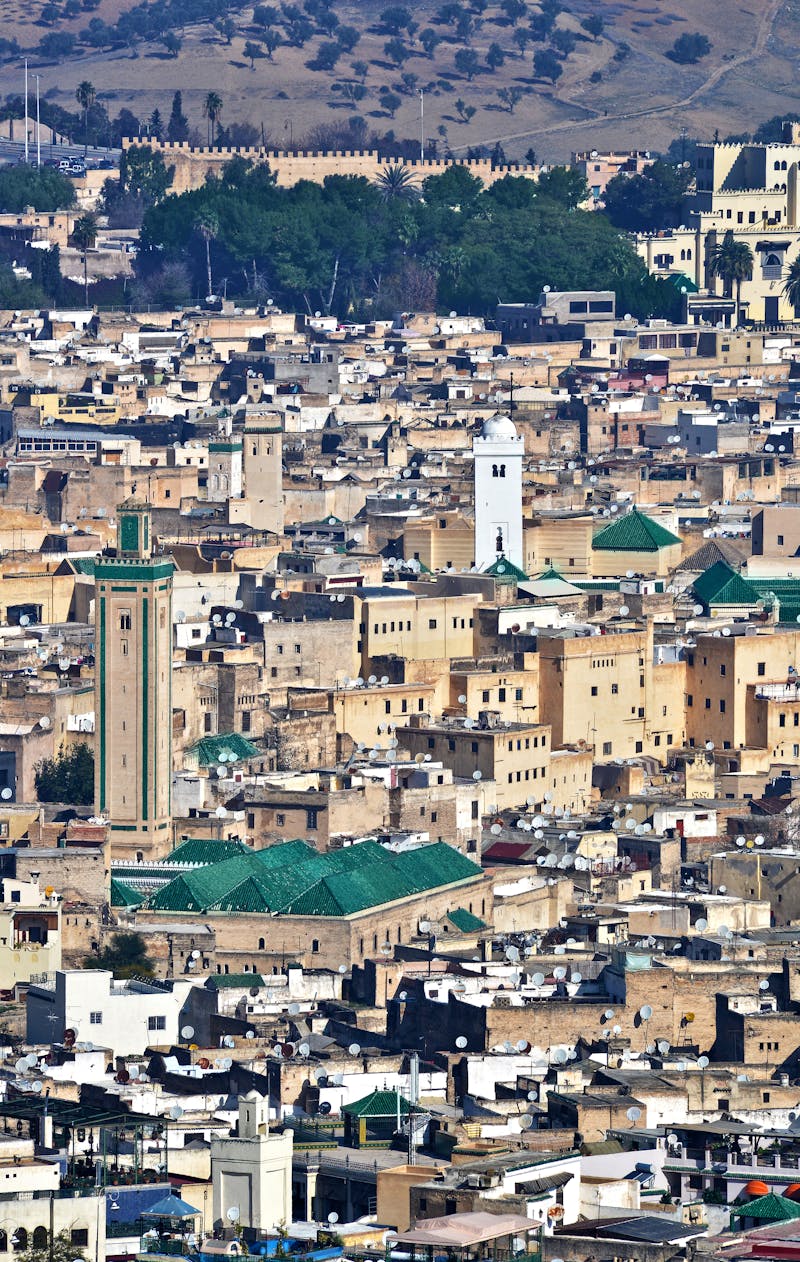
Fes is Morocco's oldest imperial capital, founded in 789 AD by Moulay Idriss I and expanded under his son Moulay Idriss II, whose reign saw the arrival of thousands of Andalusian and Tunisian refugees who brought with them the artistic and intellectual traditions of Islamic Iberia. The Fes el Bali medina, the old city whose streets the festival inhabits, was inscribed on the UNESCO World Heritage List in 1981 and is widely considered one of the best-preserved medieval Islamic cities in the world.
The medina's principal monuments deserve a full day of exploration both before and after festival events. The Bou Inania Madrasa, a 14th-century theological college with carved cedar ceilings, sculpted plaster panels, and intricate zellij tilework, is the finest example of Marinid architecture in Fes and one of the most beautiful buildings in Morocco. The Al Quaraouiyine University and Mosque, founded in 859 AD, is recognised by UNESCO and the Guinness Book of Records as the oldest continuously operating educational institution in the world. The Chouara Tanneries, where leather artisans continue the centuries-old dyeing techniques of the guild quarter, provide one of the most distinctive visual experiences in the city.
The medina's lanes and souks are best explored with a knowledgeable local guide for a first visit: the streets are genuinely labyrinthine, and without orientation, it is easy to spend hours lost without reaching the key monuments. Many festival visitors arrange a guided medina tour on arrival day before the evening's first concert.
Practical Travel Guide for 2026
Dates and Tickets
The 2026 festival is scheduled to begin around 4 June 2026 according to the organising Foundation, with a ten-day programme running through mid-June. The exact programme will be announced at fesfestival.com in the weeks before the festival opens. Ticket sales for the headline Bab Makina evening concerts typically open through the official website one to two months before the festival begins. Early registration for ticket release notifications is strongly advisable, as the most popular performances sell out quickly.
Evening concerts at Bab Makina typically begin at 21:00. Tickets for the main evening concerts vary in price by seat category, with front sections selling at a premium. Many afternoon concerts and Forum events are free or low cost. The free Sufi nights in the gardens are open to all.
Getting to Fes
By air: Fes Saïss Airport (FEZ) serves direct flights from Paris, Brussels, Amsterdam, Madrid, London, Frankfurt, and several other European cities, as well as domestic connections from Casablanca Mohammed V International Airport. Flight time from Paris is approximately 2 hours 30 minutes. Many European low-cost carriers serve Fes directly from June, making the festival period well-connected from across the continent.
By train: Morocco's ONCF rail network connects Fes to Casablanca (approximately 3 hours 45 minutes), Rabat (approximately 3 hours), Marrakech (approximately 8 hours with a change), and Meknes (approximately 1 hour). Trains are comfortable, punctual, and well-priced relative to European equivalents.
By road: The N6 highway connects Fes to Meknes (60 km), where one of Morocco's finest historic imperial cities can be visited as a day trip. Volubilis, the Roman archaeological site near Meknes, is one of the finest in North Africa and is reachable in under an hour by road from Fes.
Accommodation
Accommodation in Fes ranges from luxury riads within the medina, whose interior courtyards and traditional decoration provide the most atmospheric base for a festival visit, to international hotel chains in the Ville Nouvelle district. Riad accommodation within the medina puts guests in walking distance of the medina venues but at some distance from Bab Makina, which is in Fes el Jdid. Ville Nouvelle hotels offer easier taxi access to all venues.
Festival period accommodation in Fes fills quickly, particularly for riads and boutique properties. Booking three to four months in advance is strongly recommended for stays during the festival week.
Currency, Language, and Practical Notes
Morocco's currency is the Moroccan Dirham (MAD). Major hotels and some restaurants accept cards; cash is preferred in the medina for souks, smaller restaurants, and contributions at Sufi events. ATMs are available in the Ville Nouvelle and at the train station.
Morocco's official languages are Arabic and Amazigh (Berber), with French widely used in commerce, culture, and tourism. English is spoken at most tourist-oriented businesses and by many younger Moroccans. At festival venues, staff and volunteers typically speak French and English.
Festival period temperatures in Fes in early June are warm: average daytime temperatures of 28 to 32 degrees Celsius, cooling to around 20 degrees in the evening. Light, breathable clothing for daytime sightseeing, with a light layer for evenings when the Bab Makina concerts run late, is appropriate.
Why the 29th Edition Belongs on Your 2026 Travel List
The Fes Festival of World Sacred Music has been building toward this point for 29 years. It is the world's first festival of sacred music, recognised by the United Nations, attended by 100,000 people a year, and held in one of the most extraordinary cities in Africa. The 2026 theme of the Maalemines brings together the festival's musical mission and the architectural heritage that makes its venues unique: the music plays in spaces built by the very tradition being celebrated.
The combination of performing in these spaces, hearing music from traditions that most visitors will have never encountered before, attending a Forum lecture in the shadow of a 14th-century madrasa, walking through the tanneries in the afternoon and attending a Sufi night in the garden after midnight: this is what the Fes Festival offers its visitors. It is not simply a music festival. It is a sustained, multi-day experience of what happens when a city with Fes's depth of history becomes the meeting point for the world's spiritual traditions expressed through sound.
Check fesfestival.com for the official 2026 programme announcement and begin planning now. The medina's lanes, the gardens, and the grand square beside the royal palace are waiting.
Verified Information at a Glance
| Detail | Information |
|---|---|
| Event Name | Fes Festival of World Sacred Music 2026 (Festival de Fès des Musiques Sacrées du Monde) – 29th Edition |
| Event Category | International Sacred Music Festival / World Music / Cultural Heritage Event / Interfaith Dialogue |
| Edition | 29th (XXIX) |
| 2026 Theme | "Fès et les Mâalemines, Gardiens du Geste et du Patrimoine" (Fes and the Maalemines: Guardians of Craft and Heritage) |
| Estimated Dates | Starting around 4 June 2026, running approximately 10 days (exact dates to be confirmed at fesfestival.com) |
| Location | Fes, Morocco |
| Organiser | Fondation Esprit de Fès / Esprit de Fès Foundation; Faouzi Skali, founder |
| Scale | Approximately 200 artists from 15+ countries; up to 100,000 attendees annually |
| United Nations Recognition | Festival recognised in 2001 as one of the world's most significant events contributing to the dialogue of civilizations |
| High Patronage | Festival placed under the High Patronage of His Majesty King Mohammed VI |
| Principal Venues | Bab Makina (grand square beside Royal Palace, Fes el Jdid) – main evening concerts from 21:00 |
| Programme Elements | Evening concerts (Bab Makina); afternoon concerts (gardens and museums); Forum (lectures, debates, round tables); free Sufi nights (gardens); riad performances |
| Ticket Booking | fesfestival.com; online bookings open 1–2 months before the festival |
| Free Events | Most Forum events; free Sufi nights in Jnan Sbil Gardens |
| Foundation Contact | Fondation Esprit de Fès, Sidi Al Khayat, BP 679 Fès, 30200 Maroc; Administration: +212 (0) 535 740 535; Technical support and ticketing: +212 (0) 637 660 013 |
| Previous Edition | 28th edition (2025), theme "RENAISSANCES," ran 16 to 24 May 2025 |
| Getting to Fes | Fes Saïss Airport (FEZ); direct flights from Paris, Brussels, Amsterdam, Madrid, London, Frankfurt and other European cities; by train from Casablanca approx. 3h45m; from Rabat approx. 3h |
| Average Temperature in Fes in Early June | 28–32°C daytime; 20°C evening; light breathable clothing recommended |
| Currency | Moroccan Dirham (MAD) |
| UNESCO Status | Fes el Bali medina inscribed on UNESCO World Heritage List in 1981 |
| Official Website | fesfestival.com |
Event Has Passed - See You Next Time!
Event Details
Date
to
Location
Bab Makina (main stage), Dar Batha Museum, Dar Tazi Palace, Bab Boujeloud & medina venues – Fes el-Jdid and Fes el-Bali, Fes
Fes, Morocco
Price
Not Available