
Event Has Passed - See You Next Time!
Event Details
Date
Time
9:00 AM - 5:00 PM
Location
Qoricancha, Plaza de Armas & Sacsayhuamán Fortress, Cusco
Cusco, Peru
Price
from €173 to €259
About This Event
Inti Raymi 2026 — Festival of the Sun in Cusco: The Most Spectacular Day in the Inca Calendar
Every June 24, the ancient capital of the Inca Empire reclaims the identity that five centuries of colonial history never fully extinguished. Inti Raymi — the Festival of the Sun — returns to Cusco for its annual celebration of the winter solstice, and 2026 brings the event to Wednesday June 24 with the full ceremony unfolding across three of the most historically significant sites in South America.
More than 100,000 local and international visitors attend Inti Raymi each year, making it one of the largest cultural events in Latin America. Approximately 700 actors, dancers, and musicians perform across the three ceremonial stages. The entire ceremony is conducted in Quechua — the language of the Inca Empire — with Spanish narration provided for the public.
The three stages, the timetable, and the practical details: the ceremony begins at 9:00 AM at Qoricancha (the Temple of the Sun), continues to the Plaza de Armas at 10:30–11:00 AM, and reaches its climax at the Fortress of Sacsayhuamán from 1:00 PM until approximately 5:00 PM. The full experience spans six to eight hours. Official tickets are available through Teleticket, with 2026 sales opening from April 15.
Five Centuries of History Behind One Day of Ceremony
The original Inti Raymi was the most important festival of the Tawantinsuyu — the Inca Empire — held annually at the winter solstice (June 21–24 in the Southern Hemisphere) to honour Inti, the Sun God, the supreme deity of the Inca pantheon and the divine ancestor of the Sapa Inca (the ruling emperor).
The celebrations in the original Inca Empire were extraordinary in scale. The Spanish chronicler Cristóbal de Molina described the festival as drawing tens of thousands of pilgrims from across the empire to Cusco — from modern-day Colombia in the north to central Chile in the south, the farthest reaches of the Tawantinsuyu sent representatives to participate in the ceremony that reaffirmed the Sun's power and the Inca's divine authority. The festival lasted nine days, included ritual sacrifices, vast communal feasting, and the kind of collective ceremony that united the political and religious life of an entire civilisation.
The Spanish colonial authorities banned Inti Raymi in 1535 — just two years after the conquest of Cusco — recognising it as incompatible with the Catholic evangelisation of the Andes. For more than four centuries, the ceremony existed only in fragments: in private devotions, in the syncretic religious practices that blended Andean and Catholic traditions, and in the cultural memory of Cusco's Quechua-speaking communities.
The modern Inti Raymi dates from 1944, when the Peruvian playwright Faustino Espinoza Navarro staged the first theatrical reenactment of the ceremony in Cusco, based on historical accounts from Spanish colonial chroniclers. The contemporary festival is a dramatically staged performance rather than a living religious practice — but the care with which Cusco's community has developed and maintained it across 80+ years of annual performance has given the reenactment a cultural weight that transcends its theatrical origins. For the hundreds of thousands of people who attend each year, and particularly for Cusco's Quechua-speaking population, Inti Raymi is something more than theatre.
June 24 is also a national public holiday in Peru — the Día del Cusco (Day of Cusco) and the Día del Campesino (Day of the Peasant Farmer) — giving the festival a civic resonance that extends beyond cultural performance into the national calendar.
The Three Stages of Inti Raymi 2026: A Ceremonial Journey Through Cusco
Stage 1 — Qoricancha: The Temple of the Sun (9:00 AM)
The ceremony begins at Qoricancha — the Temple of the Sun — at 9:00 AM.
Qoricancha (from the Quechua Quri Kancha, "Golden Enclosure") was the most sacred site in the Inca Empire — a temple whose walls were reportedly covered in sheets of pure gold, whose courtyard contained golden statues of maize, llamas, and human figures, and whose inner sanctum held a large golden disc representing Inti himself. The Spanish stripped it of all gold in 1533, and the Convento de Santo Domingo was built on and around its foundations from 1535 onward. The Inca stone walls of Qoricancha — built without mortar using precisely fitted polygonal stones — survived the colonial construction and the major Cusco earthquake of 1950 when much of the Spanish-built structure above collapsed, revealing the original Inca masonry beneath.
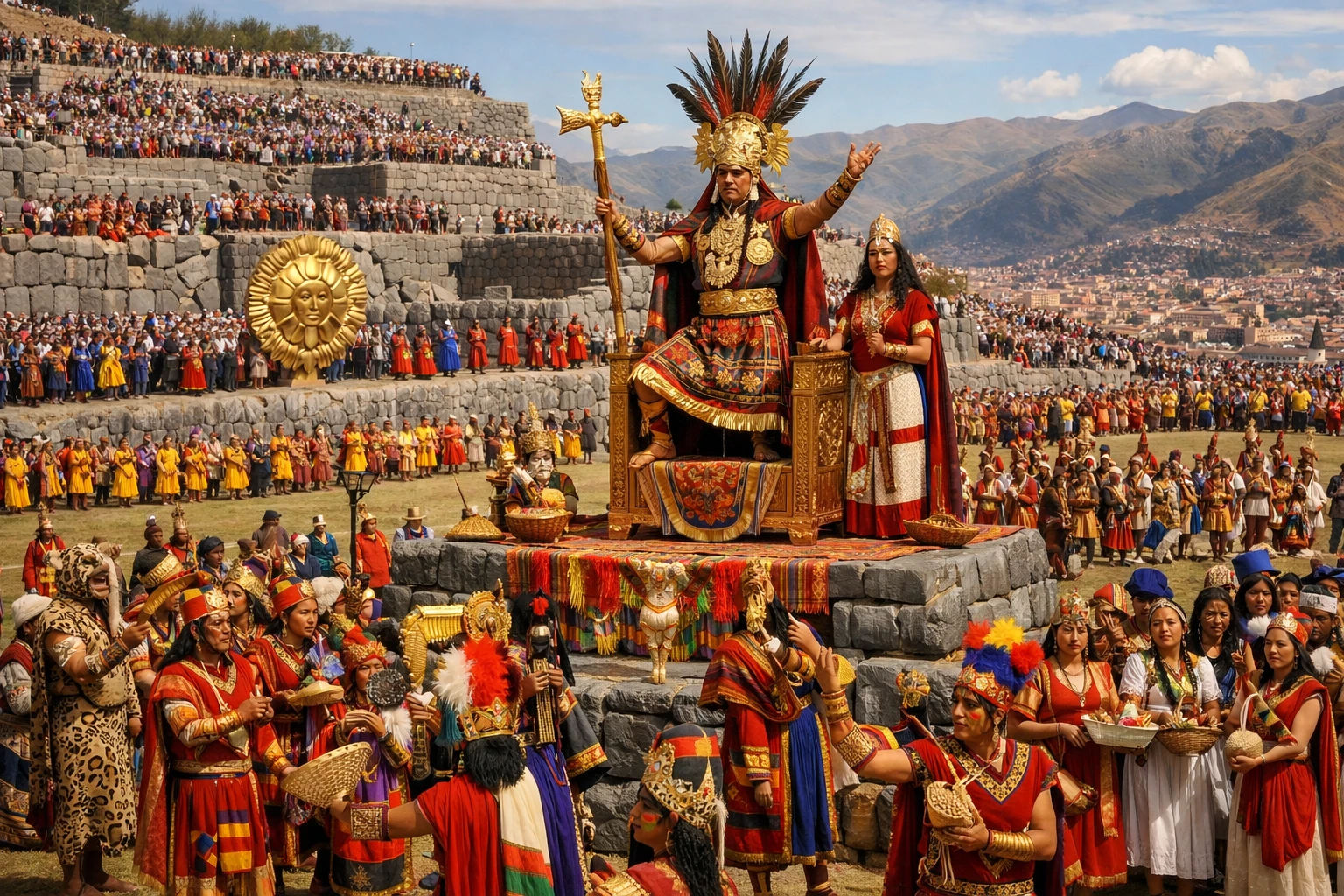
The Inti Raymi ceremony at Qoricancha enacts the Sapa Inca's greeting to the Sun — the central actor playing the Inca (a different Cusqueño is selected each year for this role) making his formal appearance to honour Inti at the site where the Inca priests once maintained the empire's most sacred solar rituals. Acllas (sacred women of the Sun, the so-called Virgins of the Sun) scatter flowers as a symbol of purity; Pichaq men perform the spiritual cleansing of the ceremonial space; and the Kumillo carry the Achiwa — the ceremonial feathered parasol that shades the Inca.
After the Qoricancha ceremony, the Inca and his imperial entourage process through Cusco along Avenida El Sol and through the Intikijllu (the "Sun Gate" lane, today's Loreto Street — a narrow colonial alleyway whose walls are built on original Inca foundations) toward the Plaza de Armas.
Admission at Qoricancha stage: Requires advance ticket purchase
Stage 2 — Plaza de Armas: The Coca Ceremony (10:30–11:00 AM)
The Plaza de Armas — the great central square of Cusco, known in Inca times as Huacaypata ("Place of Weeping," referring to the solemn ceremonies held here) and Cusipata ("Place of Joy" for the festive gatherings) — receives the Inca's procession at approximately 10:30 to 11:00 AM.
This stage of the ceremony is free and open to the public — the vast square and its surrounding streets fill with tens of thousands of spectators who position themselves along the perimeter. The ceremony here is known as the "Encounter of the Times" — a symbolic dialogue between the Inca and the mayor of Cusco representing the convergence of the Inca past and the present Peruvian state — followed by the Coca Ceremony, in which the high priest performs the ritual offering of coca leaves and chicha (fermented maize drink) that in the original ceremony allowed the priests to predict the prosperity of the coming harvest and the strength of the Sun in the months ahead.
This stage lasts approximately 50 to 60 minutes before the procession continues toward Sacsayhuamán.
Admission at Plaza de Armas stage: FREE — open to all
Stage 3 — Sacsayhuamán: The Main Ceremony (1:00–5:00 PM)
Sacsayhuamán is where Inti Raymi becomes genuinely overwhelming in scale. The Inca fortress on the hillside immediately north of Cusco's historic center — built from enormous, precisely fitted limestone blocks weighing up to 300 tonnes each, some carried from quarries more than 20 kilometres away — provides an esplanade large enough to host the full theatrical ceremony with the 700 performers and tens of thousands of spectators simultaneously.
The main ceremony begins at approximately 1:00–1:45 PM and runs until about 5:00 PM — a sustained performance of approximately three to four hours that represents the most complex theatrical production in Peru's annual cultural calendar.
The key ceremony elements at Sacsayhuamán:
- The Sapa Inca's formal address to Inti — the central actor delivers the Inca's prayer to the Sun in Quechua, with Spanish narration translating for the international audience
- The ritual fire ceremony — a new sacred fire is kindled by concentrating sunlight through a concave mirror (in the original ceremony, through a highly polished golden dish); the lighting of this fire represents the renewal of the Sun's energy for the coming year
- The symbolic llama offering — in the original Inca Inti Raymi, an actual llama sacrifice was central to the ceremony; in the post-1944 reenactment, the sacrifice is performed symbolically with a representative llama and theatrical staging that preserves the ceremonial meaning without the literal act
- Chicha and coca offerings — the ritual sharing of the sacred beverages that connect the community to Inti and to Pachamama (Mother Earth) simultaneously
- Mass performance by all 700 participants — the full complement of actors, dancers, and musicians performing the dances and songs of the Inca festival tradition, creating a visual spectacle at a scale that has no equivalent in Peruvian cultural life
Seating categories at Sacsayhuamán:
- Tribuna (grandstand) — covered or open seated sections with direct sightlines to the main stage; premium pricing; advance purchase essential
- General admission (hillside) — standing positions on the slopes above and around the esplanade; lower price; still excellent views of the ceremony
The hillside above Sacsayhuamán is accessible to spectators without tickets — a natural amphitheatre formed by the terrain that adds thousands of additional viewers to the official ticketed areas. This free viewing area offers an elevated perspective across the entire esplanade and, beyond it, the red-tile rooftops and colonial church towers of Cusco.
The June Lead-Up: A Month of Cultural Events Around Inti Raymi
Inti Raymi does not arrive in isolation. The month of June in Cusco is known as the Mes del Cusco — the Month of Cusco — and the weeks preceding June 24 build a cultural context for the main festival through a sequence of events.
- June 1–15: Mes del Cusco — art exhibitions, artisanal markets, folk music performances, and cultural events throughout the city; most are free or low-cost
- June 7: Corpus Christi Festival — one of the most visually spectacular Catholic festivals in South America, held at the Plaza de Armas, where the statues of 15 saints from Cusco's churches are brought together in procession; a direct expression of the same syncretic Catholic-Andean tradition that shapes all of Cusco's major celebrations; free
- June 20–22: Ceremonies at the sacred sites of Qenqo and Tambomachay (both accessible with the Boleto Turístico) — smaller Inca ritual sites whose ceremonies in the days before the solstice create a preparatory atmosphere for the main event; free
- June 23 (night): Vigilia — bonfires, music, and communal gatherings at Sacsayhuamán on the eve of the solstice; a deeply atmospheric free event that is among Cusco's most memorable evenings; thousands of locals and visitors gather on the esplanade and hillsides around the fortress as the bonfires burn; free
- June 25–30: Post-festival cultural week with continued events throughout the city
Practical Information: Tickets, Altitude, and Getting There
Official ticket platform: Teleticket (teleticket.pe) — 2026 sales open from April 15
Admission to Qoricancha (Sacsayhuamán stage): The Boleto Turístico (Cusco Tourist Pass) includes Sacsayhuamán entry for general visits but the special Inti Raymi ceremony seating requires a separate Teleticket purchase
Altitude:
- Cusco historic center: approximately 3,400 metres (11,152 feet)
- Sacsayhuamán: 3,701 metres (12,143 feet) — higher than the city; visitors already acclimatised to Cusco should be comfortable, but the additional altitude deserves attention; dress in warm layers for the afternoon at Sacsayhuamán even in June
June weather in Cusco: June is deep dry season — virtually no rain, clear blue skies, strong sun, and cold nights.
- Daytime highs: approximately 19–20°C (66–68°F)
- Night and early morning: 1–5°C (34–41°F)
- Strong UV radiation at altitude — sun protection is essential even on cool June days
Advance planning: June 24 is one of the busiest days of the year in Cusco.
- Book accommodation at least 3–4 months in advance; the entire week around June 24 sees elevated demand and pricing
- Machu Picchu entry permits and Inca Trail spaces for the June period fill months ahead — book separately if combining with Machu Picchu
- Book organised transfers to Sacsayhuamán for the afternoon ceremony; the road fills with traffic and walking up takes 30–45 minutes from the Plaza de Armas (a scenic but steep route)
Getting to Cusco:
- By air: Alejandro Velasco Astete International Airport (CUZ); domestic flights from Lima approximately 1.5 hours; Lima serves as the main international gateway from North America, Europe, and Australasia
- Most international visitors fly Lima–Cusco and plan 2–3 days of acclimatisation before the intense schedule of Inti Raymi week
The Solstice and the Sacred City
There is a reason that Inti Raymi in Cusco on June 24 draws visitors from every continent every year, and it is not simply spectacle. The ceremony takes place in a city whose entire physical layout was designed around solar alignment — the Inca urban plan oriented specific streets and ceremonial sites to capture the solstice sunrise, and the astronomical knowledge embedded in Sacsayhuamán's construction means that the site where the main ceremony takes place was chosen precisely because of its solar geometry.
Watching 700 performers enact a 500-year-old ceremony at a stone fortress built by an empire that worshipped the sun, in the former capital of that empire, in a city that sits at 3,400 metres where the sky is brilliant and the light is extraordinary — this is what Inti Raymi delivers. And nothing matches it.
June 24, 2026. Cusco, Peru. 9:00 AM at Qoricancha. Free at the Plaza de Armas. The main ceremony at Sacsayhuamán from 1:00 PM. Over 100,000 people sharing one day. 700 performers in the full language of the Inca. Tickets at Teleticket from April 15. The Festival of the Sun does not disappoint.
Verified Information at a Glance
| Detail | Information |
|---|---|
| Event | Inti Raymi 2026 — Festival of the Sun (Fiesta del Sol) |
| Category | Cultural / Historical Reenactment / National Public Holiday Festival |
| Date | Wednesday June 24, 2026 |
| City | Cusco (Qosqo), Peru |
| Three-stage ceremony schedule | — |
| Stage 1 | Qoricancha (Temple of the Sun / Convento de Santo Domingo), Av. El Sol 526 — 9:00 AM — ticketed |
| Stage 2 | Plaza de Armas (Huacaypata), Portal de Carnes 214 — 10:30–11:00 AM — FREE |
| Stage 3 | Sacsayhuamán Fortress — 1:00–5:00 PM — ticketed (Tribuna/General) or free hillside |
| Duration | Full day; 6–8 hours total |
| Performers | ~700 actors, dancers, and musicians |
| Annual attendance | Over 100,000 local and international visitors |
| Ceremony language | Quechua; Spanish narration for public |
| Official ticket platform | Teleticket (teleticket.pe) — sales open from April 15, 2026 |
| Free elements | Plaza de Armas ceremony; hillside viewing at Sacsayhuamán; Vigilia (June 23 night — bonfires at Sacsayhuamán) |
| Altitude | Cusco ~3,400 m; Sacsayhuamán 3,701 m |
| June weather | Dry season; 19–20°C days; 1–5°C nights; clear; strong UV |
| June 24 public holiday | Día del Cusco / Día del Campesino — national holiday |
| Leading up to June 24 | Mes del Cusco (June 1–15, free); Corpus Christi (June 7, free); Sacred site ceremonies (June 20–22); Vigilia bonfires (June 23 night, free) |
| Historical context | Original Inti Raymi banned by Spanish 1535; modern reenactment established 1944 by Faustino Espinoza Navarro |
| Getting to Cusco | Alejandro Velasco Astete Airport (CUZ); Lima–Cusco ~1.5 hrs by air; Lima is main international hub |
| Accommodation | Book 3–4 months in advance for June 24 week; high-demand period |
| Machu Picchu | Book entry tickets and Inca Trail permits months in advance if combining with June trip |
| Boleto Turístico | Cusco tourist pass covering Sacsayhuamán, Qoricancha, and multiple other sites — buy on arrival or in advance |
| UNESCO | Cusco Historic Centre — UNESCO World Heritage Site (1983) |
Event Has Passed - See You Next Time!
Event Details
Date
Time
9:00 AM - 5:00 PM
Location
Qoricancha, Plaza de Armas & Sacsayhuamán Fortress, Cusco
Cusco, Peru
Price
from €173 to €259